

Introduction
This is Five Cents: travel guide to Vietnam. This guide will help you turn a long country with three contrasting regions into a coherent first trip. You’ll travel north to south, rather than collecting disconnected stops. We’ll connect everyday city life, limestone landscapes and central heritage, with enough time for each to feel different. Start by deciding how much of the country your time allows.
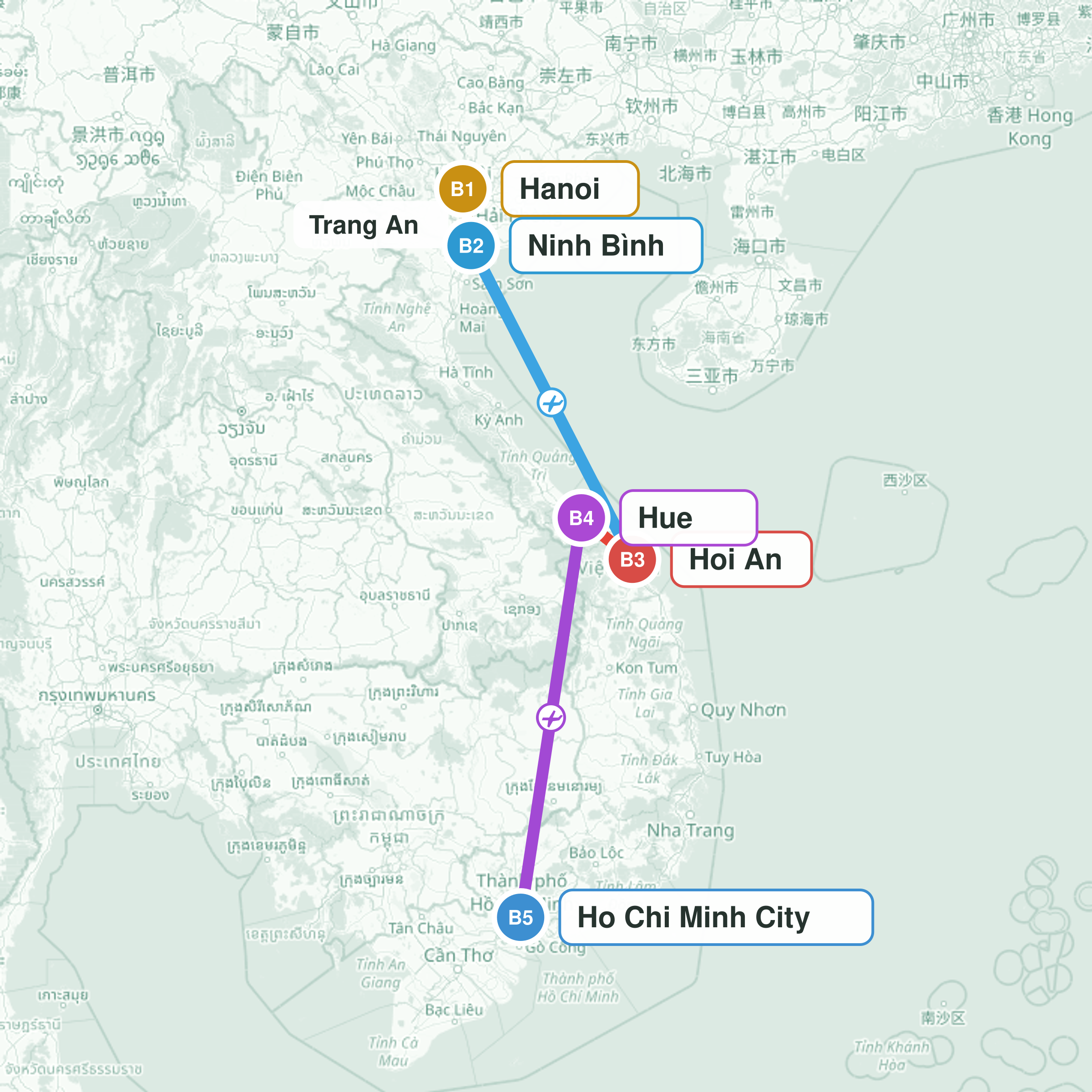
For all three regions
For all three regions, allow roughly fourteen to sixteen days at a brisk pace. Around three weeks gives you more breathing room. With one week, choose one region. The route here starts in Hanoi, the northern capital, and finishes in Ho Chi Minh City, the southern metropolis. Arriving through one and departing through the other avoids retracing the country.
Use domestic flights for the long regional jumps and road transfers for shorter connections. Divide the trip into roughly three days in Hanoi, two around Ninh Bình, four in Hoi An, two in Hue, and three in Ho Chi Minh City, including travel between stages. Choose your dates around the regions you’ll visit. Their weather patterns differ, so a single nationwide best season is misleading.
In Hanoi, take a road transfer into the city, then explore on foot. The Old Quarter is a dense, working neighbourhood where small shops, temples, food stalls and cafés share the streets. Give yourself time to walk through it and around Hoàn Kiếm Lake. The central lake helps orient your city wanderings.
Make a meal and a coffee stop the focus of one walk. Phở, a noodle soup, offers a straightforward introduction to northern food. Regional cuisine varies across Vietnam, so treat what you eat here as the beginning of that discovery, rather than a sample of everything the country cooks.
At a café, try coffee brewed through a phin, the small filter used for a slow drip. It’s often served with condensed milk. Egg coffee is a Hanoi specialty. The point of the stop is both the drink and the pause. Coffee belongs to daily social life, and sitting down gives you a different view of the neighbourhood from walking through it.
The route step by step
From Hanoi, travel south by road to Ninh Bình, a countryside base for the limestone waterways of Trang An. Give this stage two days, with an overnight stay, so the landscape has its own place in the journey.
Trang An is a protected cultural and natural landscape. Its main experience is a boat journey through waterways and caves among limestone formations. You move through the scenery at water level, rather than simply stopping at a viewpoint. After Hanoi’s busy streets, this is the route’s quieter rural chapter. Protect time for the boat journey and the countryside stay, instead of treating them as a quick interruption between cities.
Next, continue south to central Vietnam, using a northern flight gateway, then connecting through Da Nang by road to Hoi An. Da Nang is the central coast’s larger city and transport hub. Hoi An is your base for this part of the trip.
Allow roughly four days here, including the arrival. Hoi An’s historic town is a preserved former trading port. Walking through it gives the central stage a clear focus: a town shaped by commerce and exchange. Staying in Hoi An keeps that heritage close at hand. It also gives you time to explore the old town across several walks, rather than squeezing it into a single visit from elsewhere.
From Hoi An, head north along the central coast through the Da Nang area, taking a scenic road transfer via the Hai Van Pass to Hue. This short northward section connects two different historical experiences within the broader southbound journey.
Key stops and decisions
Hue was the capital of the Nguyễn dynasty from eighteen oh two to nineteen forty-five. Give it two days, with the imperial citadel as your main visit. Here, the buildings and monuments introduce royal government and the country’s last dynasty, a distinct layer from Hoi An’s trading history. A separate stay gives that difference room to register.
From Hue, continue south by air, with connecting road transfers, to Ho Chi Minh City. Allow three days for the final stage. Its contemporary metropolitan scale provides the southern counterpoint to the places you’ve already explored. Make the War Remnants Museum your focused historical visit. Its exhibits address the war and its consequences from a particular perspective, rather than providing a complete account of the conflict. That context belongs alongside your exploration of the present-day city.
Remember three decisions: allow about two weeks for all three regions, travel from Hanoi to Ho Chi Minh City with flights for the long jumps, and protect everyday Hanoi, Trang An and central heritage before adding more stops.
To continue, you can generate another Five Cents answering either of these questions: How can you plan a northern Vietnam mountain trip? Or, how can you extend a southern Vietnam trip into the Mekong Delta?