Versus a generic podcast
A topic can be requested on demand, its treatment can use personal context, and when it ends you can keep exploring without starting over.
 Five Cents
How it works
Five Cents is an app for personalized podcasts generated with AI. It turns a question, a news story, or a destination into a short podcast that is researched and written for listening. It also learns from user interactions to improve personalization and editorial quality day by day.
Personalized podcasts
One agent interprets intent and format; another gathers context and research; the writing agent turns that material into a spoken narrative; and evaluation agents review evidence, structure, clarity, and alignment with the request before the voice layer produces and publishes the podcast.
Personalization combines the listener's question with each user's selected and free-form interests, language and edition, chosen voice, listening history, and context from related podcasts. As the listener uses Five Cents, feedback, progress, completions, saves, and shares enrich a profile that helps decide what to research, which angle to take, and how to explain it better next time.
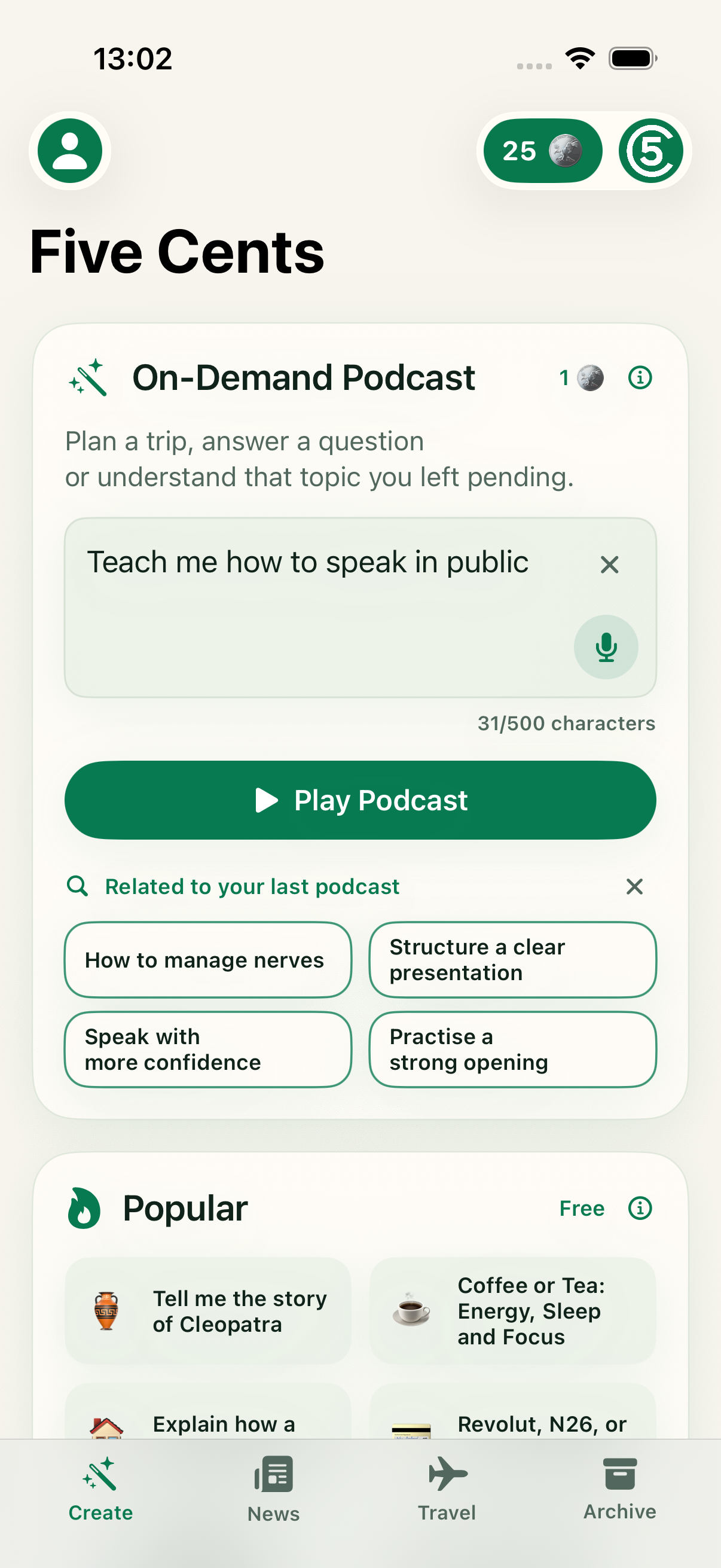
Learning and interactive continuity
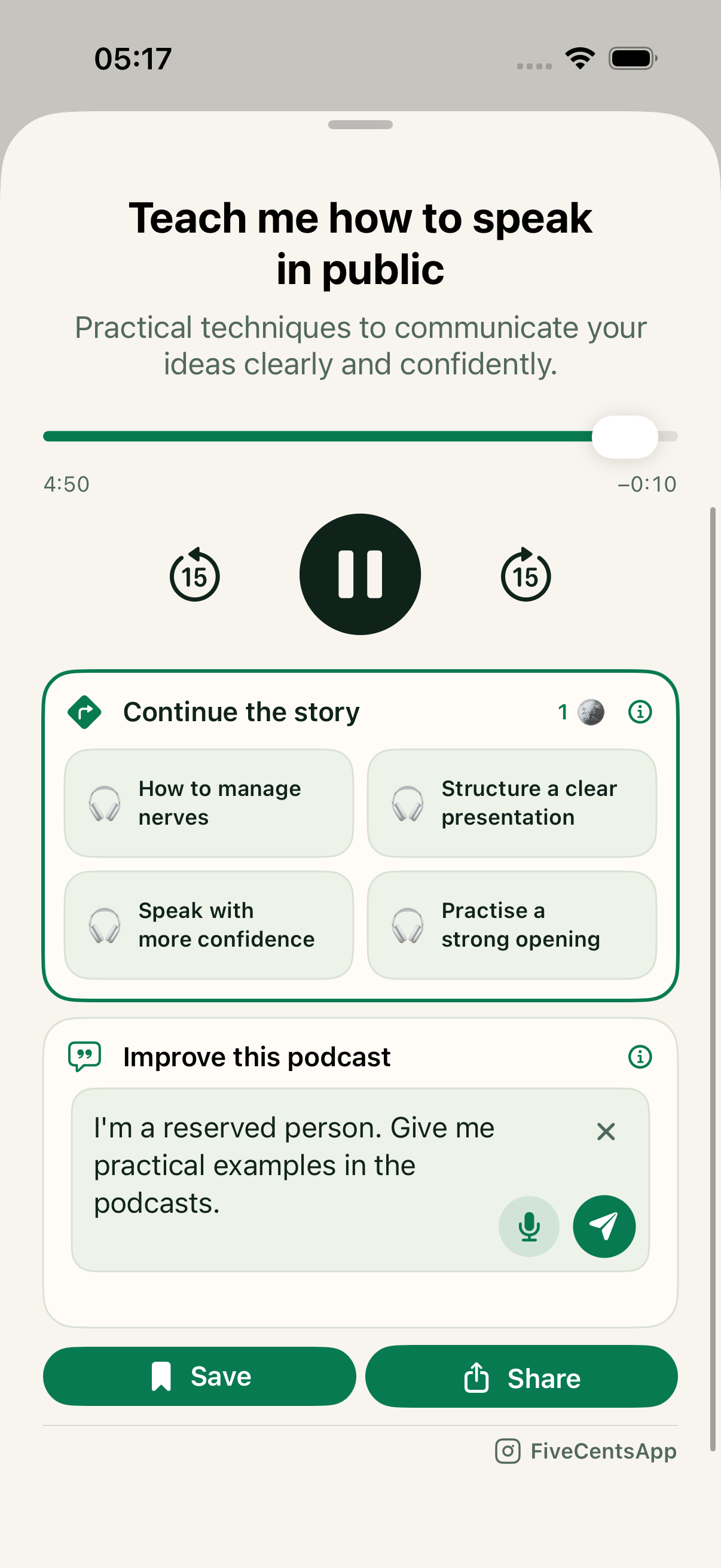
After listening, Five Cents offers four ways to continue the topic. The listener can choose one, write a new question, or take the story in another direction. The next podcast uses the previous one as context, adding to the story without repeating what has already been explained.
Feedback and listening signals help reveal what matters and how to explain it better. Individually, they improve the personalization of future podcasts; in aggregate, they improve overall editorial quality. The system also compares related podcasts so each continuation adds new information and a new angle.
Weekly content
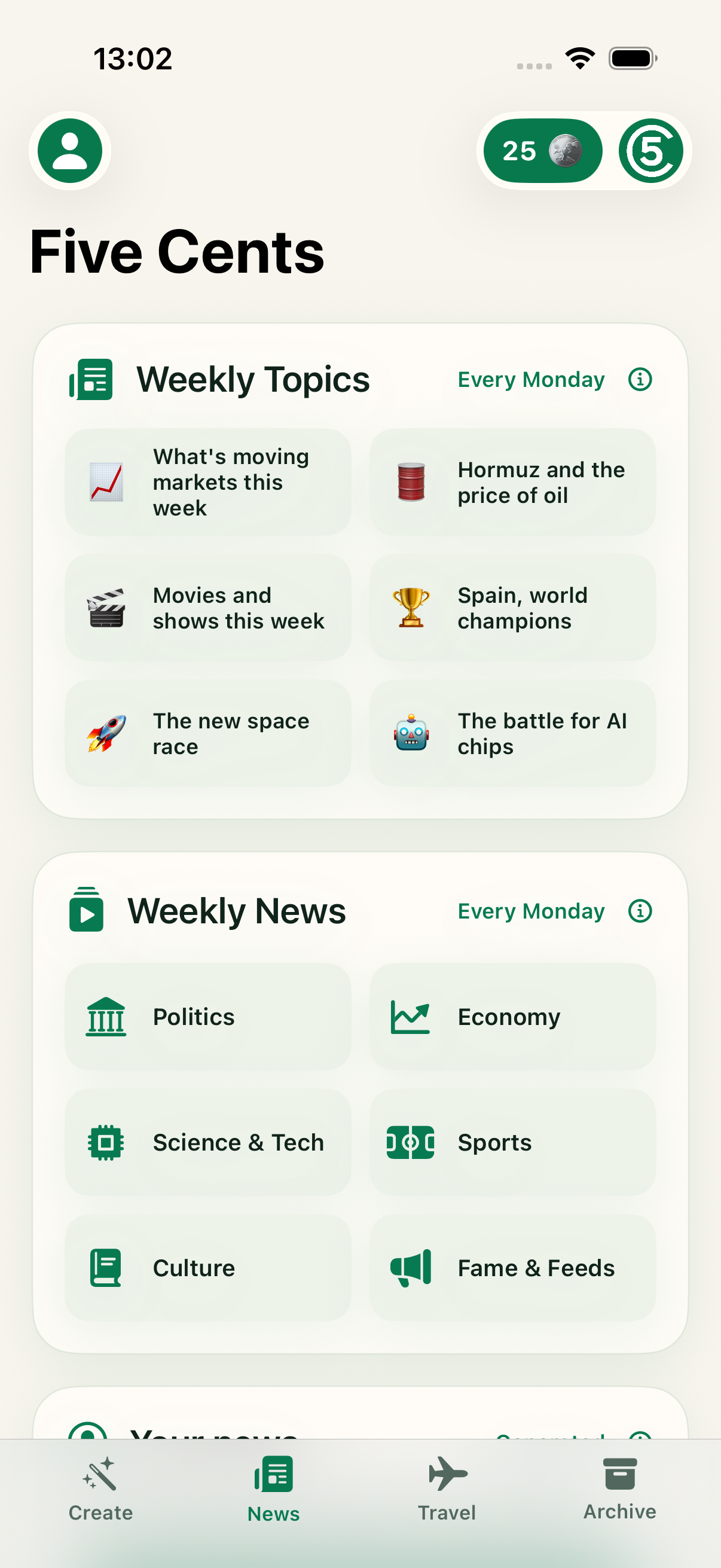
Every Monday, a group of agents researches current events and produces two formats for every listener: Topics of the Week, which explain one story with context, and six news channels with their own editorial structures.
Selection is compared with previous weeks to avoid repetition; when a story continues, it must add a real development or a new angle. Specialized evaluation agents review sources, relevance, spoken structure, and each channel's format. Continuous feedback from all users helps improve every edition and adapt the editorial line to the audience.
Personalized news
Each listener can select broad areas and add specific topics they want to follow. That profile turns the week's current affairs into a news podcast focused on their interests.
Five Cents researches the weekly topics that matter to that profile and generates a personalized edition: it decides what to include, what to prioritize, and how much context to provide. It keeps the editorial judgment of weekly content while adapting the selection to each listener.

Travel guides
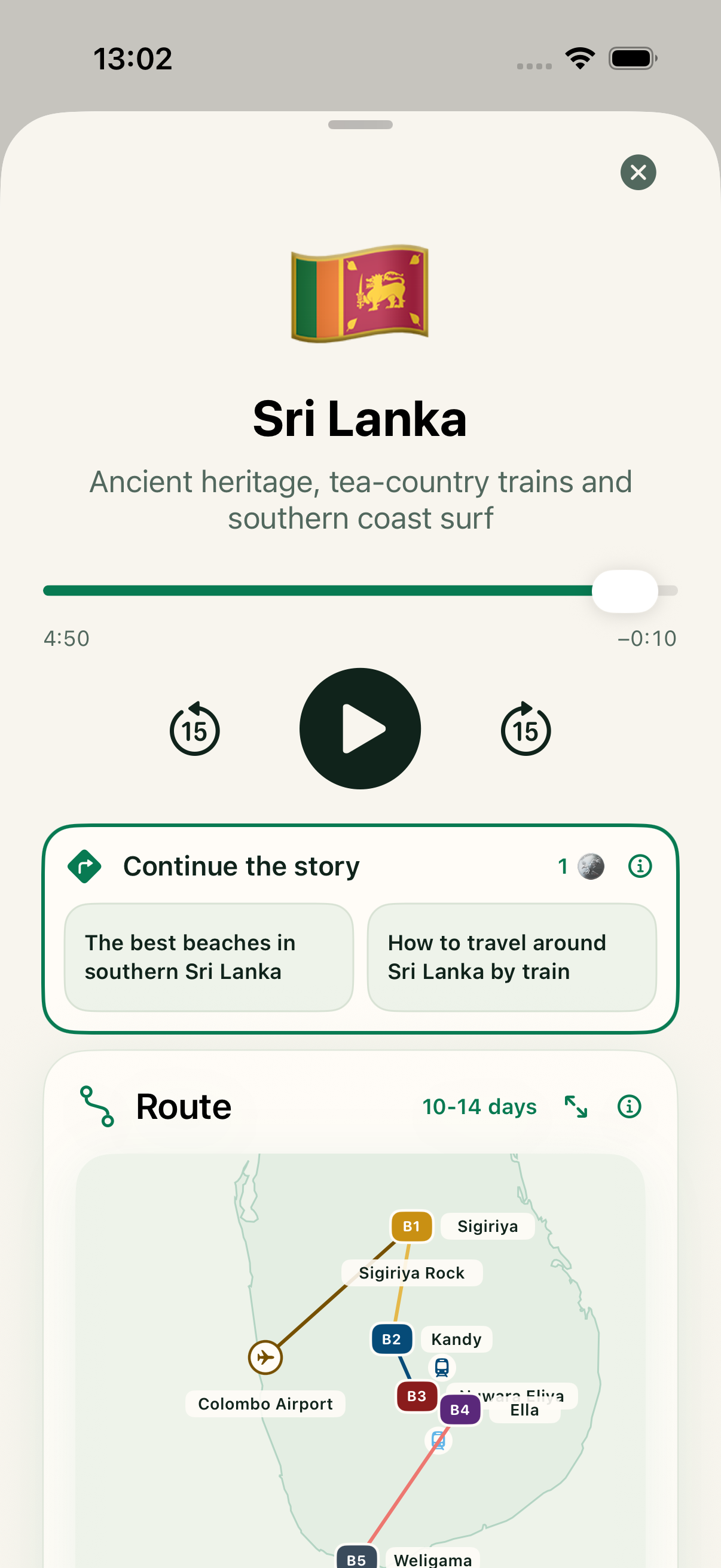
Travel guides combine a shared editorial structure with destination-specific knowledge built from recommendations by expert travellers and long-term residents. The result follows a familiar format without forcing different destinations into the same route.
A route agent identifies bases, stops, days, and connections from the script; grounds every point in textual evidence, validates coordinates, and generates both the map and the day-by-day itinerary. When destination-specific knowledge is unavailable, the system reuses the editorial structure—never facts from another place.
Continuous optimization
The system analyzes generated scripts alongside explicit feedback and listening signals from users. Evaluation agents identify patterns in quality, clarity, usefulness, coverage, and repetition; those findings are used to update versioned prompts for research, selection, writing, and review. The system then regenerates representative scripts, evaluates them again, and compares the results. This loop improves agents and formats with evidence, preserves the history of every change, and makes it possible to restore an earlier version when an update does not perform better.
Why it matters
A topic can be requested on demand, its treatment can use personal context, and when it ends you can keep exploring without starting over.
There is research, spoken structure, a versioned editorial line, continuity controls, and a product designed to work without looking at a screen.
Topics of the Week, news, Popular, and travel guides create a curated feed the listener can simply open and play.
Distribution
A selected part of the Five Cents editorial catalogue is published beyond the app to reach new audiences. Current-affairs stories, travel guides, and popular episodes are adapted to each channel with their audio, artwork, and description; the app remains the complete, personalized, and interactive experience.