

Introduction
This is Five Cents: travel guide to Venice. This guide helps you explore Venice as a city to move through, rather than a checklist of monuments. Over three full days, you’ll connect its waterways, neighbourhoods and former republic.
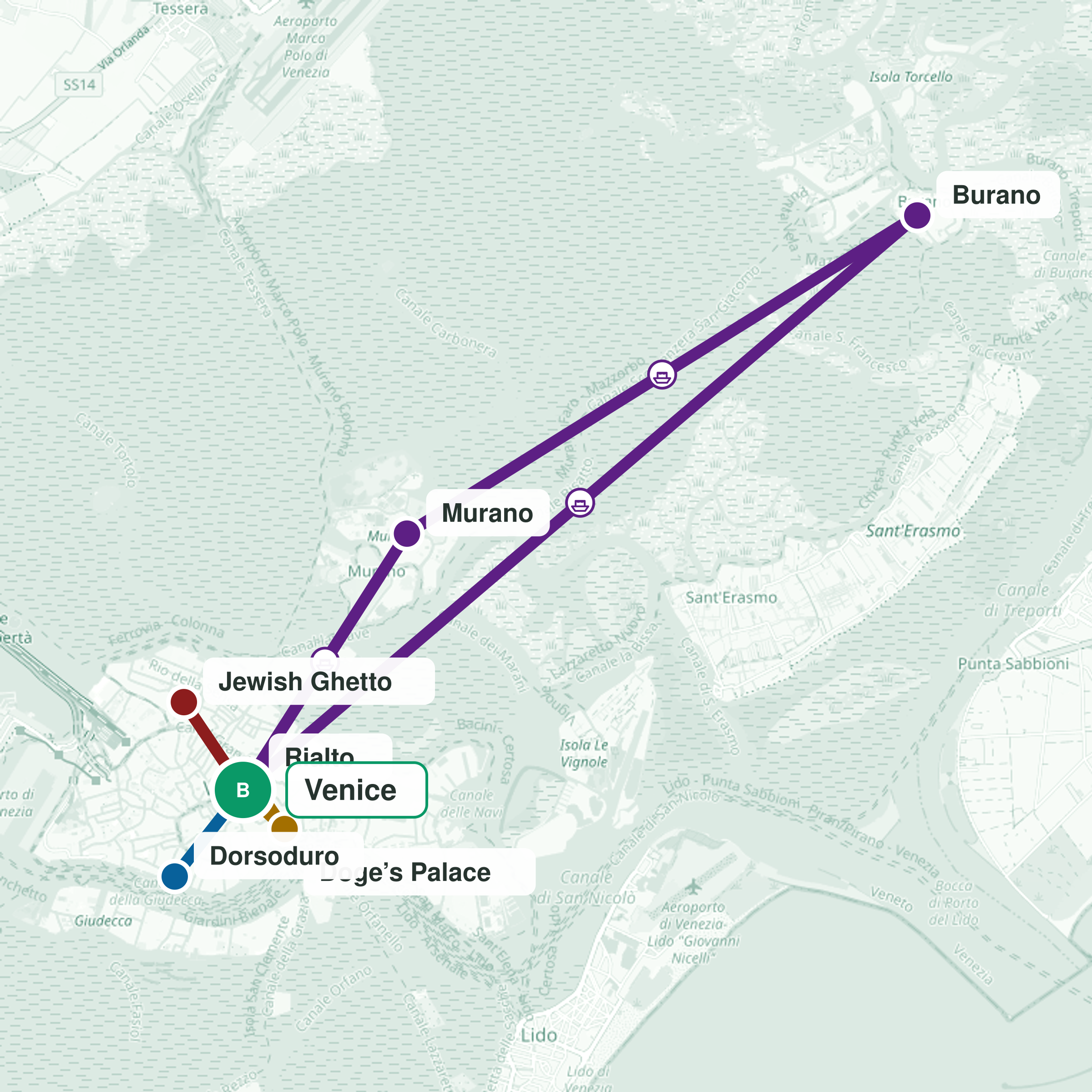
You’ll have one base
You’ll have one base, a clear route from San Marco to the quieter north, and the lagoon islands saved for a fourth day. Start by recognising that getting around is part of the visit. Stay in the historic city: early mornings and late afternoons give you more time there as day-trip crowds thin out. Arriving at Santa Lucia station brings you straight onto the Grand Canal. From Marco Polo Airport, enter Venice by water or via Piazzale Roma.
Once inside, walk through each neighbourhood and use the vaporetto, Venice’s public water bus, for longer journeys. Travelling along the Grand Canal reveals how the city’s most important façades, churches and palaces were designed to be seen from the water. On day one, head east from Santa Lucia towards Rialto and San Marco. Take that first longer journey along the Grand Canal by vaporetto. Then continue on foot through Rialto, Venice’s historic commercial crossing. It naturally connects the trading city with the ceremonial centre ahead.
St Mark’s Square is the monumental heart of the former Venetian Republic, opening towards the lagoon between the basilica, bell tower and arcades. Give it the time it deserves, and make the Doge’s Palace your main cultural visit. More than the doge’s residence, it brought together government, justice, ceremony, painting and maritime power.
San Marco becomes more than a postcard view: it was the operating centre of the Serenissima, the republic whose wealth came from trade, naval reach and control of the lagoon. Continue a little way along Riva degli Schiavoni, the waterfront promenade east of the square, to see how closely political power and the sea were connected.
The route step by step
On day two, head west and south from San Marco to Dorsoduro, returning through San Polo. Dorsoduro offers a different scale: residential canals, lived-in streets, university life and broad views near Santa Maria della Salute. Choose just one art museum. The Peggy Guggenheim Collection offers modern European and American art; the Gallerie dell’Accademia explain Venetian painting on its own terms. Both are worthwhile, but fitting both into a short stay takes time away from the neighbourhood.
Return through San Polo, where small squares, churches and narrow streets reveal a more everyday urban rhythm than San Marco. Finish on the Zattere promenade, facing the more open waters south of the city. Thomas Mann’s novella Death in Venice offers a literary lens here. It helped establish an image of beauty, decay and seasonal tourism, but it does not portray everyday Venetian life.
On day three, head north from the central districts into Cannaregio, Venice’s large northern sestiere, or district. Begin around the Jewish Ghetto, which broadens the history beyond the republic’s grand public image. It helps explain Venice as a trading city shaped by different communities, alongside its palaces and state ceremonies.
Then follow the northern canals towards Fondamenta della Misericordia, a waterside promenade that makes a good late-afternoon finish after a day of walking. The aim isn’t to hunt for a supposedly hidden Venice. It’s to give equal attention to a city where residents, services and daily life still matter.
With a fourth day
With a fourth day, take the vaporetto north across the lagoon to Murano and Burano. Murano adds the history of glassmaking and craftsmanship. Burano offers a distinct residential island setting, associated with lace and brightly coloured houses. Together, they make a full-day lagoon excursion after you’ve explored the historic city.
If you’re travelling between May ninth and November twenty-second, twenty twenty-six, the Venice Biennale can fill that fourth day instead. Its contemporary art exhibition spans the Giardini, the Arsenale and other venues. Remember three decisions: organise Venice by neighbourhoods rather than isolated monuments, include a Grand Canal vaporetto journey in your visit, and give San Marco the same attention as Dorsoduro, San Polo and Cannaregio.
To continue, you can generate another Five Cents: How can I plan a contemporary art itinerary for the Venice Biennale 2026?
To explore the lagoon further, you can generate: How can I spend a full day exploring Murano and Burano?