

Introduction
This is Five Cents: travel guide to United States. This guide helps you plan a first visit through one coherent region, combining neighborhood life with the country's national story. Start with New York and Washington, connected by train. Add a northern historical extension only when you have more nights. The first decision is the scale of your trip. The United States offers very different regional journeys. A city-focused visit, a national park itinerary, and a scenic road trip each need their own geography and transport plan. For a first urban introduction, choose the Northeast Corridor, a chain of cities linked by downtown-to-downtown rail service. Its advantage is simple: you can spend your time experiencing two distinct places, rather than repeatedly crossing enormous distances.
Plan about seven nights
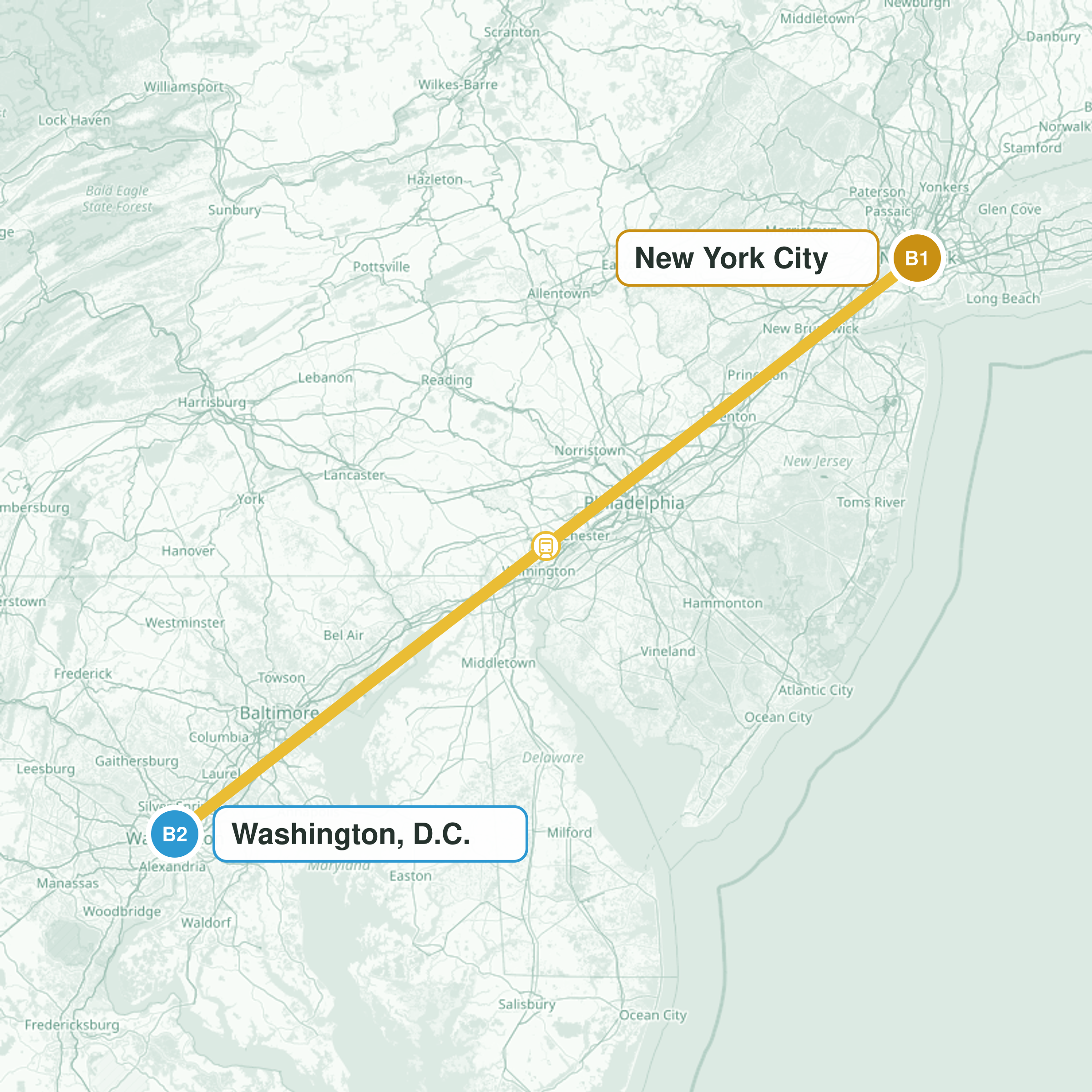
Plan about seven nights, or eight days: four nights in New York City and three in Washington, D.C. Where your flights allow, arrive in New York and depart from Washington. This gives the journey a clear southwest direction and avoids returning to your first base just to leave. Use Amtrak, the intercity passenger railway, between the cities. Then walk and use local public transport within them. Those connections make this a practical trip without a rental car.
Begin in New York, a dense, globally connected metropolis whose neighborhood variety matters as much as its skyline. Four nights give you room for a neighborhood-led day and one substantial cultural visit, with time to experience the streets between them. The aim is to understand how the city changes at ground level, rather than collect a sequence of famous views.
Manhattan, one of the city's boroughs, is a useful starting point for that walking experience. Its vertical skyline supplies the larger picture, while walking lets you notice changes from block to block. Give one stretch of the city your attention instead of moving constantly between distant attractions. The streets themselves are a central part of what you have come to see.
You can also include one nearby area of Brooklyn, another borough, to experience a different part of the city. Keep that outing focused on a single area rather than treating the whole borough as an afternoon checklist. The value lies in comparing the street-level experience with Manhattan, not in adding another name to your itinerary.
For your main cultural visit
For your main cultural visit, choose one major museum according to your interests. New York's arts institutions deserve sustained attention, so let that choice occupy a meaningful part of your stay. A single focused visit leaves room for neighborhood life and time outdoors. This balance gives you both an institution's curated view and the less orderly experience of the city around it.
From New York, continue southwest by Amtrak to Washington, the federal capital. The downtown-to-downtown connection keeps the transfer aligned with this urban route. Washington earns its three nights because it adds something genuinely different: national institutions, memorials, and museums that place American ideals alongside different accounts of American experience.
Start with the National Mall, the connected civic landscape containing monuments and museums. Walk it with a small selection of monuments in mind. Their spacing and the scale of the landscape are part of the visit, so leave room to experience the places between individual stops. This is where the capital's deliberate symbolism becomes visible, rather than remaining an abstract idea about government.
Then choose one or two museums from the Smithsonian, the group of public museums that offers several ways into the country's history and culture. These museums are generally free. Give your selection a clear historical focus rather than trying to cover the entire institution.
African American and Indigenous histories
African American and Indigenous histories, for example, help you understand why American history is more than a single founding narrative. The Mall presents national ideals. The museums let you consider whose experiences have shaped those ideals, and whose experiences have been left out of their telling. Pairing the two makes Washington more revealing than a sequence of monument photographs.
With the core trip complete, consider Boston only as a longer-trip extension. This older northeastern city adds a colonial and revolutionary-history perspective. Allow about two nights, bringing the journey to nine or ten nights. Geographically, it belongs before New York: enter through Boston, then continue south through New York to Washington by train. Protect those extra nights rather than borrowing them from the two main stays.
Keep three decisions in mind: choose a region rather than a coast-to-coast checklist; give New York four nights and Washington three, connected by Amtrak; and pair neighborhood-scale city life with a layered national story. Landscapes and scenic drives deserve a separate regional journey.
To continue, you can generate another Five Cents answering, How can I plan two history-focused nights in Boston? Or explore a different kind of journey with, How can I build a regional United States national park trip?