

Introduction
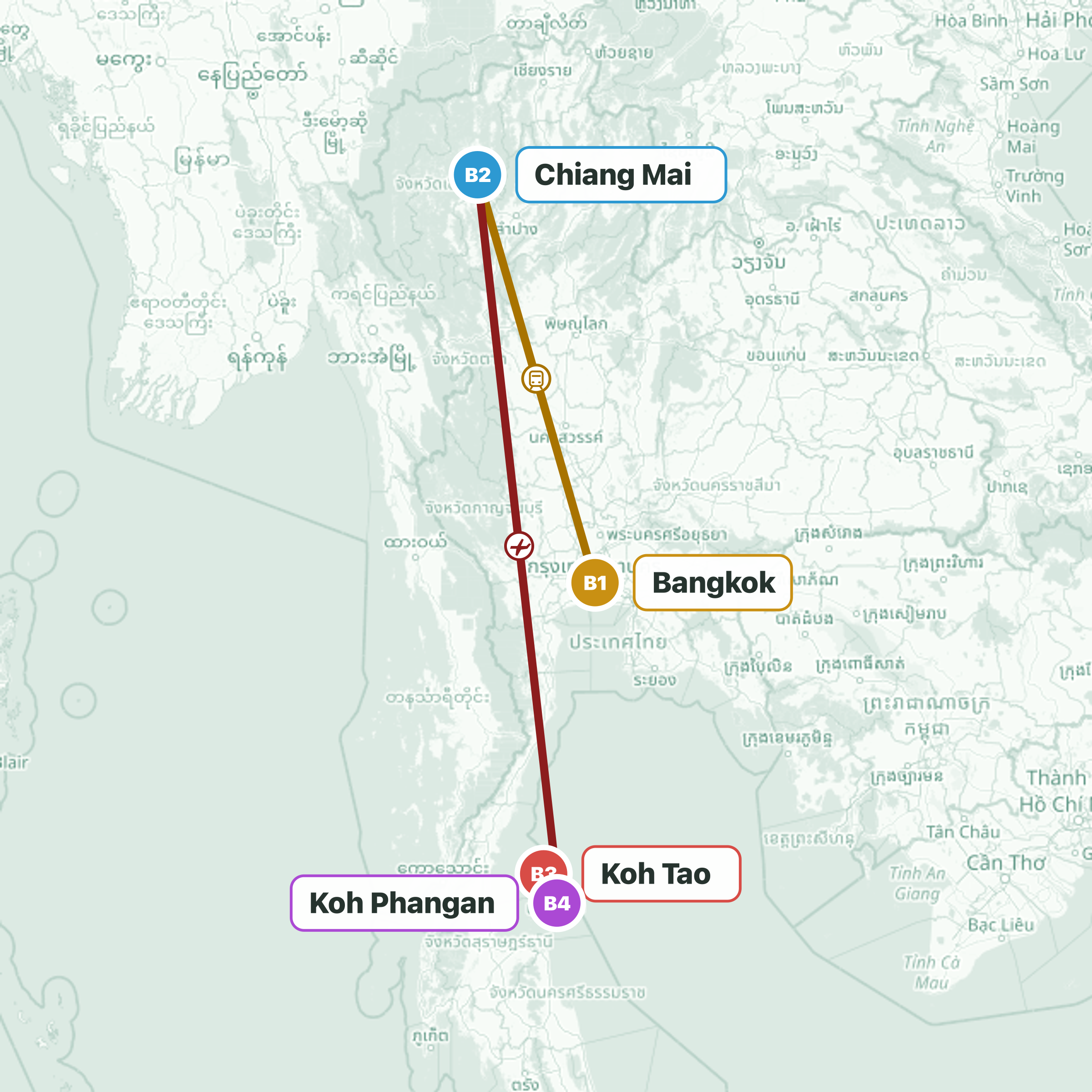
This is Five Cents: travel guide to Thailand. Plan it as a connected two-week journey, not a rush between famous stops. Bangkok explains the country’s urban contrasts. Chiang Mai changes the pace through northern culture. Koh Tao and Koh Phangan complete the route as complementary islands.
We’ll follow that progression through temples
We’ll follow that progression through temples, food, markets, mountains and the Gulf. Start by giving Bangkok the time to make sense. Thailand is an accessible first independent trip in Asia because its main routes are well established. But its appeal is not just convenience. Buddhist temples, shrines and offerings remain part of everyday life, while food stalls, markets and small restaurants shape how both cities work.
Give Bangkok three or four days. The best way to orient yourself is the Chao Phraya, the river that runs through the city’s historic core. Travelling by boat reveals temples, riverside homes, piers and towers in the same view. Near the river, the Grand Palace, the former royal complex, introduces Bangkok’s ceremonial history. Pair it with Wat Pho, a major temple compound known for its Reclining Buddha. The point is to see a working religious space rather than tick off another monument.
In the evening, head to Yaowarat, the main artery of Bangkok’s Chinatown. Its shopfronts, stalls and restaurants show food as part of the city’s public life, not a separate tourist activity. Then use Sukhumvit, a long modern corridor of elevated transport, hotels, offices, restaurants and nightlife, to understand the other Bangkok: commercial, vertical and affluent.
From Bangkok, travel north to Chiang Mai. The overnight train is worth choosing when the journey itself matters. It is long, and it can be noisy, warm and tiring, but arrival through northern landscapes has its appeal. Fly instead if you want to save time and arrive rested. Chiang Mai is smaller, easier to move around and framed by mountains. Its old city, marked by remnants of walls and a moat, is the place to understand Lanna culture: the living northern tradition visible in temples, crafts, food and community life.
Walk its lanes
Walk its lanes. Choose a temple or two rather than a long list, and let the markets do the rest. They bring together evening food, textiles, handmade goods and the city’s social rhythm. Try khao soi, the northern curry-noodle dish, because it makes the regional difference tangible. Chiang Mai also has a contemporary side in Nimman, an area of cafés, design, restaurants and younger nightlife. It helps explain why the city became associated with long stays, yoga and remote work, though that is only one layer of a now very tourist-facing city.
For the essential outing, go west to Doi Suthep, the mountain above Chiang Mai. Its temple, Wat Phra That Doi Suthep, connects a living religious site with views over the city and the forested landscape beyond it. A car with driver or an excursion works well. A motorcycle gives you more freedom to continue along the green roads around the mountain.
The next move is a real crossing of the country: from the northern mountains south toward the Gulf. The practical structure is a flight south, a road transfer and then a ferry, because Koh Tao has no airport. Treat it as a substantial travel block rather than a quick connection. Koh Tao is the compact island stage: relaxed, international and easy to enjoy in two days. It is also a practical place to take an Open Water course. In that case, allow roughly four days.
Its busiest social reference point is Sairee Beach, the island’s most animated beach area. But Koh Tao works best here as a small-scale pause before the larger island. A short ferry south links it to Koh Phangan, which should be the final base for three or four days. Koh Phangan has more room to explore: beaches, inland greenery, mountain scenery and a wider social mix.
The Full Moon Party is part of its international identity
The Full Moon Party is part of its international identity, but it is not the reason to define the island. The real contrast is with Koh Tao. One is compact and dive-oriented. The other is broader, more varied and easier to fill with beach days, nature and an evening out. The Gulf islands do not share exactly the same rainfall pattern as Thailand’s Andaman coast, so make sure this route fits your travel dates.
Keep three decisions in mind. Give Bangkok enough time for its river, temples, food and skyline. Use Chiang Mai for Lanna culture and the mountain edge. And combine Koh Tao with Koh Phangan rather than choosing between them. For your next Five Cents episode, you could make Bangkok: River, Chinatown and Street Food, or Northern Thailand Beyond Chiang Mai.