

Introduction
This is Five Cents: travel guide to Tanzania. This is a safari-first trip. Arrive near Arusha, join an organized northern circuit, and only then decide whether to slow down on Zanzibar’s coast. The key choices are how to choose the package, why Serengeti and Ngorongoro need enough time, and how Zanzibar fits as a second act.
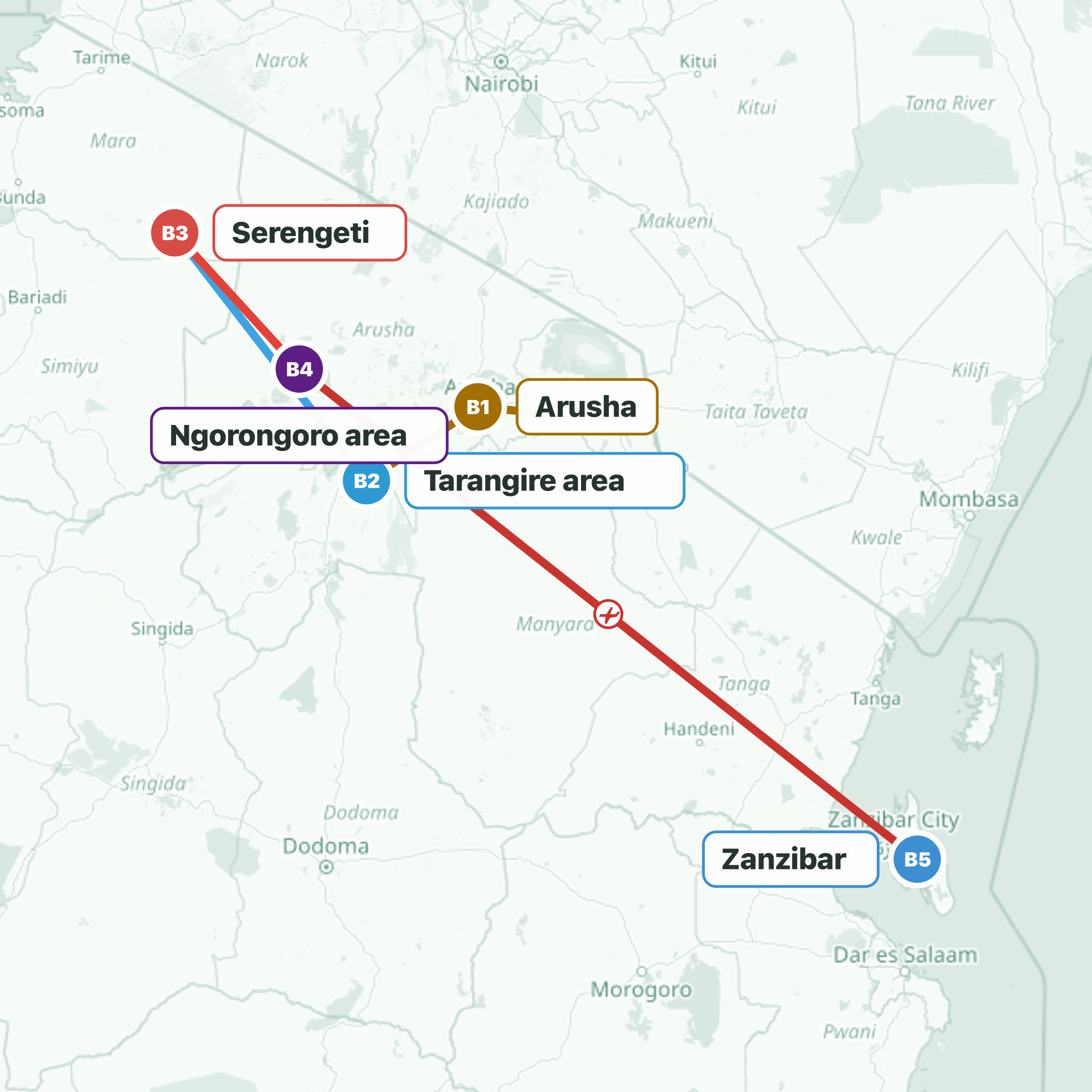
Start with the journey that makes Tanzania distinctive
Start with the journey that makes Tanzania distinctive. Arusha is the practical gateway for many northern safaris. Arrive, spend the night, and let your package begin the following morning. It is a starting point, not a city to build the trip around.
The usual approach is to book one complete safari, rather than assembling park entries, vehicles, and lodges separately. SafariBookings is useful for comparing routes, safari length, accommodation, group size, included services, and reviews. Begin with the duration. Then check whether the route reaches Serengeti, where you sleep each night, and whether the vehicle is shared or private.
Choose at least four or five safari days if Serengeti is part of the plan. The protected areas are spread across a large region, and a shorter trip can turn too much of the experience into transfers. A seven- to ten-day first trip works well: one arrival night near Arusha, four or five safari days, then three or four nights in Zanzibar, only if beach time matters to you.
Price differences can be substantial, but more money does not automatically mean more wildlife. Many trips follow similar authorized routes in similar four-wheel-drive vehicles. The bigger differences are usually camping versus a permanent camp or lodge, the location of the accommodation, the room category, group size, privacy, and overall comfort. In Serengeti, where distances are large, sleeping inside or close to the park can matter more than extra luxuries you will barely use.
From Arusha, the safari vehicle carries you west and northwest through the circuit. Tarangire is the best additional park when the package includes it. Elephants move through a dry landscape marked by baobabs and the Tarangire River. It gives the route a distinct scene before the main pair of landscapes.
The next major stage is the Ngorongoro Conservation Area
The next major stage is the Ngorongoro Conservation Area, a lived conservation landscape where wildlife and pastoral life coexist. Its centrepiece is Ngorongoro Crater, a vast volcanic caldera. Descending into it changes the scale of the safari. Instead of open distance, you have an enclosed bowl with dense wildlife viewing. The wider area also includes Olduvai Gorge and Laetoli, places tied to evidence of human evolution. So this is more than a dramatic backdrop.
From Ngorongoro, the circuit continues northwest into Serengeti National Park, the main stage of the Tanzanian safari. Its long plains make the experience feel less like a sequence of sightings and more like moving through an enormous ecosystem. Lions, elephants, giraffes, zebras, wildebeest, and hippos may all become part of the day. But do not reduce the trip to a Big Five checklist. A herd of zebras and wildebeest stretching across the grass, elephants crossing open ground, or giraffes against the late light can stay with you just as strongly.
A typical day begins early, often with the first light. It then moves through a game drive, a midday pause, and more driving in the afternoon before returning to camp or lodge. Time in the vehicle is the experience. The guide reads tracks, behavior, vegetation, and movement while the landscape keeps changing.
Talk to your driver-guide. Ask about what an animal is doing. Say which species or behavior interests you, and stay engaged with the route. That conversation turns observation into understanding.
Season changes the look and rhythm of the parks. The dry season often brings less vegetation and more wildlife around water. The wet season makes the landscape greener and changes animal distribution. The Great Migration moves through different areas over the year, so treat it as a reason to match a specific date to a specific route, not as the whole definition of Serengeti.
One practical health point
One practical health point: malaria is a risk in Tanzania, so discuss prevention and any prophylaxis decision with a healthcare professional before travel. Once the safari is complete, Zanzibar is a natural optional extension, reached by flight. It should change the pace, not compete with the wildlife journey. Stone Town, the historic core of Zanzibar City, is worth an afternoon or evening for narrow streets, seafront architecture, and a sense of the island’s Swahili trading history.
For the broadest beach stay, choose Nungwi in the north. It combines beach time with restaurants, bars, evening activity, snorkeling, diving, and boat trips. If you want a quieter resort-style stay, the east coast is the better alternative, especially for couples or families, and for kitesurfing in the right season. Its tides change the beach and swimming experience considerably.
Choose one base, or two only with enough days. There is no need to circle the island. Remember the structure: book a complete northern-circuit safari from Arusha, give Serengeti and Ngorongoro at least four or five days, and add Zanzibar after the wildlife route rather than instead of it. For your next Five Cents episode, you could explore How to Read a Safari Day: Animal Behaviour and Game Drives, or Zanzibar: Choosing Between Nungwi and the East Coast.