

Introduction
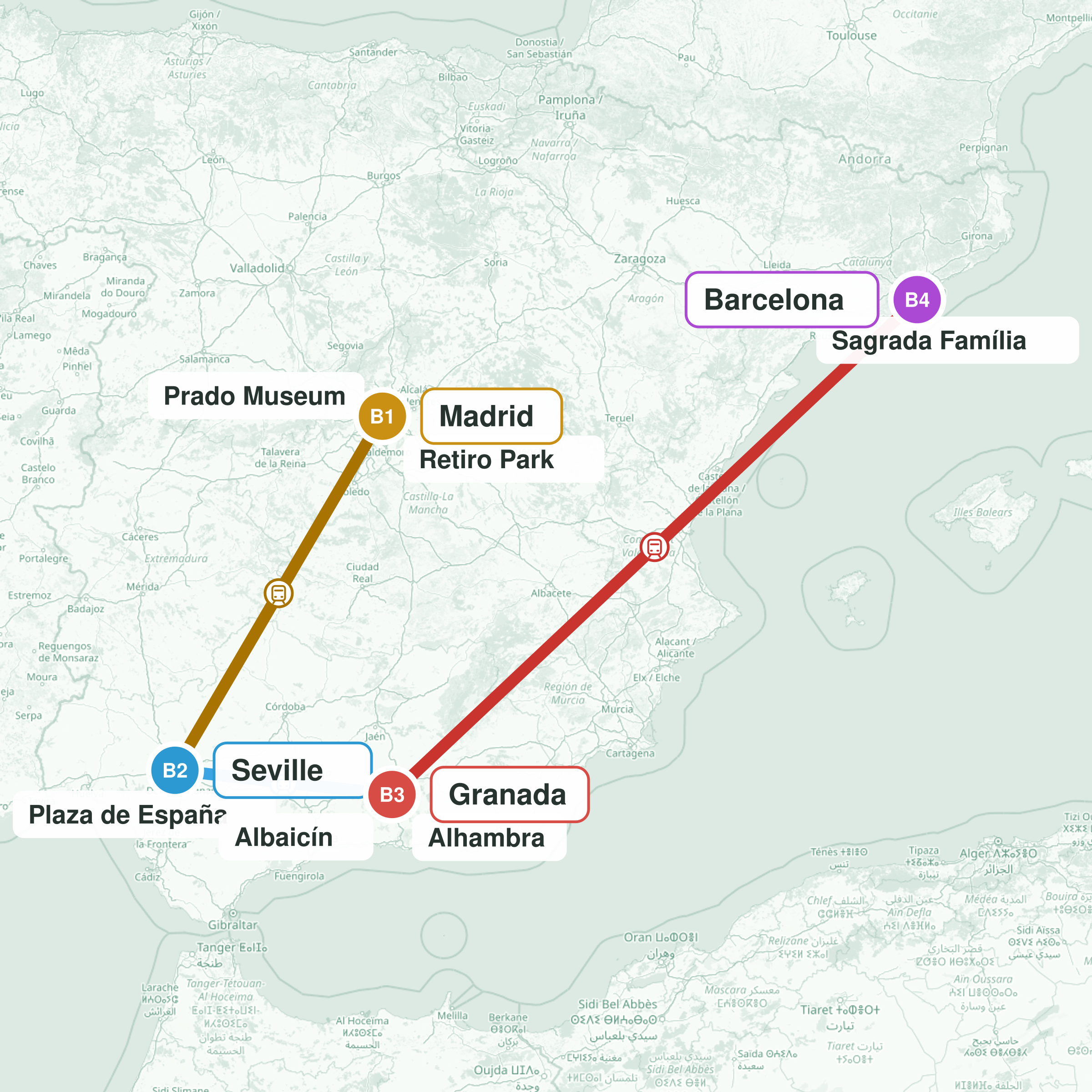
This is Five Cents: travel guide to Spain. Plan your first ten days as a rail journey from Madrid to Barcelona, linking art, historic Andalusia and Mediterranean modernism without trying to turn a diverse country into a checklist. We’ll cover four bases, the key experience in each, and the train connections that make the route work. Start with the shape of the journey. Keep four bases: three nights in Madrid, two in Seville, two in Granada and three in Barcelona. Arrive in Madrid and depart from Barcelona. High-speed rail handles the major journeys, while urban transport and walking take care of each city. This avoids backtracking and makes the regional contrasts clear.
How to plan the route
Begin in Madrid, a capital where art, institutions and street life meet on an urban scale. Spend one day at the Prado Museum and along the Paseo del Prado-Retiro axis. The Prado is the main choice for a first visit because it concentrates Spain’s painting tradition. Its surroundings bring together a museum, a historic avenue and a park in one cultural landscape.
Madrid’s other side is in the historic centre. Walk through Plaza Mayor, the Royal Palace, Sol and La Latina to understand the city through squares, seats of power and small bars. Food belongs to the walk here: alternate tapas and taverns rather than turning every meal into a formal reservation. Madrid works as an introduction because it combines a major art collection with a city best explored on foot.
From Madrid, take the high-speed train south to Seville, a journey of around two and a half hours. This is a more compact city, where history appears in courtyards, gardens and buildings that combine Islamic, Christian and imperial layers. The central visit is the group formed by the Cathedral, the Giralda and the Royal Alcázar. The Giralda retains its origins as an Almohad minaret. The cathedral stands on the site of a former mosque. And the Alcázar brings together Islamic, Mudéjar and Renaissance architecture.
The next day, walk to Plaza de España and María Luisa Park. This open urban setting shifts the pace after the monumental centre. In the evening, include a flamenco performance centred on music and dance. It introduces an artistic tradition closely linked to Andalusia without reducing the whole city to it. Round out Seville with a walk through the centre and tapas.
The route then continues east within Andalusia to Granada
The route then continues east within Andalusia to Granada. Keep two nights: the Alhambra is the heritage centre of the trip and needs time. The complex brings together a fortress, palaces and gardens. Its Nasrid architecture is best understood through the relationship between water, vegetation, geometry, ceramics and decorative writing. The Generalife extends that experience through gardens and landscape.
There is one essential warning on this route: the Nasrid Palaces have an assigned entry time, so advance purchase through the official system is decisive. For preparation, Washington Irving’s Tales of the Alhambra can accompany the visit as a romantic foreign view of the monument, though it cannot replace its history.
Then climb to the Albaicín, the former Hispano-Muslim neighbourhood spread across the hill opposite the Alhambra. Its steep streets, traditional houses and views explain the relationship between the city and the palatial complex. The Mirador de San Nicolás is a useful landmark, but the point is to walk the neighbourhood and see how the two hills speak to each other.
From Granada, take the high-speed train northeast to Barcelona. The journey starts at around six hours and twenty-five minutes. The change is deliberate: from historic Andalusia to a Mediterranean metropolis shaped by Catalan identity and modernism. Give one day to the Sagrada Família, Gaudí’s work that best explains this stage through its scale and architectural language. For a second encounter with Gaudí, choose Park Güell or a Modernista house on Passeig de Gràcia, but do not try to string together all his works.
Save another day for Ciutat Vella
Save another day for Ciutat Vella, the historic core that includes the Gothic Quarter and El Born. Then continue to the waterfront to see that Barcelona is not only a medieval or Modernista city. It is also organised around the Mediterranean. Las Ramblas and La Boqueria can help you get your bearings, but they should not be the centre of the visit.
With more than ten days, Córdoba is the most logical extension between Seville and Granada, for the Mosque-Cathedral. Toledo, from Madrid, is another extension for travellers who prefer a compact historic city to more time in the capital’s museums and neighbourhoods.
Remember three decisions: do not try to see all of Spain; use rail to connect Madrid, Seville, Granada and Barcelona; and protect two nights in Granada so the Alhambra becomes a complete experience. To continue, you can generate “Córdoba and the Mosque-Cathedral in One Day” or “Modernist Barcelona Beyond the Sagrada Família”.