

Introduction
This is Five Cents: travel guide to South Africa. Plan it as two distinct journeys. Cape Town and the Cape are for city, coast, and history. The Kruger region is for safari. This guide maps out the right duration, the flight between them, and the historical stops that give the trip context.
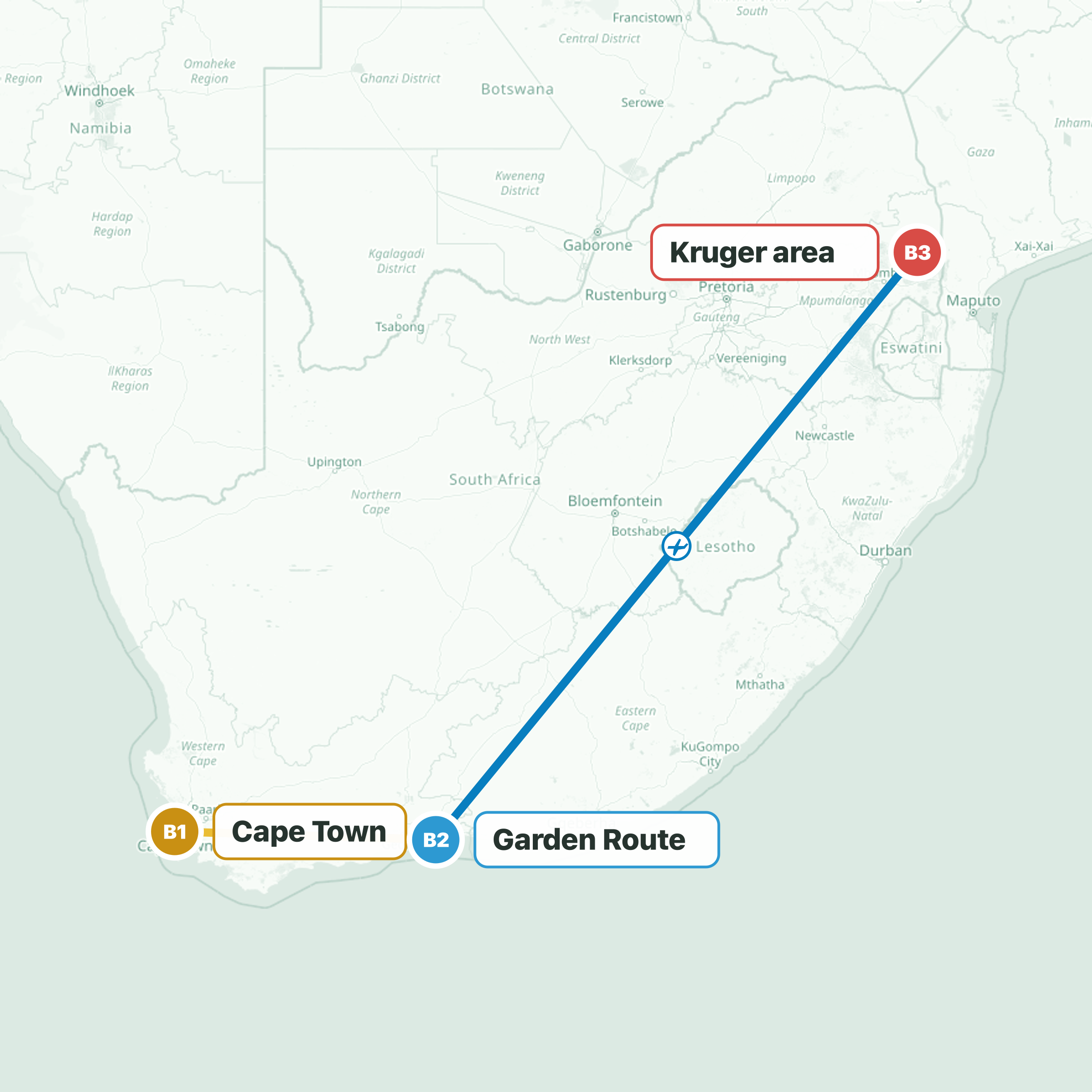
How to plan the route
Start by resisting the idea of crossing the whole country by road. For a first visit, allow ten to fourteen days: four in Cape Town, three or four nights in Kruger, and one or two days in Johannesburg. With only a week, keep Cape Town and Kruger, linked by a domestic flight. That pairing gives South Africa enough space to feel varied without becoming a transit itinerary.
Begin in Cape Town, in the southwest. It is the country’s strongest first base because Table Mountain, protected coastline, and political history sit within one compact region. Give Table Mountain half a day early in the trip. The cableway reaches the summit in about five minutes. The plateau turns the city, Table Bay, and the surrounding national park into a visible map. Its fynbos vegetation is part of the Cape Floral Region, one of the world’s most distinctive botanical landscapes. So this is more than a skyline viewpoint.
Use a rental car for one full day south along the Cape Peninsula. This is where the city gives way to coastal roads, the Cape of Good Hope area, and the protected landscapes of Table Mountain National Park. Around Simon’s Town, Boulders adds a penguin colony on the False Bay side of the peninsula. It is a better use of a day than collecting separate viewpoints because it explains the relationship between Cape Town and the open coast.
Make room for one concentrated historical visit. Robben Island is the clearest choice in Cape Town. Ferries leave from the V and A Waterfront, and the visit takes around three and a half hours. The island connects colonial rule, political imprisonment, and anti-apartheid resistance. It is not only about Nelson Mandela’s imprisonment. Reading Mandela’s autobiography, Long Walk to Freedom, before this part of the trip gives the crossing and the prison buildings their political context.
The route step by step
From Cape Town, fly northeast to the Kruger region rather than adding a long overland transfer. Skukuza and Hoedspruit are practical access points, depending on whether you choose self-drive inside Kruger or a lodge-based safari. A car is useful for an independent stay. Lodge transfers suit a guided-drive base.
Kruger National Park is nearly two million hectares of savannah, wildlife, and archaeological history. Its value is not a single sighting, but the rhythm of repeated drives: early mornings, later afternoons, and time to notice how the landscape changes. Give it at least three nights, ideally four. During the dry winter period, broadly May to September, thinner vegetation and animals gathering around water can make wildlife easier to spot. Summer brings greener scenery and stronger birdlife, but it is a different safari.
The essential rule here is simple: treat Kruger as a slow region. Internal distances, gate hours, and unpredictable wildlife make excessive daily driving counterproductive. Choose one area and let several drives build the experience. That is why Kruger works better than scattering short wildlife stops across the country.
Continue west by domestic flight to Johannesburg when your departure route and time allow it. Give the city one day for the Apartheid Museum, which traces apartheid’s rise and fall. It helps explain why South Africa’s cities and neighbourhoods look and function as they do. Together with Robben Island, it makes history part of the route rather than an optional extra. South Africa has twelve official languages, including English, Afrikaans, isiXhosa, and isiZulu. That diversity is another reminder that this is not a single cultural landscape.
With the core journey complete
With the core journey complete, two extensions deserve separate time. The Cape Winelands add food, wine, and cultivated scenery to a longer Cape-focused trip. The Garden Route is the better choice for an extra five to seven days: a one-way self-drive through forests, lagoons, and coast between the southern Cape and Gqeberha. It is a road trip in its own right, not a detour to squeeze between Cape Town and Kruger.
Remember the three decisions: make South Africa a two-region trip, fly between Cape Town and Kruger, and give both history and safari enough time to mean something. For a next episode, you could create a Five Cents guide to Cape Town beyond the headline sights, or a Five Cents guide to planning a Kruger safari: self-drive or private reserve.