

Introduction
This is Five Cents: travel guide to Sicily. This is a road journey across an island where volcanic slopes, Greek cities, Baroque streets, and Arab-Norman Palermo keep changing the story. We’ll map the right length, the east-to-west route, and the stops that earn their place.
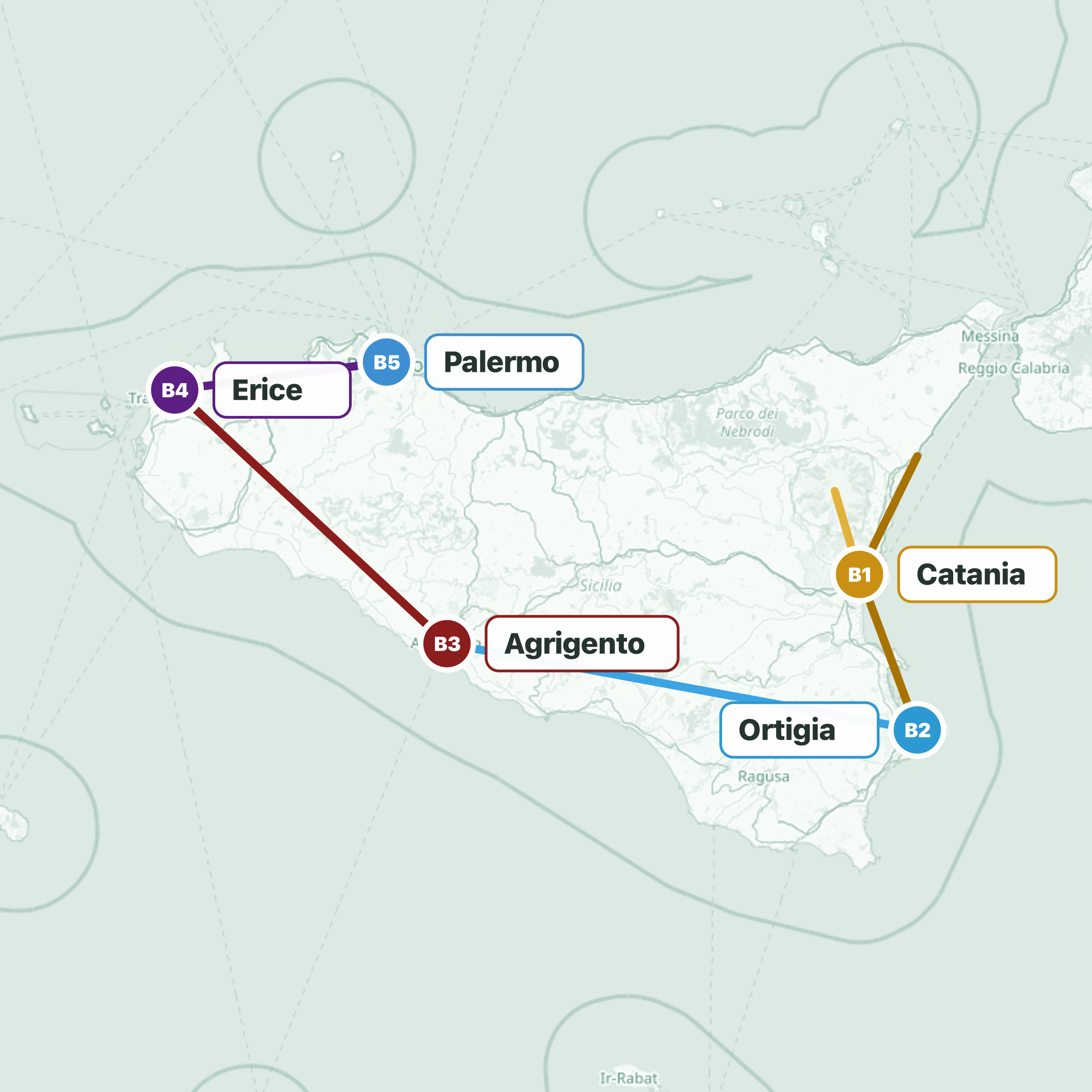
Start by treating Sicily as a crossing
Start by treating Sicily as a crossing, not a loop. Ten days is the best rhythm. Fly into Catania, rent a car, and leave from Palermo. That lets you move west without retracing the island. Six days can still work, but make it selective. Choose either Etna or more time in Taormina. Keep Syracuse and Ortigia. Add Agrigento only if Greek archaeology matters to you.
Catania is the right opening because it is much more than an airport base. Its grand Baroque squares were rebuilt after the sixteen ninety-three earthquake, but much of the city is made from dark volcanic stone. In Piazza del Duomo, the lava-stone elephant captures that mix of monumentality and Etna’s presence. Have a granita with brioche in a café or square. It is an easy way into the city’s everyday food culture.
Use the car between regions, then leave it outside historic centres and walk. From Catania, head north along the east coast for the Etna and Taormina block. Mount Etna is the landscape that explains eastern Sicily: the dark stone, the cultivated slopes, and the huge horizon behind Catania. Drive up through changing vegetation. Then give yourself time for a walk or excursion on volcanic terrain. In a six-day trip, choose Etna when landscape matters more than an elegant coastal town. With ten days, give both places proper time.
Taormina sits high above the Ionian Sea, with polished streets, a theatrical setting, and views back toward Etna. It is expensive and heavily visited, but its value is real. The ancient theatre frames sea and volcano in one view, making Greek history and landscape inseparable. Before the trip, season two of The White Lotus is useful preparation.
Its central setting, the San Domenico Palace, a former convent turned hotel, captures Taormina’s elegant, slightly excessive atmosphere. Then drive south to Syracuse. This was one of the great cities of the Greek Mediterranean, but the best base is Ortigia, its compact historic island. Ortigia is where that history becomes a walkable evening: narrow streets, waterfront promenades, squares, and façades surrounded by water.
Its cathedral is the key to reading the city
Its cathedral is the key to reading the city, because it incorporates the structure of an ancient Greek temple into a later Christian and Baroque building. Continue west across the south coast, where Sicily becomes more open and rural. This is a travel day, not a beach checklist. Agrigento’s Valley of the Temples is worth the stop on a ten-day route. It is a broad archaeological landscape of ancient Akragas, with temples spread across open ground.
Give it real time and energy. It is not a quick photograph stop. Nearby, Scala dei Turchi is a brief visual contrast: a white marl formation rising above the sea, very different from the darker eastern terrain. For the longer route, continue northwest to Erice, a historic hill town with a medieval feel and wide western-coast views. It gives the journey one final change of scale before the city.
With six days, skip this extra stage and keep moving toward Palermo. Finish in Palermo, where the car stops helping. Walk through the Arab-Norman centre, where Byzantine, Islamic, and Western traditions meet in the city’s monuments. Then head to Ballarò, a market where produce, street food, and public life overlap. Palermo’s streets and squares stay active into the evening, giving the route its most intense urban finish.
Keep three ideas: cross from Catania to Palermo rather than backtracking; use Etna, Greek Sicily, and Palermo as three keys to the island; and leave room for the roads, changing landscapes, and city life. You can create a new Five Cents episode on Greek Sicily from Syracuse to Agrigento, or on Sicilian food through Catania and Palermo.