

Introduction
This is Five Cents: travel guide to Scotland. This guide helps you plan seven to eight days around the contrast that makes a first visit work: compact historic cities followed by expansive Highland landscapes. We’ll connect the urban stages with a western Highland stay, choosing transport and protecting time to walk along the way.
Start with the scale of the journey
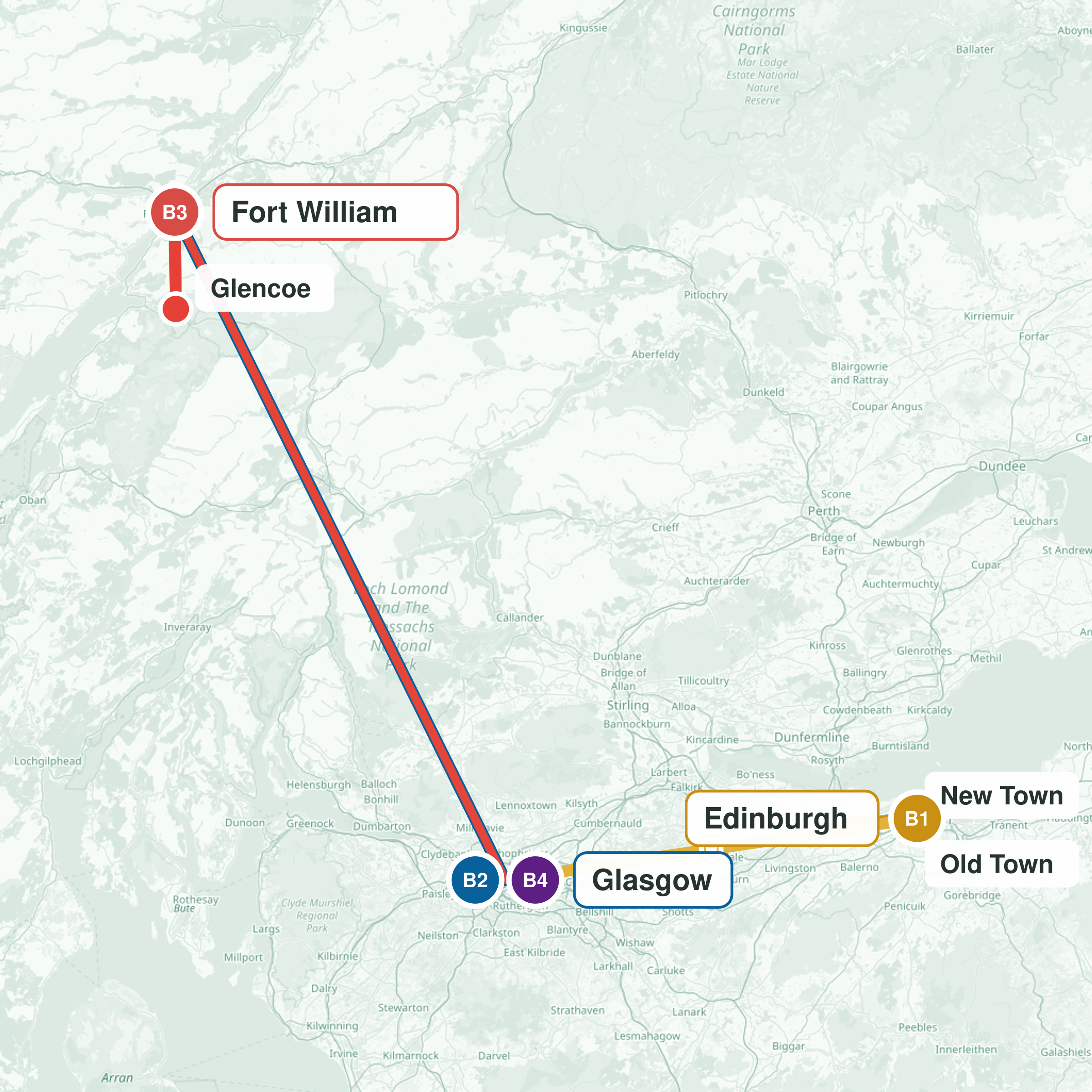
Start with the scale of the journey, because that determines how much you can experience. Scotland is a country within the United Kingdom, and this route gives you a focused introduction to its urban and rural character. Begin in Edinburgh, spend a day in Glasgow, then head north and west to stay in Fort William before returning south.
Eight days gives you two days in the capital, one contrasting city day, a Highland transfer followed by three days in the region, and a final return. With seven days, remove one slower Highland day. Take the train between the cities, then rent a car for the rural stage. The car’s value is the freedom to connect dispersed landscape stops and spend longer where you want to walk. A small-group Highland tour is the driving-free alternative, although its route and pace replace that flexibility.
Keep the city stages on foot and by rail. The rural journey is where your transport choice becomes decisive. Arrive through Edinburgh Airport and head into Edinburgh, Scotland’s historic capital. Give its centre two days, with walking as the main activity. The defining experience is the difference between the Old Town and New Town, two parts of the city that make its history visible in the streets.
Begin in the Old Town, where medieval street patterns shape the historic centre. Follow the Royal Mile, its principal historic street, and explore the narrow closes: passages that lead away from the main streets. Pay attention to how those confined spaces fit together. The reward is understanding the shape of the city, rather than moving between a series of interiors.
On the second day
On the second day, turn to the New Town, Edinburgh’s planned Georgian district. Its eighteenth-century layout offers a different idea of urban life from the older streets. Walking between the two areas lets you compare an inherited medieval pattern with an ambitious planned city. Together, they form Edinburgh’s UNESCO-listed historic cityscape. Make that architectural contrast the priority of your capital stay.
From Edinburgh, travel west to Glasgow by train. Some services take roughly forty-two minutes, making this a straightforward change of city. Allow a day for Glasgow, a larger city with a more contemporary feel and its own architectural and cultural life. Here, shift your attention from Edinburgh’s historic street patterns to museums, architecture and contemporary culture. Glasgow adds a different urban perspective to the journey.
That matters because Scottish identity includes substantial city life alongside the countryside and heritage that often dominate visitors’ expectations. Treat this as a distinct city day, with room to explore its cultural life at an unhurried pace. Next, collect your rental car and head north and west from Glasgow, travelling via Loch Lomond, a freshwater loch on the approach to the western Highlands. Continue through Glencoe, a mountain landscape with a significant historical setting, towards Fort William.
This town will be your accommodation base for the rural stage. Give the transfer its own day: reaching the region is part of the trip, rather than something to squeeze around a full sightseeing programme. From Fort William, drive south to Glencoe for your main landscape day, returning to the same base afterwards. Build the day around a short walk and a few landscape stops. Step out of the vehicle and spend sustained time among the mountains.
Key stops and decisions
Staying within the region makes this possible without repeatedly travelling out from a distant city. Use the remaining Highland days for short walks and viewpoints from Fort William, including one deliberately slower walking day. Seasonal daylight and conditions determine how much walking fits, and no season guarantees reliable weather. Leave enough flexibility for the outdoor part of the trip to respond to those conditions.
The Highlands also add regional cultural context. Gaelic is a living language particularly associated with parts of the Highlands and Islands. Where you encounter Gaelic signage, understand it as part of that continuing culture, rather than evidence that all Scotland shares one language or one Highland identity.
Reserve the final day for the drive south from Fort William to Glasgow, your last accommodation stop. The journey’s three priorities are simple: walk Edinburgh’s contrasting urban fabrics, stay in the Highlands with time outside the vehicle, and follow a focused city-to-western-Highlands route instead of circling the country.
To continue, you can generate another Five Cents answering either of these questions: How can you plan a multi-night trip to Skye? Or, how can you explore Scotland by rail with guided Highland excursions?