

Introduction
This is Five Cents: travel guide to Rome. This guide helps you plan four full days without turning the city into a monument sprint. Use one central base, and group each day by area. You will move from ancient Rome to the Vatican, the Baroque centre, then art and neighbourhood life.
Start with the idea that makes the route work
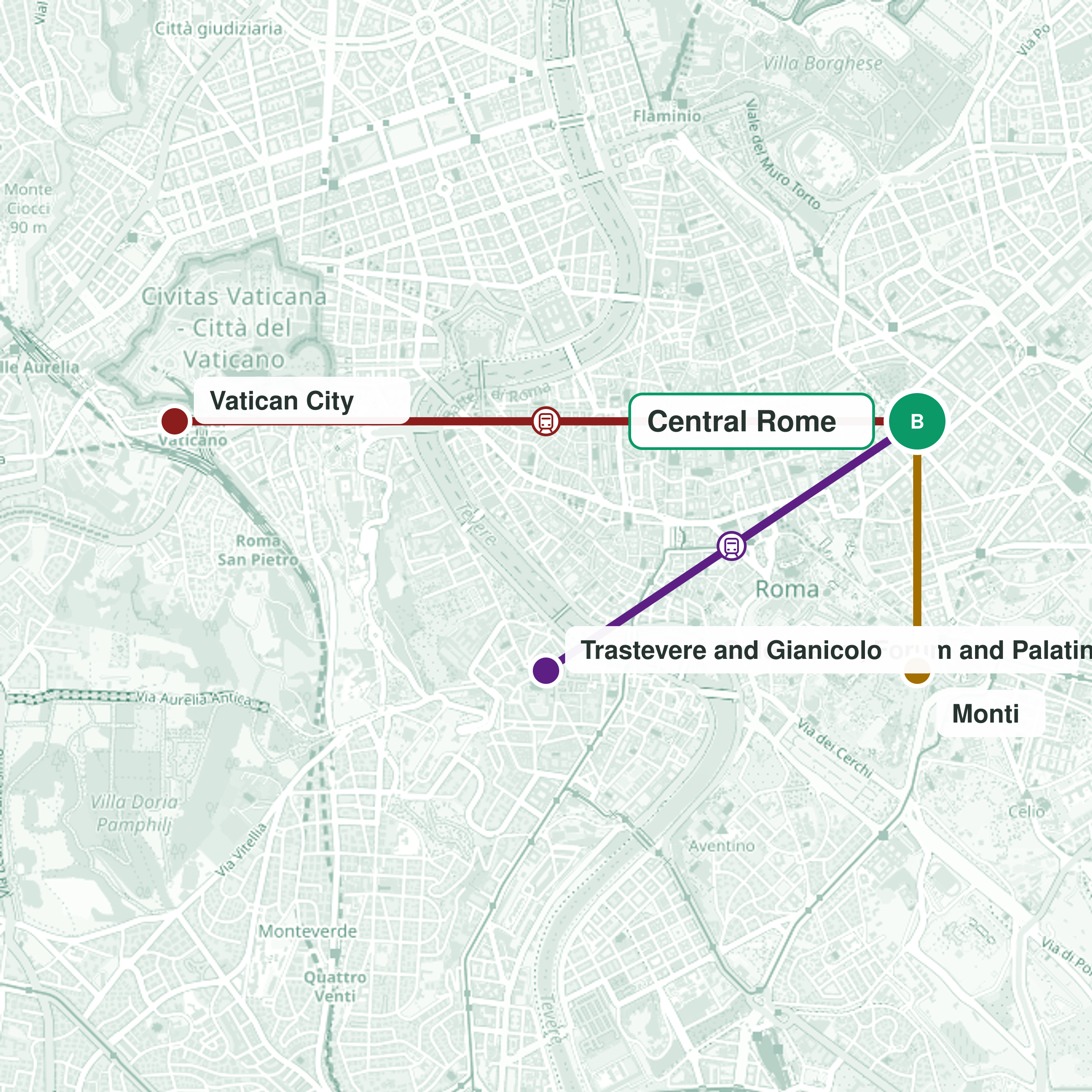
Start with the idea that makes the route work: Rome is a walkable city of layers, built by reusing and reinterpreting what came before. Arrive through Fiumicino, then take the Leonardo Express to Roma Termini in thirty-two minutes. Stay in Monti, the central residential district near the Colosseum and Termini. It gives you easy access to the ancient sites, the Vatican connections and the historic centre.
Walk for most of the trip. Use the metro or buses to bridge the outer edges. A car adds little to this first visit. On day one, head south-east from Monti to the Colosseum, Roman Forum and Palatine. Treat them as one archaeological landscape, not three separate stops. The Colosseum explains Roman spectacle. The Forum was the political, religious and commercial centre of the city. The Palatine connects the ruins to Rome’s founding stories and imperial residences.
Give the sequence three and a half to four and a half hours. The value is in moving from the famous amphitheatre to the spaces that explain who controlled Rome and how public life worked. Timed entry needs to be booked in advance, and opening conditions vary by date. Finish around Campidoglio or back in Monti, where the day can slow into dinner and neighbourhood streets.
Day two moves west across the centre by metro, then on foot, to Vatican City. Start with Saint Peter’s Basilica, the great church built around the tradition of Saint Peter’s tomb and shaped by Bramante, Michelangelo, Bernini and Maderno. Then give the Vatican Museums and Sistine Chapel about three hours. Together, they show how religious authority and artistic patronage shaped another Rome: Christian, Renaissance and papal.
Afterwards, walk towards Castel Sant’Angelo and the Tiber
Afterwards, walk towards Castel Sant’Angelo and the Tiber. The fortress began as Emperor Hadrian’s mausoleum before becoming part of the city’s papal defences. That change is Rome in miniature: ancient structures repeatedly given new roles rather than simply replaced. For day three, walk west and south-west from Monti into the historic centre. Begin at the Pantheon, an ancient temple turned church. Then continue to Piazza Navona, a Baroque square whose shape still follows the Stadium of Domitian beneath it.
From there, pass through Campo de’ Fiori or the Jewish Quarter before reaching the Trevi Fountain and Piazza di Spagna. This is the day to leave room for the streets between landmarks. Trevi and Piazza di Spagna belong on the route because they explain Rome’s international image, but keep those stops brief.
The deeper experience is the continuous shift between ancient structure, Baroque public space, churches and daily urban life. Add one Baroque church interior rather than another museum. Some of Rome’s finest art remains part of working religious spaces. Roman Holiday is useful before this walk because it captures the cinematic image of Rome’s plazas and monuments, while the real city is more compelling in the connections between them.
On day four, take the metro or bus north to Galleria Borghese, a compact art museum with Bernini, Caravaggio, Canova, Raphael and Titian. Its focused, roughly two-hour visit is a better use of time than scattering several smaller museums across the city. Afterwards, walk through Villa Borghese and stop at the Pincio viewpoint.
Head south to Testaccio for the evening
Then head south to Testaccio for the evening. This former working port district grew around the Emporium and Monte Testaccio, an artificial hill formed from discarded amphorae. It links Roman food to trade, workers and urban history. So eat here as part of the route rather than as a separate food activity.
Trastevere is the alternative for lanes, squares and nightlife, but Testaccio gives this four-day plan a more distinct final chapter. With a fifth day, add Ostia Antica as a separate archaeological extension. It takes most of a day by metropolitan rail from Rome and offers a Roman port city that is easier to read as a complete urban place than scattered ruins in the centre.
Use it only if it does not replace the main four days. Keep three decisions in mind: stay central and organise Rome by zones; read the Colosseum, Forum and Palatine as one story; and protect time for walking, because the continuity between eras is the city’s greatest experience.
To continue, you can generate Rome’s ancient archaeology beyond the Colosseum. To explore further, you can generate Rome for food: Testaccio, markets and Roman cooking.