

Introduction
This is Five Cents: travel guide to Romania. This is an eight-to-ten-day route for understanding Romania through its contrasts: a capital shaped by ambition and communist redevelopment, the Carpathians, and Transylvania’s layered historic cities.
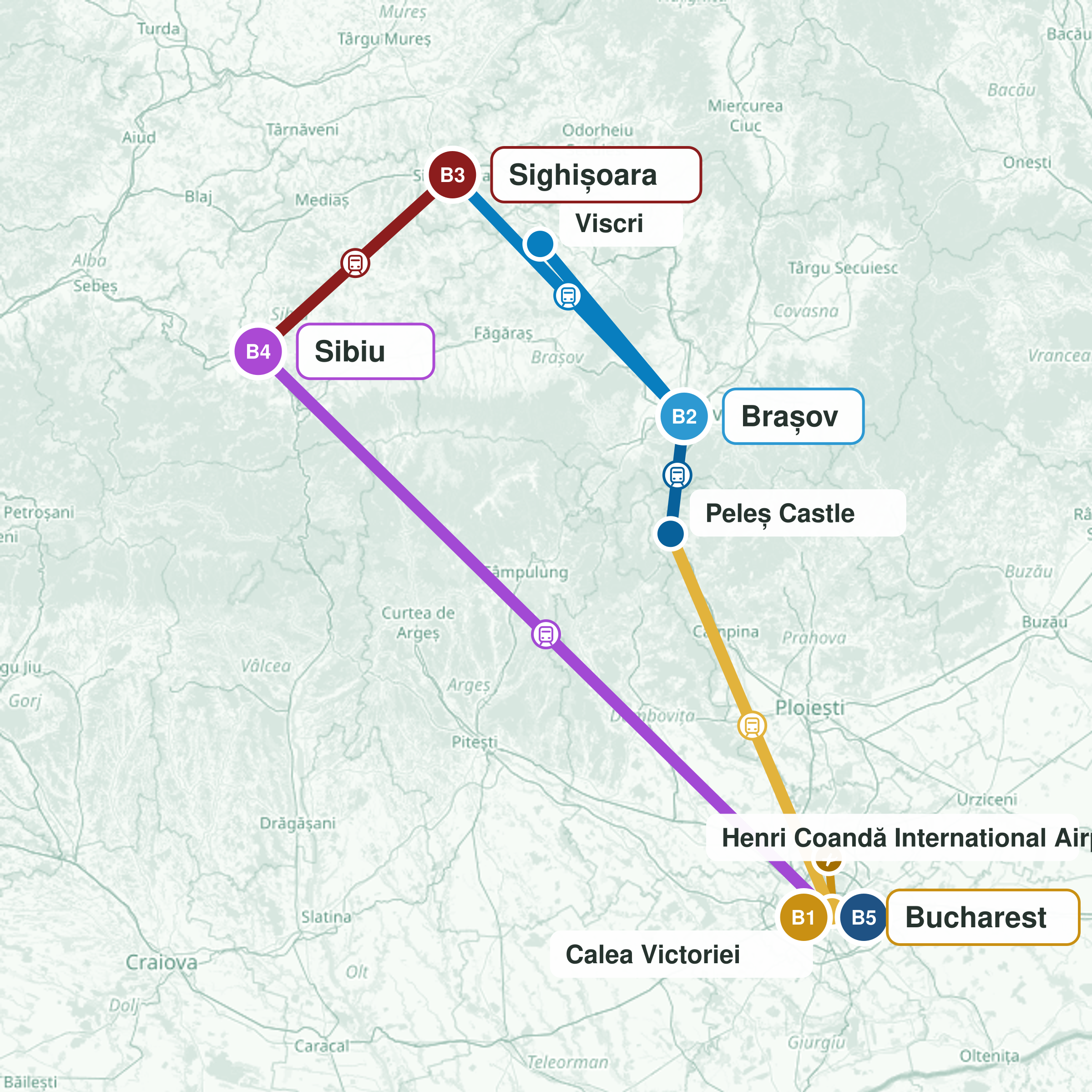
We’ll follow the rail corridor from Bucharest to Sinaia
We’ll follow the rail corridor from Bucharest to Sinaia, Brașov, Sighișoara, and Sibiu. Then we’ll decide when rural heritage and the Danube Delta deserve more time. The best place to start is with the route itself. Romania works when you travel between complementary places, rather than trying to collect castles.
Begin in Bucharest, with two nights after arriving through Henri Coandă International Airport. The capital is not the country’s prettiest stop, but it provides the context the rest of the trip needs. Walk Calea Victoriei, the grand central avenue, and see the Romanian Athenaeum, a landmark of the city’s European-facing cultural ambition.
Then contrast that with the old centre and the Palace of Parliament area. Here, historic streets meet the scale of communist-era redevelopment. Bucharest makes Romania’s modern political and architectural tensions visible before the journey turns north. From Bucharest, take the train north into the Carpathians and stop in Sinaia for Peleș Castle.
Sinaia is a mountain resort, but on this route, it is a focused royal interlude rather than another base. Peleș Castle connects the capital’s history with mountain Romania. Its setting makes the shift in landscape part of the visit. Continue north by train to Brașov and stay two nights. Brașov is the practical first base in Transylvania: a compact historic city at the foot of the mountains, with Council Square at its centre and a fortified-city legacy around it.
Give yourself time to walk the old town in the evening, rather than treating it as a stop between castles. This is also where Transylvania starts to make more sense as a borderland shaped by Romanian, Hungarian, Saxon German, and Jewish communities. Those histories are visible in the region’s architecture and urban form, not as a single folklore theme.
The route step by step
Use Brașov for one rural day by car or local excursion to Viscri. This small Saxon village is organised around its fortified church. It provides the counterpoint the cities cannot: a rural settlement where worship, defence, and daily life were tied together. One fortified-village visit is enough. It gives depth to the route without turning the trip into a sequence of similar churches and towns.
From Brașov, continue northwest by train to Sighișoara for one night. Its inhabited medieval citadel is the route’s most concentrated historic experience: walls, towers, and steep lanes contained within a small centre. Sighișoara is associated with Vlad Țepeș, one source behind later Dracula mythology. Bram Stoker’s Dracula is useful here as a way to understand Romania’s international image, but it is fiction, not a guide to the region’s history.
The real story is broader: a fortified town in a multicultural part of Europe. Then travel west by train to Sibiu and stay two nights. Sibiu complements Sighișoara rather than repeating it. Where Sighișoara is compact and defensive, Sibiu is a larger former Saxon city of broad squares, historic houses, and cultural life.
Spend a full day moving between its central spaces. Notice how a city built around guild traditions feels more open and lived-in than the citadel. Food in this part of Romania also reflects the meeting of Romanian, Hungarian, and Saxon traditions. It is another reminder that Transylvania is more than its vampire myth.
Return southeast by train to Bucharest for a final night and departure. That closes a clean loop without adding a detour simply for the sake of covering more ground. In eight or nine days, this is enough: capital, mountains, a practical Transylvanian base, one rural fortified church, and two cities that do different jobs.
With the main route complete
With the main route complete, the extension worth adding is the Danube Delta. Go only with three or four additional days, via Tulcea. The Delta is a wetland of channels, lakes, reedbeds, and villages where boats replace the road-based rhythm of the Transylvanian loop. Choose it for birdlife, water, and slower landscape travel. It is not a casual day trip from Bucharest or an add-on to a one-week itinerary.
Keep three ideas: treat Romania as a focused southern Transylvania loop, let Brașov, Sighișoara, and Sibiu explain different versions of the region, and save the Danube Delta for its own extension.
To continue, you can generate “Romania’s Danube Delta: a four-day boat and wetland route.”
To explore the cultural side, you can generate “Transylvania beyond Dracula: Saxon towns and fortified villages.”