

Introduction
This is Five Cents: travel guide to Portugal. This is a first mainland trip built around one simple decision: travel north from Lisbon to Porto, rather than trying to collect every region. We’ll set the right pace, give Sintra the time it needs, and finish with one extension that adds either river landscape or medieval history.
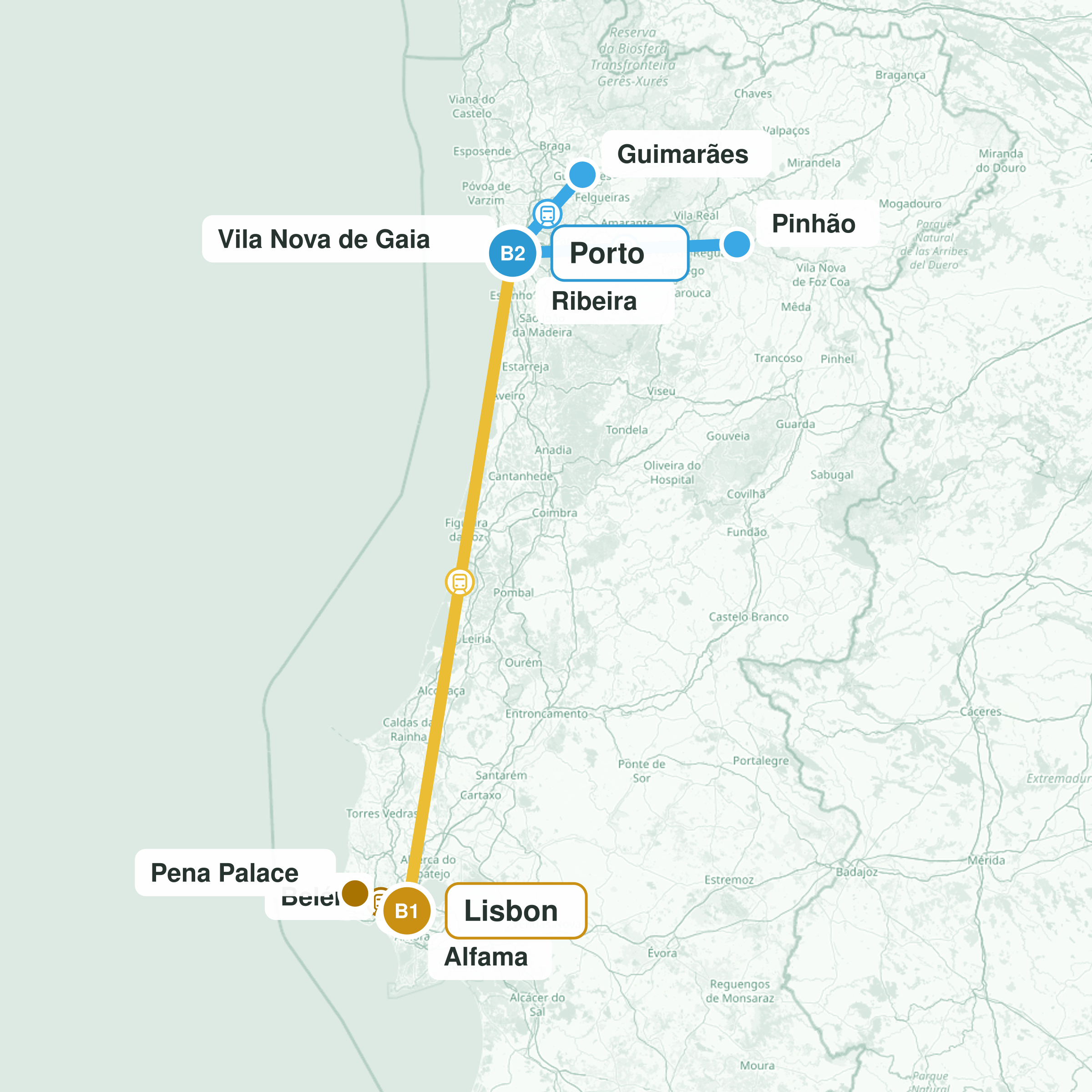
Start by keeping the route linear
Start by keeping the route linear. Plan for eight or nine days, or a focused seven-day version. Fly into Lisbon. Use public transport and walking in both cities. Then take the direct intercity train north to Porto. A car is useful only if you later build a rural or coastal trip around places such as the Algarve or Alentejo. For this first route, it would add little in the cities and complicate the journey.
Give Lisbon three full days. It is Portugal’s Atlantic capital: a city of hills, historic neighbourhoods, the Tagus River and fado. Begin on foot in Baixa, the orderly lower town rebuilt after the seventeen fifty-five earthquake. Continue uphill through Chiado, where cafés, bookshops and cultural life give the centre a different rhythm. Then head into Alfama, the older maze of lanes and viewpoints above the river.
Choose one viewpoint along that walk rather than chasing several. The point is to understand Lisbon as a city stretched between hills and water. Set aside another block for Belém, west of the centre along the Tagus. The Jerónimos Monastery and Belém Tower make Portugal’s maritime past tangible. This is where Atlantic navigation, trade and imperial expansion become visible in the riverfront architecture.
Around Lisbon, make food part of the route rather than a separate checklist. Have a pastel de nata with coffee, try bacalhau or another fish dish, and eat once in a traditional tasca or café. Fish, olive oil, salted cod and regional wines all belong to the country’s Atlantic geography. Return to Alfama or nearby Mouraria one evening for fado. This is not simply background music. It is an urban tradition shaped by Portuguese guitar and saudade, a way of singing about longing, loss and everyday life.
It gives the older districts an emotional and cultural dimension that a daytime walk cannot. José Saramago’s Journey to Portugal is also a useful companion here, because it frames the country as a sequence of landscapes and historical layers, not just two city breaks. From Lisbon, head northwest by train and local transport to Sintra. Give it a full day.
Sintra is a wooded cultural landscape of hills
Sintra is a wooded cultural landscape of hills, gardens and Romantic architecture, not a quick stop beside Lisbon. Make Pena Palace the centre of the visit. Its theatrical form only makes sense together with the surrounding slopes and designed landscape. Add one second site, such as Quinta da Regaleira or the Moorish Castle, rather than racing through several palaces. Sintra’s hills, queues and internal transfers make a rushed visit disappointing.
Then return to Lisbon and take the direct intercity train north to Porto. This is the route’s cleanest long move. It turns the trip into a journey between two Atlantic cities without retracing your steps. Coimbra, with its historic university, is worth a day only when you have extra time and a particular interest in university history. Otherwise, keep the transition simple.
Give Porto two days. Porto is more compact than Lisbon but built on steep slopes above the Douro River. Walk down through the historic centre to Ribeira, the riverside quarter, and take in the Luís the First Bridge. The descent matters. It shows how the city developed as a port, with the river organising its streets, trade and views.
Cross south over the Douro to Vila Nova de Gaia. Gaia is the riverside city opposite Porto, known for the cellars where port wine is stored and presented. A simple cellar visit or tasting works because it connects the city directly to the valley inland where the grapes are grown. It is a useful distinction: Porto wine is more than a drink in a historic cellar. It belongs to a river landscape further east.
With the main route complete, choose one final extension. The best choice is the Douro Valley, reached east from Porto by train or organised transport for a full day. Its terraced vineyards and steep river corridor show the landscape behind the wine. Stay overnight only if you want a slower rhythm and more time for the scenery.
Key stops and decisions
Choose Guimarães instead only when medieval history matters more than landscape and wine. Its historic centre gives a focused view of Portugal’s early formation, but do not add both Guimarães and the Douro to a short first trip. Likewise, save the Algarve, Alentejo, Madeira and the Azores for journeys with their own time and transport logic.
Remember three things: enter through Lisbon and leave from Porto; treat Sintra as a full-day detour; and choose the Douro for landscape or Guimarães for history.
To continue, you can generate Madeira: Hiking and Island Landscapes. To explore the food and wine side further, you can generate Portugal: Food, Fado and Port Wine.