

Introduction
This is Five Cents: travel guide to Paris. Plan four full days around the Seine, using one central base and the Metro only for longer jumps. You’ll move from the medieval islands west toward the Eiffel Tower, then finish in Montmartre, where Paris changes scale completely. Start by making the river your map.
Stay in the Marais
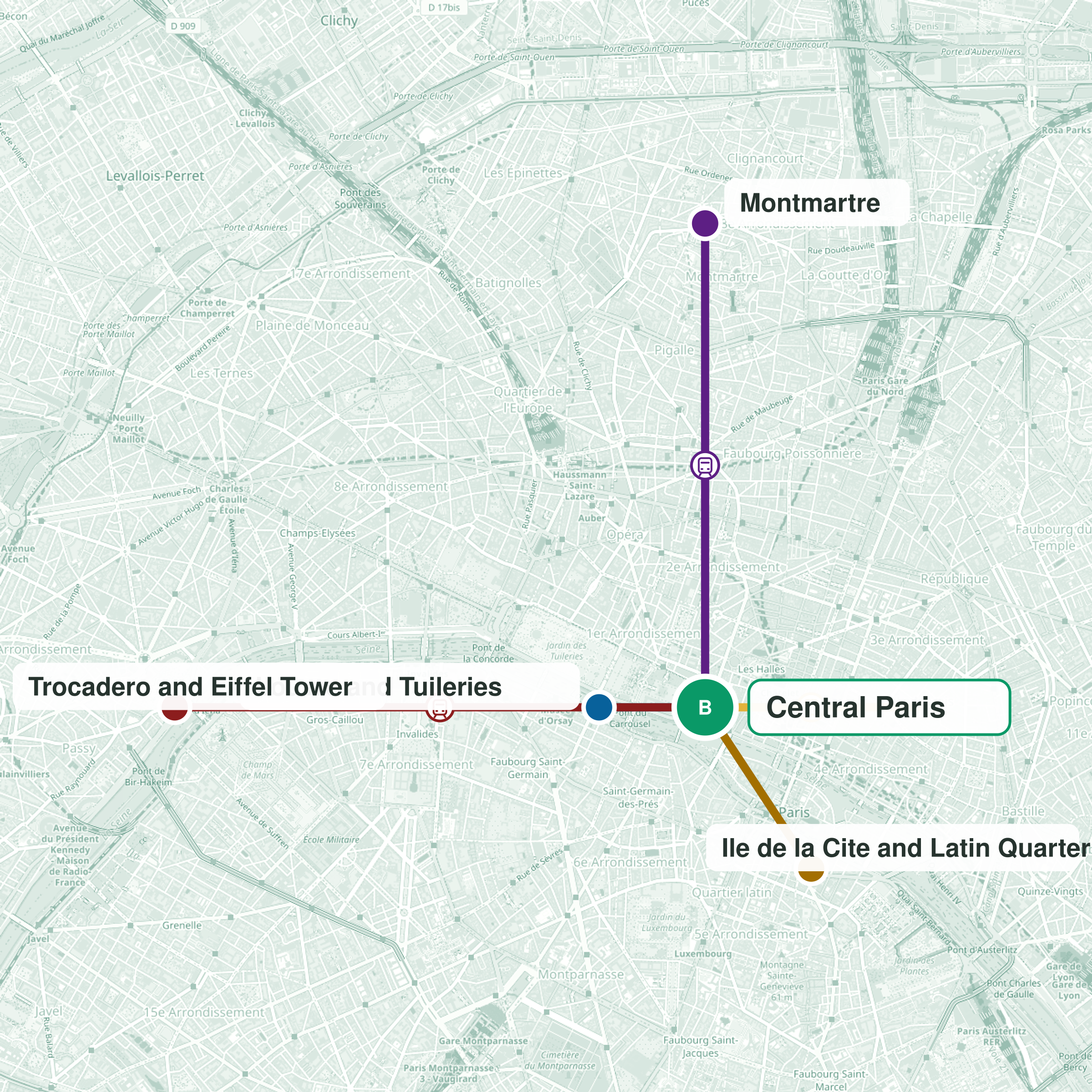
Stay in the Marais, a historic neighbourhood on the Right Bank, with old streets, restaurants, and easy walking access to the Seine. From Orly, Metro Line fourteen reaches Châtelet–Les Halles in about twenty-five minutes, followed by a short walk east. The Latin Quarter is the main alternative, especially if you want a Left Bank base near the Sorbonne and Luxembourg Gardens. But the Marais gives the cleanest balance for this route.
On day one, walk southwest from the Marais across the Seine to Île de la Cité, the island at the medieval heart of Paris. Notre-Dame is more than a cathedral stop. It helps explain why the river became the city’s organising axis. Its restoration also recalls Victor Hugo’s The Hunchback of Notre-Dame, a novel tied to nineteenth-century arguments about protecting medieval Paris and its architecture.
Continue to Sainte-Chapelle, the royal chapel known for its concentrated Gothic interior and stained glass. Then slow down along the riverbanks. This is where Paris starts to make sense as a connected city, rather than a set of monuments. Bridges, bookstalls, public space, and the shifting view between the Right and Left Banks all belong to the same walk.
Leave room for a neighbourhood meal or a café stop here. Make it part of the rhythm of the day, rather than a search for a famous address. Day two continues west along the Seine to the Louvre. Treat it as your one major museum, not as a collection to conquer. Give it three or four focused hours, and choose a small number of sections before you arrive.
The route step by step
The Louvre is the strongest single encounter with Paris as a centre of royal power, state culture, and global art. Trying to see everything turns it into an endurance test. It is closed on Tuesdays, so build the route around that. Afterward, walk into the Tuileries Garden, the formal green space that extends the old royal axis toward Place de la Concorde. The important shift is from enclosed galleries back into the city: art, gardens, and broad public perspectives in one afternoon.
There is no need to turn the Champs-Élysées into a dedicated shopping walk on this first visit. For day three, use the Metro west across the city to Trocadéro. This broad terrace gives the clearest approach to the Eiffel Tower, placing the structure within the wider Paris landscape before you reach it.
Walk down toward the tower, continue through Champ de Mars, and let the monument work as part of the city, rather than only as a ticketed viewpoint. Go up if the view from the tower itself is a priority. Otherwise, the esplanade and gardens give you the essential experience on the ground. From here, you can continue toward Les Invalides for military and imperial history, or return along the Seine for a slower afternoon. For four days, I’d choose the river walk unless that history is a particular interest.
On day four, take the Metro north to Montmartre, the hilltop district that provides the counterpoint to the formal river corridor. Arrive below the hill, then climb through the streets or take the funicular toward Sacré-Cœur. The basilica gives you the citywide view, but Montmartre is more rewarding when you continue past it.
Walk through Place du Tertre and into quieter lanes
Walk through Place du Tertre and into quieter lanes, where the hill still feels more village-like than monumental. Its artistic reputation comes from the nineteenth and early twentieth centuries, when figures including Picasso, Van Gogh, Renoir, and Toulouse-Lautrec were associated with the area. Today it is a mixture of living neighbourhood, heritage landscape, and tourism. That is precisely why the wider walk matters. It gives you more than the square and the basilica alone.
With the central route complete, Versailles is the optional extension. It needs a separate full day and changes the subject from urban Paris to royal court and palace history. Add it only with an extra day, rather than cutting short the Seine walk, the Louvre, or Montmartre. Keep three ideas: use the Seine to make Paris legible, choose one museum and visit it with focus, and pair the Eiffel Tower’s scale with Montmartre’s hilltop streets.
To continue, you can generate Paris Museums Beyond the Louvre. To explore this further, you can generate Versailles as a Day Trip from Paris.