

Introduction
This is Five Cents: travel guide to New Orleans. This is a four-day first visit built around the Mississippi, living music, and the cultural mix that makes the city more than its party image. We’ll walk the historic core, move toward Tremé and Marigny for music, use food to read the city, and leave the wetlands for an extra day.
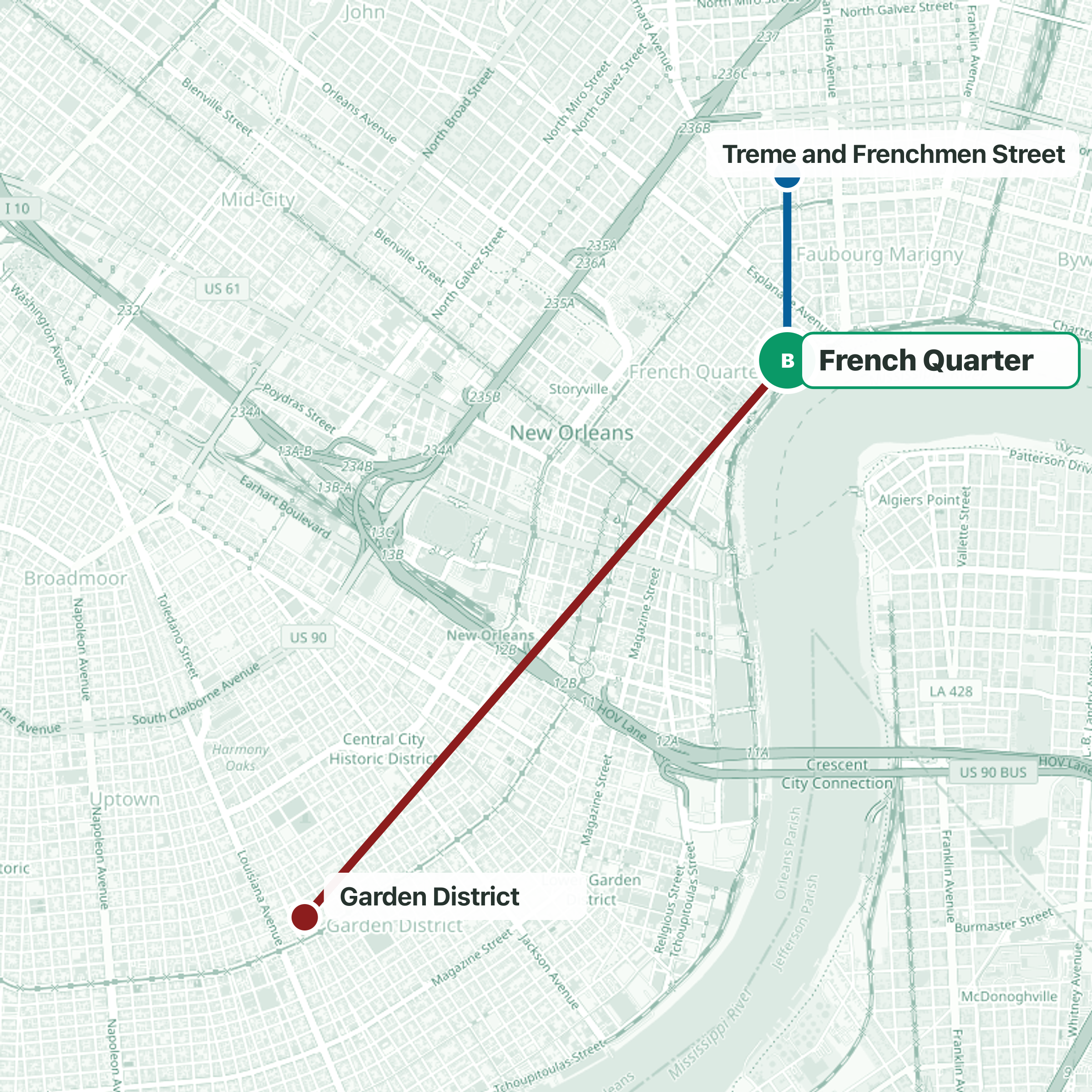
Start with the river
Start with the river, because it explains everything else. New Orleans grew beside the Mississippi, the great river that crosses the United States and made this bend in Louisiana a port city. French and Spanish rule left balconies, courtyards, and a compact street pattern. African, Caribbean, Creole, and later American influences shaped its food, religion, and music.
Stay in one central base near the French Quarter, CBD, or Warehouse District. The core is easy to cover on foot. Begin at the riverfront, then walk into the French Quarter, also called the Vieux Carré: the city’s oldest and best-known district. Around Jackson Square and the quieter side streets, you get the mix of old façades, patios, restaurants, residents, and tourism that defines the area.
Many American visitors find its scale unusually European. For European visitors, the more distinctive point is the cultural mixture behind the architecture. Bourbon Street is nearby, and it is worth a short pass-through. It is the Quarter’s famous party street: loud bars, cheap drinks, crowds, and plenty of bachelor and bachelorette groups.
It can be entertaining, but it is also often tacky. See it as the city’s mass-tourism image, then give your evening to music elsewhere. From the Quarter, walk toward Tremé, one of New Orleans’ historic African American neighbourhoods and a major centre of Creole and musical culture. Here, Creole means an urban culture formed through complex European, African, and Caribbean histories. It is not the same as Cajun, which refers mainly to Acadian communities and traditions developed elsewhere in southern Louisiana.
Tremé helps explain brass bands
Tremé helps explain brass bands, Mardi Gras Indians, and second lines. Mardi Gras is a whole carnival season of parades, costumes, music, and community preparation. A second line is the dancing crowd that follows a band and the main parade group. Music here is public, social, and tied to neighbourhood life.
Then continue downriver to Marigny and Frenchmen Street, a live-music corridor between the Quarter and the Marigny neighbourhood. It is still visitor-facing, but the purpose is clearer: enter a small venue, hear a band at close range, and let the performance be the evening rather than background to a bar crawl.
Jazz lives alongside blues, funk, rhythm and blues, and brass-band traditions. Watch Treme before the trip if you can. The series follows musicians, cooks, and other residents rebuilding after Hurricane Katrina and the floods of two thousand five. It shows that music is work, memory, and community, not decoration. It also makes visible how Katrina displaced people and deepened unequal recovery across the city.
Food belongs in this same story. Try gumbo, a thick stew shaped by several Louisiana traditions, or a po’boy, the city’s everyday filled sandwich. Fried oysters are common. If you are used to raw oysters, you may find frying softens their marine character. Alligator is a local curiosity, not a required meal.
For a change of scale
For a change of scale, take the streetcar toward the Garden District and Uptown for a half-day. The ride matters because it gradually shifts the view from the dense historic centre to broad residential streets, mature vegetation, and large historic houses. With the city understood, use day four for the bayous.
A bayou is a slow, low-gradient watercourse, part of the wetlands, marshes, channels, and flooded ground connected to the Mississippi delta. This is not simply a swamp. On a boat excursion, the city noise drops away as you move through narrow channels or wider marsh, past cypress trees, Spanish moss, and slow water.
Guides point out what can disappear into the vegetation: American alligators in the water or along the bank, plus herons, egrets, and turtles. The point is not an alligator show. It is seeing the water landscape that surrounds and conditions New Orleans. Keep three decisions: begin with the Mississippi, choose Frenchmen Street over Bourbon Street for your main evening, and save the bayou for the wetland continuation of the city.
You can create a new Five Cents episode on Mardi Gras and second-line traditions, or on Louisiana wetlands and coastal loss.