

Introduction
This is Five Cents: travel guide to Netherlands. Plan a week as a southbound rail journey through a country shaped by water, trade, and dense urban life. Do not treat it as an Amsterdam stay with scattered day trips. We’ll connect canals and art, a smaller historic city, Rotterdam’s modern identity, and one landscape that makes Dutch engineering visible.
How to plan the route
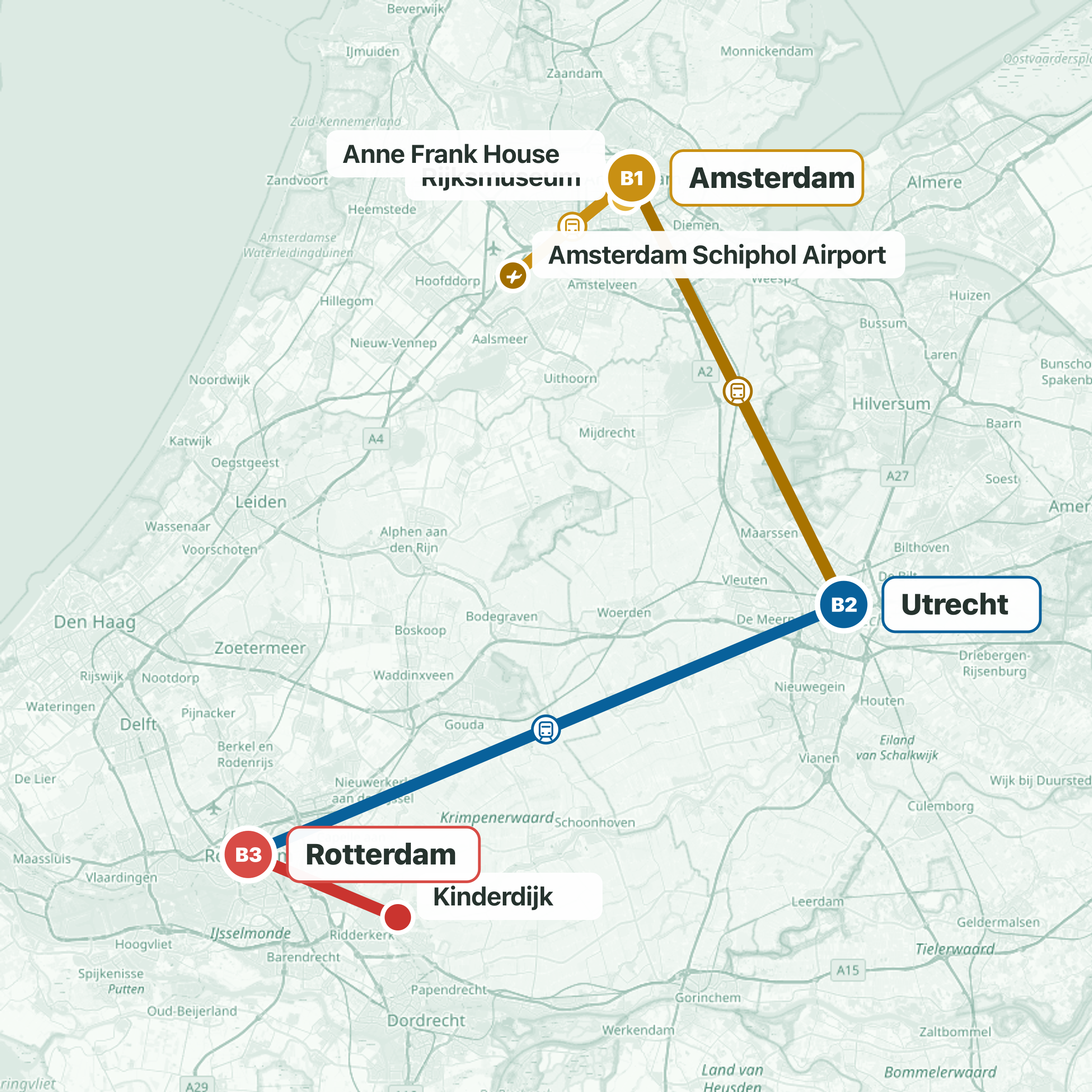
Start at Amsterdam Schiphol Airport and take the train northeast into central Amsterdam. Use trains between cities, then walk or cycle locally. This central corridor gains little from a car. Give Amsterdam three nights. Begin in the Canal Ring, the seventeenth-century expansion that made canals part of the city’s street plan, trade network, and daily geography. Walk through Jordaan, the adjoining former working-class district. Then take a canal cruise in the early evening for orientation.
The point is not simply the views. The water explains how Amsterdam expanded and prospered. On the next day, choose the Rijksmuseum as your main museum. Its paintings, decorative arts, and history connect artists such as Rembrandt and Vermeer to the urban wealth created by maritime trade. That makes it a broader introduction than a single-artist collection.
Keep one further Amsterdam day for the Anne Frank House, where the preserved annex gives The Diary of a Young Girl its exact setting during the Nazi occupation. This is a focused historical visit, not another stop on a checklist. Anne Frank House and the major museums use timed entry, so secure the required slot before fixing that day’s route.
Then take the train southeast to Utrecht for one night. Utrecht is a compact medieval city centred on the Dom area and the Oudegracht, its main canal. What makes it distinct are the lower-level wharves and cellars beneath the streets. Water here is not just an edge to the city, but a layered working space.
Walk the canal and the historic centre. Use a bike for a practical glimpse of how cycling links everyday Dutch urban life. From Utrecht, continue southwest by train to Rotterdam for two nights. Rotterdam is the necessary counterpoint to Amsterdam. Wartime destruction and post-war reconstruction produced a city of modern architecture, broad public spaces, and a port-facing identity.
Start around Rotterdam Central
Start around Rotterdam Central, then walk through the modern centre toward the waterfront. Focus on how the city has been rebuilt, and how its harbour still shapes its scale and character. Rotterdam shows that the Netherlands is not only Golden Age houses and historic canals. It is also experimental, contemporary, and infrastructural.
Use your final full day for Kinderdijk, east of Rotterdam, by local public transport. This UNESCO-listed mill network is the clearest landscape conclusion to the route. Here, windmills, drainage, and low-lying settlement form one system. The mills helped manage water in land that had to be continually made usable. Allow the whole day, rather than treating it as a quick photograph.
By the end, the canals of Amsterdam and Utrecht, Rotterdam’s port, and Kinderdijk’s dikes and mills read as parts of the same national story. Leave Delft, The Hague, the coast, and the Wadden Islands for a separate extension. Delft is the better choice when Vermeer and ceramics matter more than water engineering. The Wadden Islands suit a slower nature trip built around dunes, tidal landscapes, and cycling. In spring, the bulb region can replace a countryside stop, but it should not displace Amsterdam’s core cultural day.
Keep three decisions in mind. Take the train from Amsterdam through Utrecht to Rotterdam. Read Amsterdam’s canals and art through trade and water. And choose Kinderdijk to understand infrastructure as cultural heritage.
To continue, you can generate Dutch bulb region and North Sea coast in spring. To explore further, you can generate Wadden Islands: a slow cycling and tidal landscape itinerary.