

Introduction
This is Five Cents: travel guide to Mexico City. This first visit is organised by area, rather than as a checklist of attractions. That way, you can understand a city that is Mexica, colonial, modern and still connected to water.
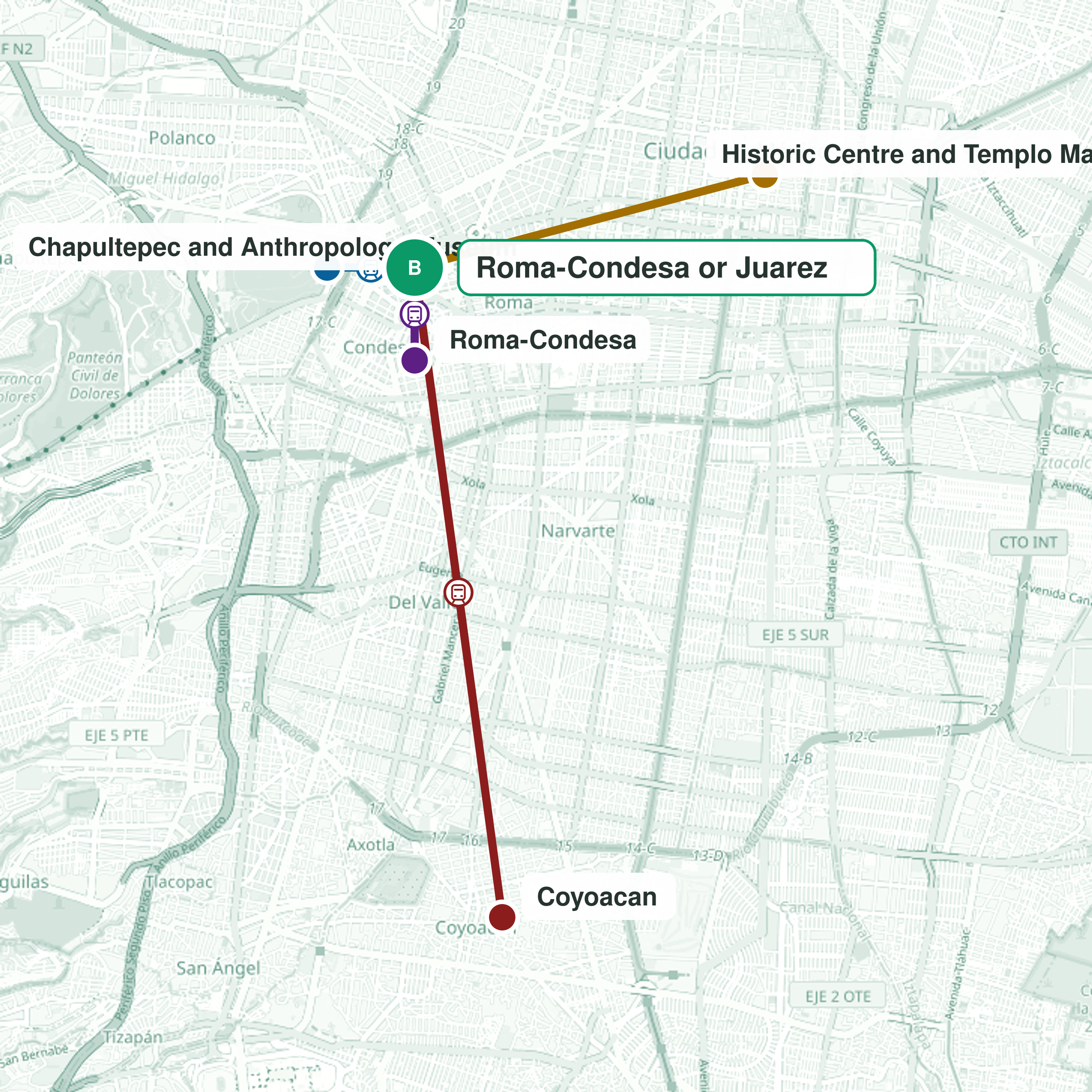
The five-day route starts in the Historic Centre
The five-day route starts in the Historic Centre, continues through Chapultepec, heads south to Coyoacán and leaves the major excursions until the end. The principle is simple: each neighbourhood deserves its own day. Start by choosing a single base, preferably Roma-Condesa or Juárez. From there, walk around your local area, use the Metro or Metrobús along the main corridors, and take an app-based ride when it saves time between distant areas.
Renting a car does not improve this itinerary. The trip works better when each day stays within one part of the city. Begin in the Historic Centre, the city's old heart. Tenochtitlan stood here, with the colonial and republican capital built over it. Start at the Zócalo and visit Templo Mayor, the archaeological site preserving part of the main Mexica ceremonial precinct. This visit makes sense of everything that follows. It shows how colonial buildings did not entirely replace the earlier city: they grew on top of it.
Then walk past the Metropolitan Cathedral, through the shopping streets and towards Alameda Central and the Palace of Fine Arts. This walk brings together centuries of religious, institutional and cultural architecture, without requiring a succession of indoor visits. For a deeper visit, choose one building. The Palace of Fine Arts suits an interest in architecture, murals and cultural life. The National Palace offers a reading of Mexico's political history through Diego Rivera's murals. Do not try to explore both thoroughly on the same day.
The second day changes the scale. From the centre, head towards Reforma and Chapultepec, a large urban park offering two different perspectives on Mexico. The National Museum of Anthropology deserves at least half a day. Its collections connect the Mesoamerican world with contemporary Indigenous peoples, providing context for both Templo Mayor and Teotihuacán.
The route step by step
Choose particular galleries rather than trying to cover the whole museum. With enough time, continue through the park to Chapultepec Castle, now the National Museum of History. While Anthropology takes an archaeological perspective, the castle explores the colonial period, independence, foreign interventions and the formation of the Mexican state.
Reforma connects the park with the contemporary city. It does not need to become another lengthy visit. On day three, head south to Coyoacán, an old district with squares, gardens, historic streets and a market. Explore it on foot as a neighbourhood, at a different pace from the centre. Casa Azul, the Blue House, is a specific choice for anyone wanting to explore Frida Kahlo, Diego Rivera and their connections with Coyoacán. The area's appeal does not depend on that one house.
This variety also helps explain an unequal, layered metropolis. Luis Buñuel's film The Young and the Damned can accompany the trip as a portrait of urban tensions in the mid-twentieth century, rather than an image of today's city. Leave room for Roma-Condesa on the fourth or fifth day. From a nearby base, explore on foot or by ECOBICI, passing parks, residential architecture, cafés and contemporary urban life.
It provides a welcome pause after several days of monuments: a chance to see how people live in the city, without turning the walk into a list of restaurants or shops. Once the urban route is complete, consider the excursions. Teotihuacán, outside the city, is the most valuable extension for understanding the scale of pre-Hispanic Mexico. It was one of Mesoamerica's great cities and needs a full day, including the road journey and the walk along its monumental axis.
Give it that whole day
Give it that whole day. Do not combine it with the Historic Centre or Chapultepec. With only three days in Mexico City, prioritise the three main urban areas and leave Teotihuacán for another visit. Xochimilco offers a different alternative with five days or more, if you prefer to explore the city's connection to water. Its canals and chinampas preserve the memory of the watery landscape where Tenochtitlan began.
Allow a generous half-day or a full day, rather than adding it as a quick stop after Coyoacán. It offers a tangible reminder that this capital is more than stone, traffic and museums. Remember three decisions: start in the centre to understand the city's layers; set aside Chapultepec to understand Mexico through its museum and park; and avoid crossing the metropolis without a clear purpose.
To explore further, you can generate another Five Cents asking: how can I explore Teotihuacán in depth? Or, what can I discover at University City through UNAM's murals?