

Introduction
This is Five Cents: travel guide to Mexico. We’ll plan a first week by choosing a few regions and connecting them sensibly, because long distances make the scope of your trip the most important decision. The route pairs a capital that provides context with a city that reveals a different regional history. Then we’ll consider an optional day trip and what extending the journey involves. Let’s start by dividing up the time.
How to plan the route
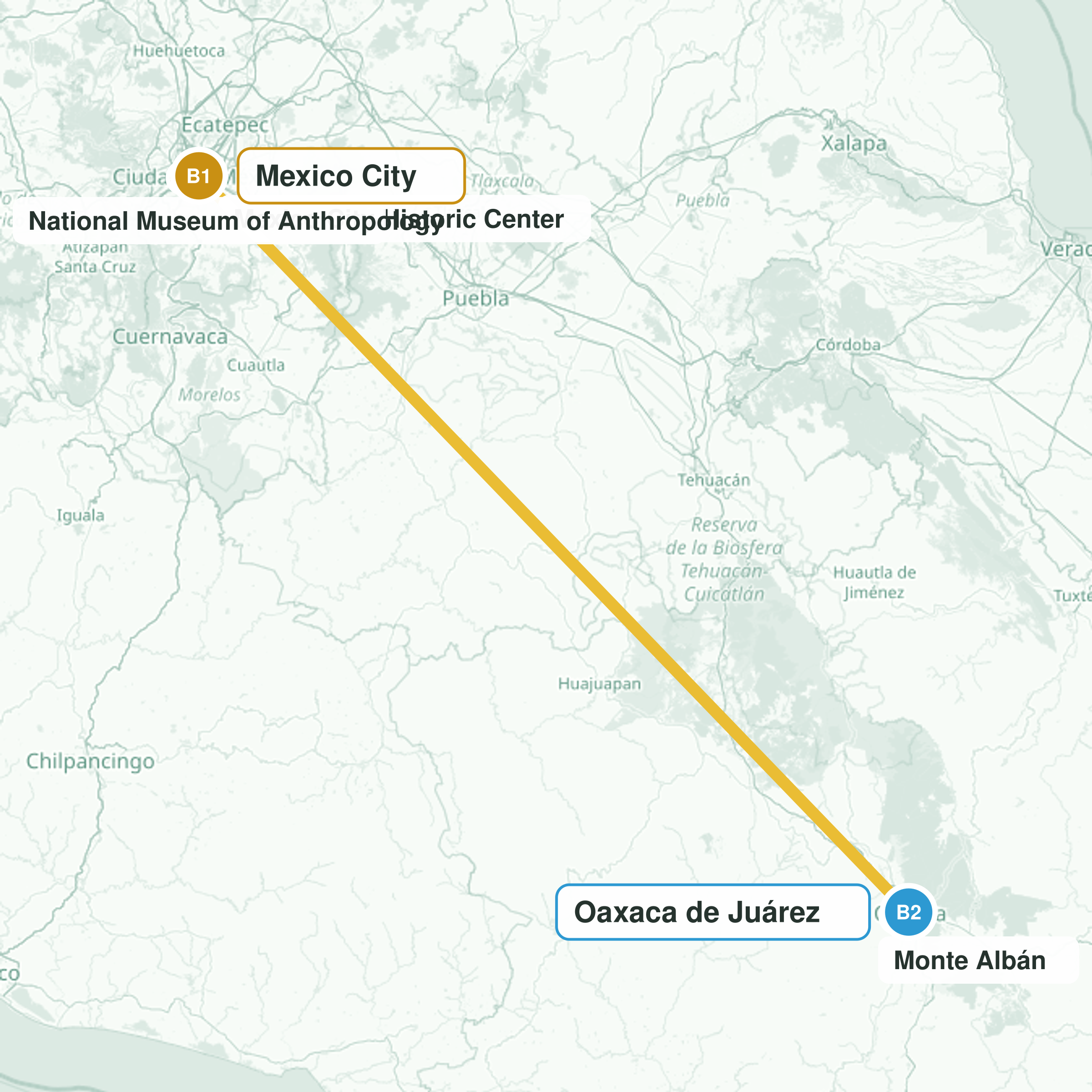
Spend four days in Mexico City and three in Oaxaca de Juárez. These are your two bases, connected by a southbound bus journey of around six or seven hours. That journey takes up a substantial part of a day and needs space in the itinerary. Day five is for continuing to Oaxaca, leaving the next two days for the city and its archaeology.
To add the Yucatán Peninsula, a region with Maya heritage, extend the trip to around two weeks and include a flight connection. That extension needs time of its own. For this week, the priority is getting to know the two chosen regions rather than spending several days moving between them. Mexico City is a contemporary metropolis where the legacy of Tenochtitlan, the former Mexica capital, overlaps with the colonial period and the modern city. Begin with an introductory urban walk, then devote day two to the historic center.
Here, the experience is about walking and connecting those historical periods with the spaces of today’s capital. Its appeal lies both in the history and in seeing how these spaces remain part of a living city. Set aside day three for the National Museum of Anthropology, which brings together heritage and context from pre-Hispanic cultures. This visit helps you distinguish between peoples and regions before continuing your journey.
Rather than trying to take in every object, aim to leave with one clear understanding: the history you’ll encounter in Oaxaca belongs to a distinct tradition and deserves to be understood on its own terms. The historic center and the museum complement each other. One shows how different periods share an urban space; the other provides a framework for understanding that diversity.
Keep day four flexible for exploring more of the capital
Keep day four flexible for exploring more of the capital. This gives the contemporary city a place in your visit alongside its major historical landmarks. From Mexico City, continue south by bus to Oaxaca de Juárez. On arrival, the scale of the trip changes: your second base is a historic city connected to its valley and to Zapotec culture.
Start by exploring its center, where the colonial street layout still serves everyday life. Walking here lets you see a functioning city as well as appreciate its heritage. The main visit from this base is Monte Albán, a former Zapotec capital above the Oaxaca Valley. Leave from the city and return to the same accommodation after exploring the site.
Its elevated setting and the scale of its ceremonial center bring landscape and history together. It adds depth to the trip without requiring another change of accommodation. Give it day six in this itinerary. The aim is to understand the layout and size of an ancient city, and its relationship with the valley.
One distinction matters here: Monte Albán belongs to Zapotec history, which is different from Yucatán’s Maya heritage. That difference explains what Oaxaca adds to the journey. Day seven is for Oaxaca’s historic center. After Monte Albán, this walk connects two different periods in the region: the ancient capital above the valley and the colonial city that remains an everyday living space. Experiencing both is the reason to spend time at this base.
With the main route covered
With the main route covered, there’s one optional excursion from Mexico City: Teotihuacan, an ancient archaeological city whose broad avenue reveals the scale of the site. It particularly suits anyone who wants more time with archaeology. Use it to replace the flexible city day on day four, returning to the same base rather than adding a day to the trip.
Exploring the site takes around three to five hours, plus travel time. That’s why it needs the full day: walking the avenue and exploring the complex is the main experience, not a quick stop before continuing to Oaxaca. Remember three decisions: a week gives you time for two regions, not the whole country; the capital provides context, while Oaxaca reveals a distinct regional history; and you can visit Monte Albán from Oaxaca without adding another base.
To continue, you can generate another Five Cents with the question “How can I plan Mexico City and its surroundings?” You can also create “How can I explore Yucatán with up-to-date access and transport information?” to develop that region into a trip with time of its own.