

Introduction
This is Five Cents: travel guide to Lombok. Plan seven to nine days as an island circuit, not a stay in Kuta or a quick detour to the Gilis. You’ll start with southern surf, climb through Sasak countryside and Rinjani’s highlands, then return along the west and southwest coast.
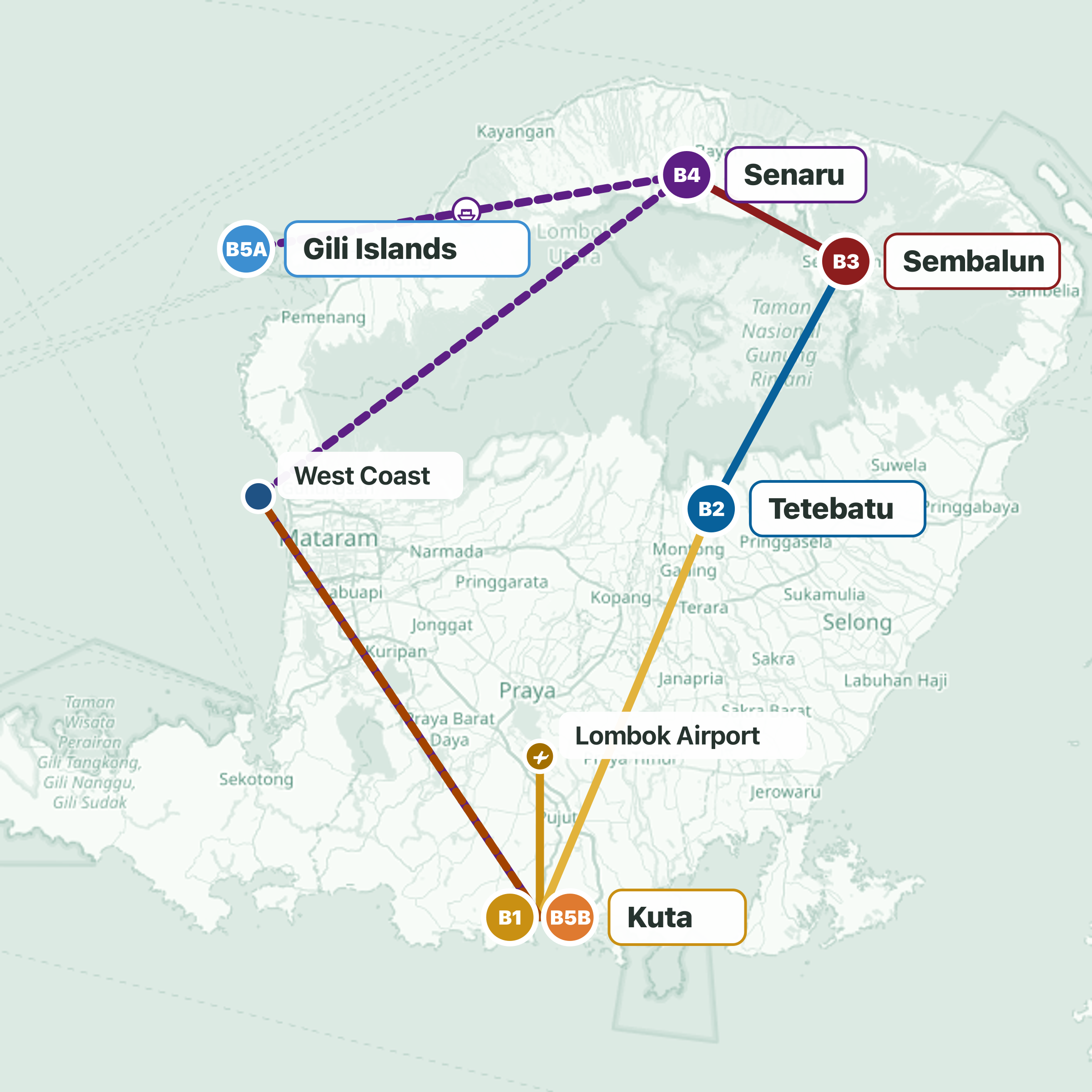
How to plan the route
The right first decision is to fly into Lombok International Airport and take the short road transfer southwest to Kuta. Kuta is the best opening base for two or three nights. It has the island’s main concentration of cafés, restaurants, surf schools, and visitor services. But it is only the first chapter. Lombok is predominantly Muslim and shaped by Sasak culture, with a rhythm and settlement pattern distinct from Bali.
A motorcycle gives the route its freedom, especially for beach stops and rural roads. A car with driver is the practical alternative. Begin on the south coast at Tanjung Aan, a broad bay that works for both a beach day and accessible surf. The break is reached by a short boat ride. When conditions suit, its long lefts and rights are friendly to beginners and intermediates, with longboards often in the water.
The shore itself remains lightly built, so there is still room to spend the day swimming or simply staying on the sand. Gerupuk, nearby, is the useful comparison. It is a surf village with several boat-accessed peaks. Inside is the common choice. Don-Don is close by, and the outer breaks demand more skill.
But Inside can be crowded with surf schools. Walk through the village calmly and compare boats, boards, and schools before choosing. For an independent surfer looking for a less school-dominated session, Tanjung Aan is the stronger default. Before leaving the south, make a short stop in Sade, a Sasak village near this part of the route. The point is not to treat it as a museum set, but to understand weaving as living identity and craft knowledge.
Textiles such as songket and ikat connect household work
Textiles such as songket and ikat connect household work, community life, and tourism in a way that helps explain a Lombok beyond beach resorts. From Kuta, head northeast to Tetebatu, on Rinjani’s southern slopes. Stay the night. This is where dry bays give way to rice fields, farms, and paths between villages.
Rural accommodation and small meals sit within the landscape rather than along a resort strip. The overnight makes that change feel like a real stage of the trip. The next morning, continue northeast around the Rinjani massif towards Sembalun. Treat this road as one of Lombok’s main experiences, not as a transfer to rush through.
Leave in daylight, drive steadily, and let the altitude change the journey. Sembalun is a cooler, green high valley, with cultivated fields, strawberries, and wide views towards Mount Rinjani. At Bukit Selong, one elevated stop is enough to understand the valley’s scale. Fields spread below the mountain rather than beside the sea.
Spend a night here, then descend west along Rinjani’s northern side to Senaru. The landscape turns wetter and more forested. Senaru is another gateway to the mountain, but its priority for this route is Sendang Gile and Tiu Kelep, two waterfalls linked by short walks. They give you a close experience of Rinjani’s water and forest without confusing it with the summit trek.
That trek is a separate decision
That trek is a separate decision. Add two or three days for substantial ascent, loose ground, heat, early starts, and nights on the mountain. It is not a day trip to squeeze into the circuit, and current route availability is determined by the national park. From Senaru, continue west to the north coast, and then south along the western shore. Bangsal is the usual Lombok departure point for the Gili Islands, but keep them as an extension.
One or two nights suit travellers who specifically want swimming, diving, snorkelling, or island nightlife. Gili Trawangan is the biggest and most social. Gili Meno is quieter. Gili Air sits between the two. They are developed islands, not a remote escape, and they should not replace Lombok’s own range of landscapes.
Continue through the Mataram area, using it as a practical waypoint rather than a major sightseeing base. With a full itinerary, keep the western and southwestern coastal return towards Kuta or the airport. Stop selectively for a swim, a meal, or a view, and let this final road section complete the shift from highland forest back to the coast. If time is short, return south on the main road instead.
Remember the three decisions that make Lombok work. Begin in Kuta, but leave it behind. Make the Tetebatu-to-Sembalun road a central experience. And keep both the Gilis and Rinjani trekking as additions rather than substitutes for the circuit. You can create a new Five Cents episode on Lombok’s surf breaks from Tanjung Aan to Gerupuk, or on Rinjani trekking and waterfall routes.