

Introduction
This is Five Cents: travel guide to Japan. Plan your first trip as one focused rail journey. Go from Tokyo’s contemporary scale to Kansai’s historic cities and food culture, rather than trying to collect the whole country. We’ll map the right length, the westbound route, and the stops that give each city a distinct role. Start by choosing the corridor, because that decision protects everything that follows.
Ten days is the strongest first itinerary
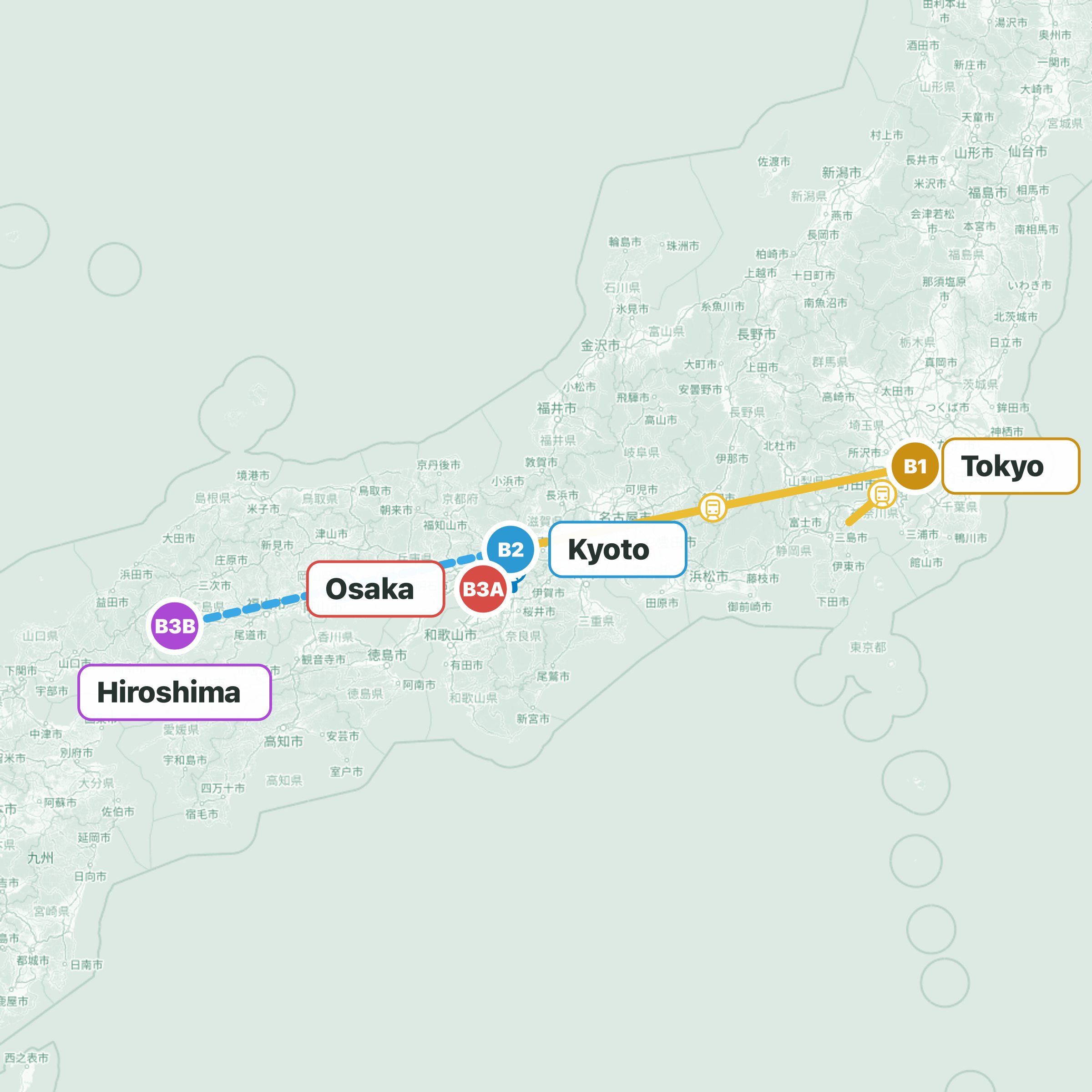
Ten days is the strongest first itinerary. Arrive in Tokyo, continue west to Kyoto, take Nara as a day trip, add Hiroshima and Miyajima, then finish in Osaka. With seven days, keep Tokyo, Kyoto, Nara, and Osaka. Save Hiroshima for another time. If flights allow it, arrive in Tokyo and depart from Osaka’s Kansai airport, so you do not retrace the route.
Use the Shinkansen between regions and local rail within cities. Tokyo to Kyoto takes about two hours and fifteen minutes on the fastest Nozomi services. Buy ordinary tickets, or compare a rail pass against your actual long-distance journeys. It is not automatically the best choice. Give Tokyo three nights.
Begin in Asakusa, a historic district centered on Senso-ji, Tokyo’s oldest temple. Its gate, temple grounds, and traditional shopping streets give the city a religious and commercial past that remains visible inside a vast modern metropolis. Then make one connected modern-city outing through Shibuya and Shinjuku. Shibuya brings the crossing, retail, and constant movement. Shinjuku adds one of the world’s great rail hubs, towers, and evening life. Together, they explain Tokyo better than hopping between several similar shopping districts.
Yasujirō Ozu’s Tokyo Story is a useful counterpoint before the trip. It looks beyond the neon image toward generational change, and the tension between urban life and quieter rhythms elsewhere in Japan. From Tokyo, take the Shinkansen west to Kyoto for three nights. Kyoto is where temples, gardens, wooden streets, and political history form a cultural landscape. But it works only if you keep each day geographically compact.
Start in eastern Kyoto with Kiyomizu-dera
Start in eastern Kyoto with Kiyomizu-dera, a temple complex on a hillside. Then walk the historic lanes below it. The value is the connection between religious architecture, elevated views, and the old urban fabric, not simply ticking off another temple. Balance that with Nijo Castle, a former shogunal residence. It shows how Kyoto was shaped by warrior government, as well as court culture and religion.
Add Nishiki Market as a compact food stop. Its long association with ingredients and culinary goods helps explain Kyoto’s refined food traditions. Give Kyoto more time than Osaka on a first cultural trip. Its important areas are dispersed, and rushing across town turns the city into a checklist. From Kyoto, travel south by regional train for roughly an hour to Nara.
This former capital is more than its free-roaming deer. Nara Park is an open sacred landscape where parkland, temple precincts, and monumental Buddhist architecture meet. Its centerpiece is Todai-ji, one of Japan’s most important Buddhist complexes and home to the Great Buddha. Spend enough of the day walking between the park and the temple to understand why Nara adds a different, earlier layer of history to Kyoto, without demanding another hotel change.
For a ten-day trip, continue west beyond Kansai to Hiroshima and Miyajima for two nights. Hiroshima’s Peace Memorial Park, Atomic Bomb Dome, and museum give the route a direct encounter with destruction, memory, and postwar reflection. Treat this as an overnight stop, not a rushed detour. Then use most of a day for Miyajima, an island in the Seto Inland Sea whose Itsukushima Shrine creates a very different religious landscape.
Key stops and decisions
Together, Hiroshima and Miyajima shift the journey from city and heritage sightseeing toward history and remembrance. Return east to Osaka for your final one or two nights. Osaka is the food-and-nightlife finale, not just a transfer point. In Dotonbori and the wider Minami district, canal-side neon, food streets, and evening crowds show a more informal, outward-looking urban culture than Tokyo.
Make this your place to eat through the evening and feel the city’s public food culture at street level. A nature stop such as Hakone belongs on a longer trip, but keep it separate from this core route. Japan’s strength is contrast, and the route works because each stop has a clear job. Remember three decisions: choose one central corridor, give Kyoto time without scattering visits across the map, and let Osaka close the trip with food and evening energy.
For your next Five Cents episode, you could make Tokyo beyond the first visit, or Hiroshima and Miyajima in depth.