

Introduction
This is Five Cents: travel guide to Italy. For a first trip, the goal is not to collect famous names, but to follow one clear northbound journey through three very different cities. We’ll set the right length, use rail to connect Rome, Florence and Venice, and give each city the time its character demands. Start with the route, because Italy makes most sense here as a sequence of regional worlds.
Give it eight or nine days
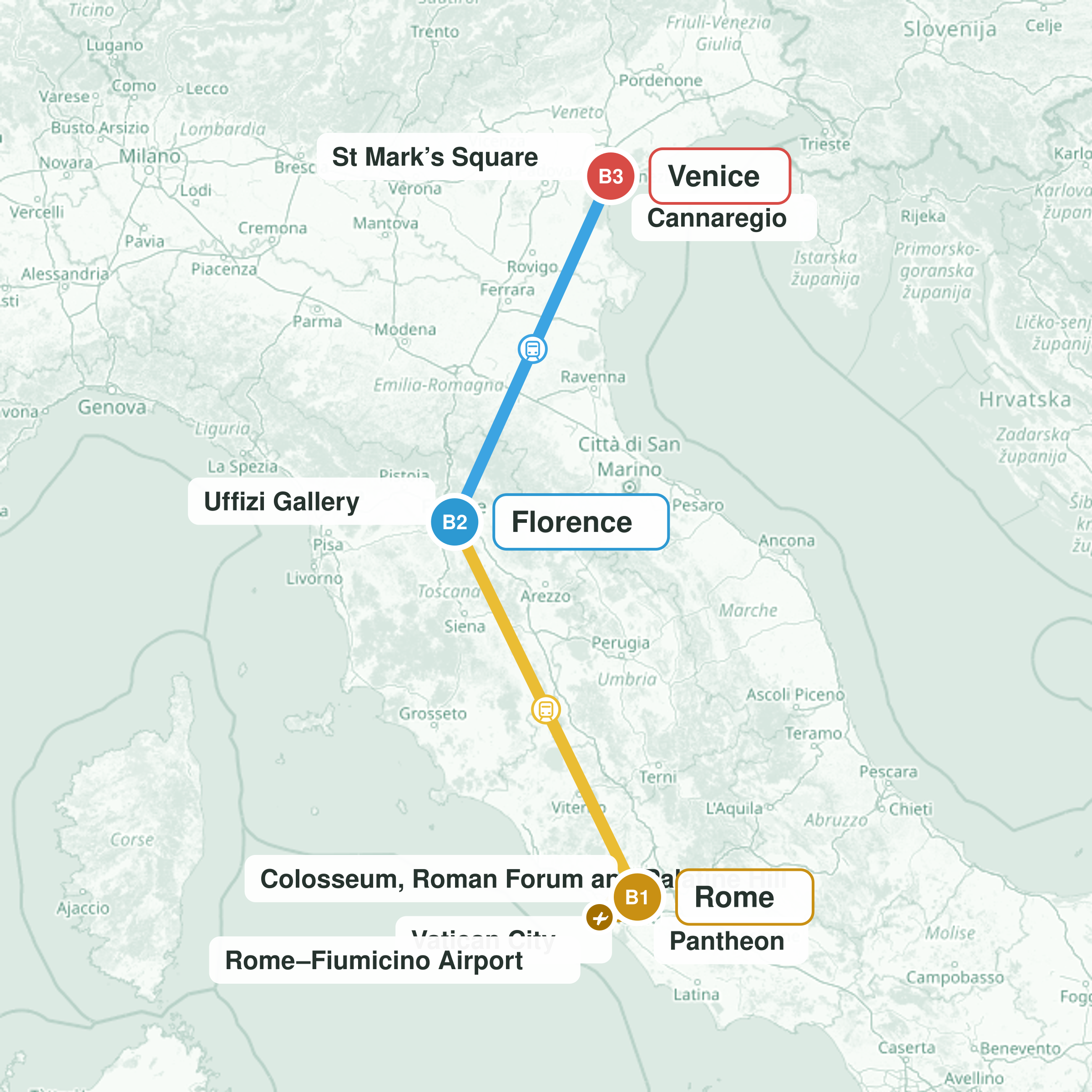
Give it eight or nine days: four nights in Rome, two in Florence, and two or three in Venice. Arrive in Rome, usually through Fiumicino, then rely on high-speed trains between city centres. A car adds little on this route. The main sights are in historic cores built for walking. The larger point is cultural as much as practical. Italy is a national country with strong regional identities, visible in its architecture, history, daily rhythm and food.
Rome is the foundation. From Fiumicino, take the rail transfer northeast into central Rome, and use the first day for orientation on foot. Rome is not one preserved ancient site. It layers imperial ruins, papal power and a modern capital across a large city. Before arriving, The Great Beauty, or La grande bellezza, is a useful atmospheric companion. It captures the collision of monuments, Catholic imagery and contemporary life, rather than offering a factual portrait.
On your first full day, walk southeast from the historic centre to the Colosseum, Roman Forum and Palatine Hill. Treat them as one archaeological landscape: the amphitheatre, the political and commercial centre of ancient Rome, and the hill associated with the city’s earliest elite life. Together, they make imperial Rome spatially legible. Reserve this visit around the rest of the day, because Colosseum entry is timed.
Give another day to a walking circuit through the historic centre. Use the Pantheon as its anchor, and link the Trevi area with Piazza Navona. This is where Rome’s layers feel most immediate: an ancient temple transformed into a church, Baroque squares, fountains and everyday streets, all within the same walk.
On the fourth day
On the fourth day, devote a serious half-day to Vatican City, the independent city-state and centre of the Catholic Church. Its scale and collections deserve focused time, rather than a rushed add-on. Eat in the city where you are staying. Roman cooking and trattoria culture are part of how this stage differs from the next one.
Then travel north to Florence by high-speed train, a journey of just over an hour and a half. Florence is smaller and far more concentrated than Rome, so the change is immediate. It can be understood largely on foot. Use your arrival afternoon for the historic centre, then make the Uffizi Gallery your one major museum. The Uffizi turns the Renaissance from a label into something visible through painting and sculpture by Florentine and Italian masters.
Outside the museum, Florence makes more sense when you see art as civic language. Wealthy families, guilds and religious institutions used patronage to signal authority, devotion and competition. That is why the city’s art, churches and public spaces feel connected, rather than separate attractions. Give Florence two full days, and leave room to notice the Tuscan shift in food culture, rather than treating Italian cooking as one national menu.
From Florence, continue northeast by high-speed train to Venice. The final stage changes the geography of the whole trip. Venice is a historic city spread across islands, bridges and waterways in a lagoon, where water functions as part of the street system. Arrive with time to get lost on foot, then spend one full day around St Mark’s Square, the monumental core that concentrates the city’s political and religious history.
Your next day should move beyond that centre to Cannaregio
Your next day should move beyond that centre to Cannaregio, a residential district north of the busiest route. Walk its canals and smaller streets, then take a vaporetto, Venice’s public water bus, for the lagoon perspective that walking cannot provide. The experience explains why Venice needs more than a day trip. Its identity lies in both the landmark city and the slower movement between water, bridges and neighbourhood life.
With the core route complete, extensions should change the trip rather than crowd it. Bologna fits naturally between Florence and Venice for a food-focused rail journey. Naples and Pompeii work better as a southern extension from Rome, adding a different urban intensity and Roman archaeology. Tuscany’s countryside deserves an additional day and a dedicated plan, rather than being squeezed into Florence.
Keep three decisions in mind: choose three contrasting cities rather than a national checklist, take high-speed rail north from Rome through Florence to Venice, and give Venice time to walk and travel by water.
To continue, you can generate Five Cents: Naples and Pompeii from Rome. To explore the food route further, you can generate Five Cents: Bologna and Emilia-Romagna by train.