

Introduction
This is Five Cents: travel guide to Istanbul. Plan four full days around a city where imperial landmarks, working market streets, and contemporary neighborhoods are connected by water. We’ll use one base, move through neighboring districts in sequence, and make the Asian shore part of the trip with an ordinary public ferry.
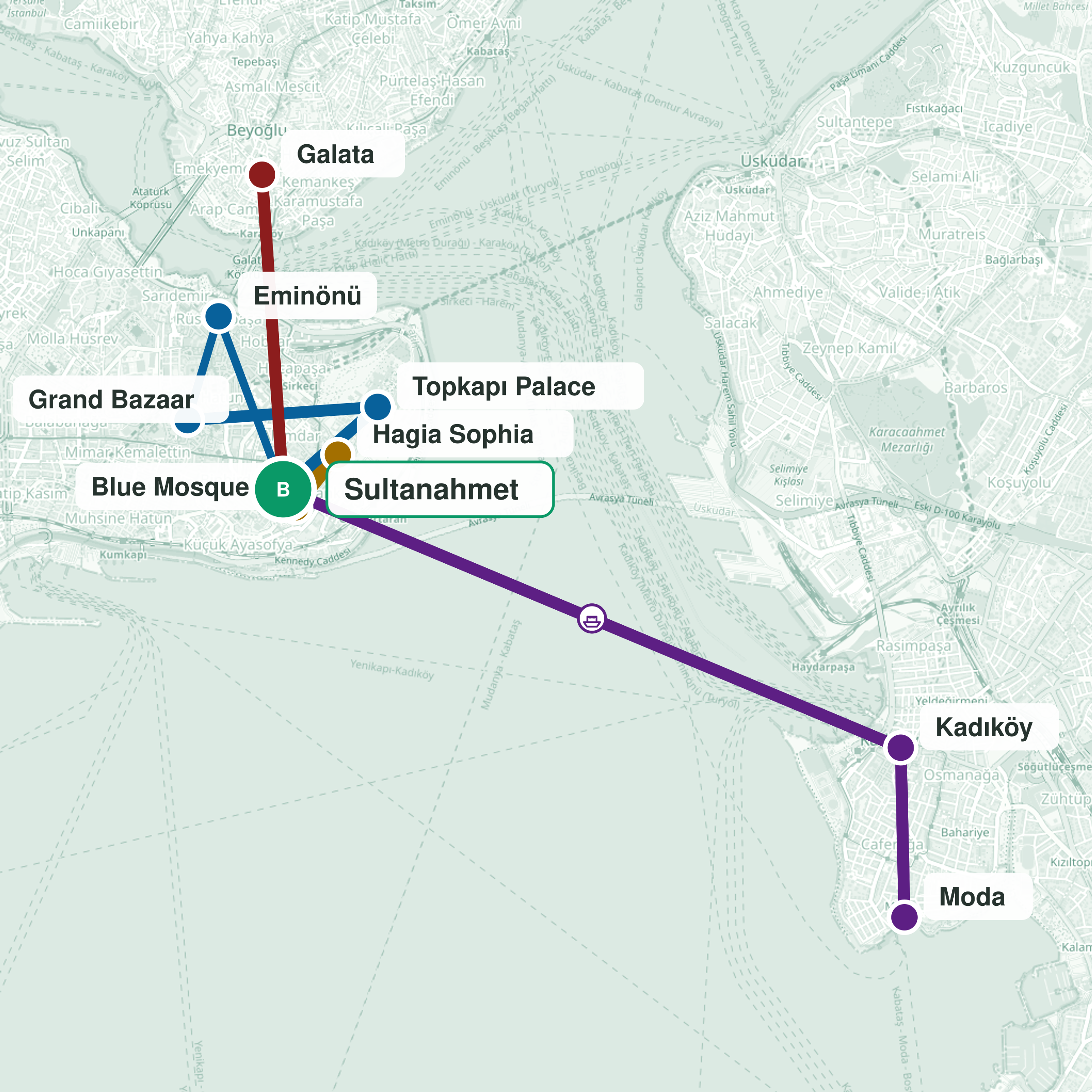
How to plan the route
Start by choosing a base that keeps the first two days together. Stay in Sultanahmet, the main imperial landmark district on the historic peninsula. Four full days give you a focused first visit. A fifth gives you room to return to the peninsula at a slower pace. Keep the same accommodation throughout. The variety comes from changing districts, rather than changing hotels.
Your arrival arrangements depend on which airport your flight uses. Once settled, build the trip around walking, rail, and ferries. These connect the areas in this route more naturally than a car. The important planning unit is the neighborhood. Spend time within one area, then make a deliberate move to the next.
Day one belongs to Sultanahmet. Hagia Sophia, the landmark associated with the city’s Byzantine imperial history, and the Blue Mosque, its Ottoman counterpart across the square, give you a clear starting point. Explore them together, with time for the shared space between them. Their proximity makes successive periods of Istanbul’s history visible within a single walk.
This is the context that matters throughout the peninsula: Istanbul developed through successive Byzantine and Ottoman imperial capitals. The buildings belong to different periods, but they now sit within the same working city. Give this district a substantial day, allowing the landmarks and their surroundings to make sense together.
Begin day two nearby at Topkapı Palace, the former Ottoman palace complex. Set aside a focused half-day. This is a different experience from the facing landmarks of the previous day. You’re exploring a palace complex associated with imperial government, rather than moving between monuments around a square. Giving it its own block of time makes it a meaningful visit instead of a hurried stop.
For a five-day trip
For a five-day trip, use the additional day for an unhurried return to the historic peninsula. That gives you breathing room while keeping the same base and geographic focus.
After the palace, spend the remaining half-day moving through the peninsula’s commercial streets. Your main market stop is the Grand Bazaar, a large historic covered market made up of a network of streets and shops. Walk through it for its scale, covered architecture, and continuing commercial activity. The experience is worthwhile even without a shopping agenda. The market’s structure is as important as what is sold inside.
From the bazaar area, continue toward Eminönü, the waterfront district with ferry piers at the edge of the Golden Horn, the inlet separating this peninsula from the districts beyond. This part of the walk connects imperial Istanbul with the city in motion. Market streets lead toward a working waterfront, where crossings become part of the urban map.
On day three, return toward Eminönü from your base and cross the Golden Horn to Karaköy, the waterfront neighborhood on the other side. The T one tram connects Sultanahmet, Eminönü, and Karaköy. Combine it with walking for this stage.
From Karaköy, climb toward Galata, the hillside district above the waterfront, then continue uphill into Beyoğlu, an area shaped by later commercial and cultural life. Allow at least half a day for this sequence. The changing streetscape is the main experience: waterfront below, hillside streets above, and another architectural layer as you continue. The climb helps you understand how these districts fit together.
Key stops and decisions
Orhan Pamuk’s book, Istanbul: Memories and the City, is a useful companion here. Its personal memories and attention to changing streets help you notice the city beyond its major monuments. Read it as one writer’s perspective on urban life and change, rather than as current practical guidance.
Day four takes you across the water. From your base, head to the European waterfront and take a public ferry to Kadıköy, a district on the Asian shore. The crossing does two jobs: it moves you into another part of Istanbul and shows how water organizes everyday travel.
From the pier, walk into Kadıköy’s market streets, then continue toward Moda, a neighboring area with cafés and contemporary cultural life. Give this shore the day. Make time for food and a café stop along the walk. After two days centered on imperial history and another on the European hillside, this adds a present-day neighborhood experience to the journey.
Keep three decisions in mind: one Sultanahmet base for four full days, or five at a slower pace; visits grouped geographically; and an ordinary ferry crossing that makes the Asian shore part of your trip.
To continue, you can generate another Five Cents asking: How should I explore Topkapı Palace in half a day? Or: How should I plan a Princes’ Islands day trip from Istanbul?