

Introduction
This is Five Cents: travel guide to Indonesia. A rewarding first visit starts by choosing a connected part of this archipelago, where cultures and landscapes change substantially between islands. This guide follows a twelve-to-fourteen-day journey, from Java’s religious monuments to Bali’s living agricultural landscape. Komodo is reserved for a longer trip.
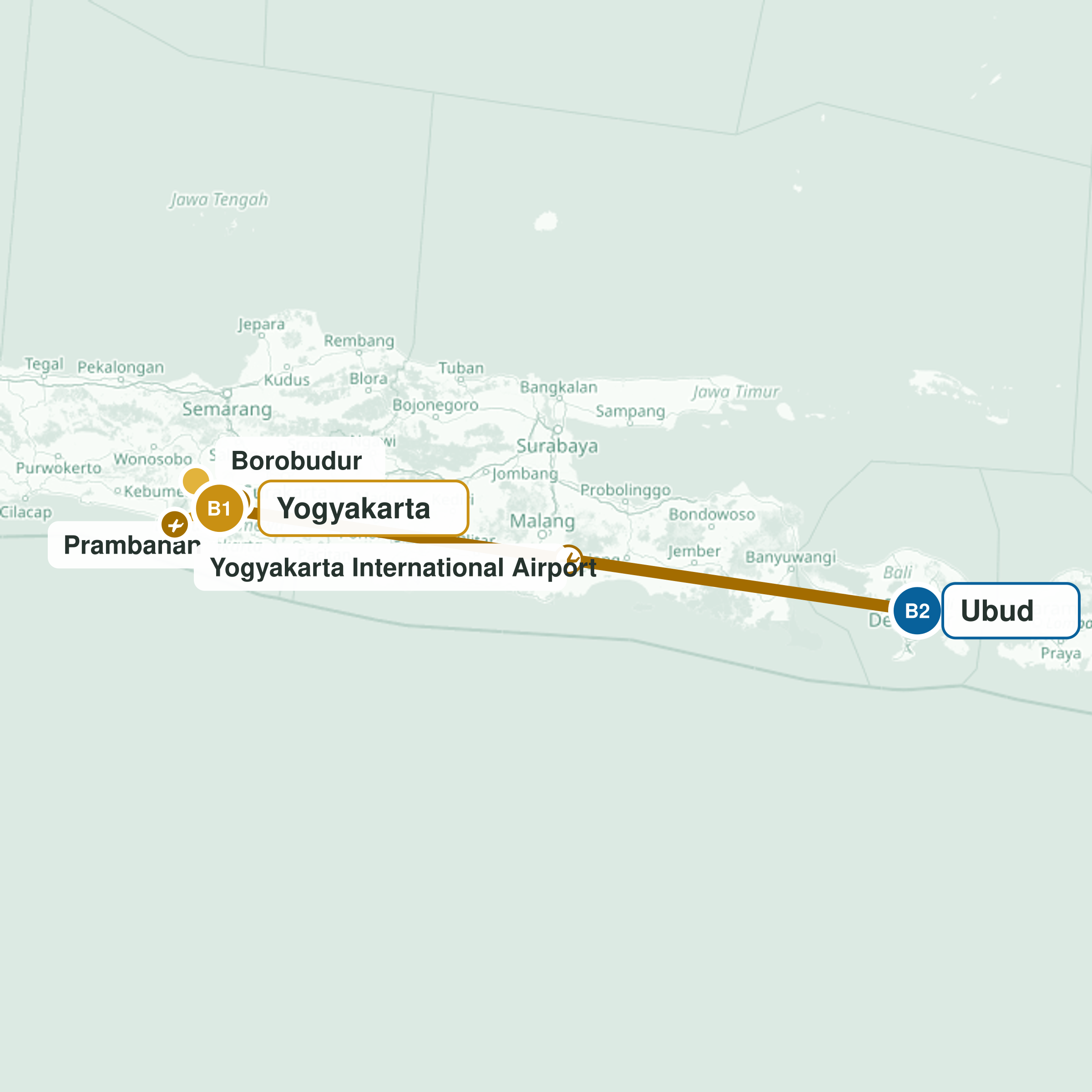
Start with the scale of the journey
Start with the scale of the journey, because that determines how much you can genuinely experience. Allow roughly four cultural days around Yogyakarta, a city on Java, and six or seven days in Bali. Across the trip, leave another two or three days for arrivals, transfers, and breathing room. Those travel days belong in the itinerary. Moving between islands means airports and onward journeys, rather than simply continuing along a road.
Enter through Yogyakarta International Airport and travel by road to the city. After your Java stay, fly east to Bali, then continue inland by road to Ubud, your accommodation base there. Finish the main journey in Bali. This gives you two clear stages, each with a different purpose, without repeatedly changing islands or retracing the route.
Yogyakarta deserves time in its own right. It is a cultural city with royal heritage and craft traditions, as well as a useful base for two major temple visits. Make its palace the focus of your city time. Royal heritage helps explain why this is more than somewhere to sleep between excursions. Leave space around that visit for everyday city life, rather than filling every available day with another out-of-town destination.
For the first temple excursion, travel northwest by road toward Magelang to reach Borobudur, then return to Yogyakarta. Give it a separate visit day. This Buddhist monument dates from the eighth and ninth centuries, and its sculpted reliefs make close attention worthwhile.
The experience is about looking at how the monument is structured and following the stories expressed in its carvings. Spend time with those details instead of treating the whole visit as a single photograph. Borobudur also remains a place of Buddhist worship, giving the stonework continuing religious significance alongside its historical importance.
The route step by step
On another day, head east from Yogyakarta by road to Prambanan, then return to the same base. Prambanan is a Hindu temple complex. Its value in this itinerary is the contrast it offers with Borobudur. You encounter a different religious and architectural history while keeping the logistics simple.
Separating the visits lets each monument hold your attention. Together, they explain why Java’s religious heritage cannot be reduced to one kind of temple. With city time alongside them, this first stage combines historical monuments with a cultural centre that remains active today.
The next stage shifts from Java’s monuments to Bali’s landscape. Allow a transfer day for the flight and onward road journey to Ubud, the inland area that anchors this part of the trip. Use road transfers to explore beyond the base. The cultural and agricultural landscapes are spread across different areas, rather than gathered into one walkable attraction.
The strongest way to understand the rice terraces is through subak, Bali’s communal irrigation system. Farming communities manage water together, and water temples are connected to that system. The terraces are therefore both agricultural land and part of a living cultural landscape.
As you look at the fields, consider the connection between the visible terraces, the water that supports them, and the communities maintaining them. That relationship explains far more than collecting a succession of viewpoints. It also gives the inland stay a clear purpose: learning how farming, communal organisation, and spiritual life shape the landscape you have come to see.
Keep enough time in Bali for this change of pace
Keep enough time in Bali for this change of pace. The longer stay balances Java’s separate monument excursions with sustained attention to a living landscape. Ubud is the inland anchor, rather than a reason to attempt a circuit of every attraction on the island. After the main journey, there is one substantial nature extension. Add about three or four days for Komodo National Park. From Bali, fly to Labuan Bajo, the gateway town on western Flores, and continue into the park by boat.
The boat journey is part of the experience: rugged island scenery, guided viewing of Komodo dragons, and a marine environment known for coral-rich waters. This adds a genuinely different landscape to the trip. It also requires its own flights and boat travel, so give it additional days rather than taking time away from Java and Bali.
Remember three decisions: choose a connected slice of the country; give Java’s contrasting monuments and Bali’s living landscape time; and keep Komodo for an extended journey.
To continue, you can generate another Five Cents on “How can you explore Yogyakarta’s craft traditions?” Or explore the nature extension with “How can you plan a Labuan Bajo–Komodo journey?”