

Introduction
This is Five Cents: travel guide to Hong Kong. We’ll organise four full days around the relationship that makes this city distinctive: its harbour, dense streets, and steep green slopes. The route starts at street level on Hong Kong Island, rises above the skyline, then crosses the water to explore the opposite shore.
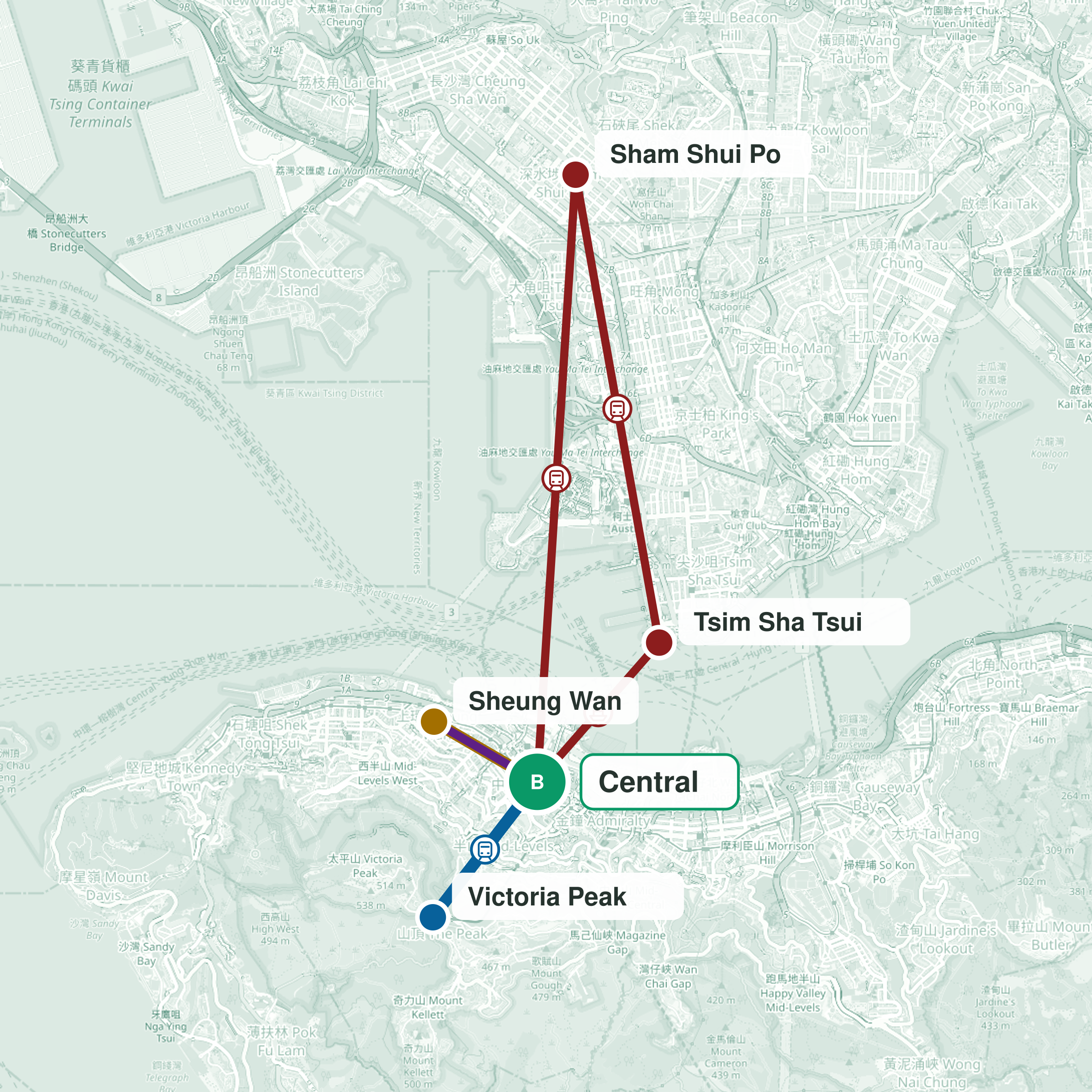
Start with the base that makes those movements straightforward
Start with the base that makes those movements straightforward. Stay in Central, Hong Kong Island’s commercial centre, for the whole visit. One hotel supports this route, leaving your time for exploring rather than changing accommodation. From Hong Kong International Airport, the Airport Express reaches Hong Kong Station in about twenty-four minutes. Your onward connection depends on where you’re staying.
Use the MTR, the city’s rail network, for cross-city journeys, and walk within neighbourhoods. Two other forms of transport belong to the experiences themselves. The Peak Tram takes you uphill from Central, while the Star Ferry lets you experience the harbour as you travel between its shores.
On day one, walk west from Central into Sheung Wan, an older commercial and residential neighbourhood nearby. This is a useful first encounter because the contrast unfolds on foot. The modern business centre gives way to streets with older commercial and residential layers. You’re looking at different parts of the city’s development within one connected walk.
Central’s colonial-era history and Sheung Wan’s Chinese commercial history help explain that contrast. Rather than reducing Hong Kong to an East-meets-West slogan, notice how these layers occupy neighbouring streets. The interest lies in their proximity. Business, housing, and religious institutions have each helped shape this compact part of the island.
Include a local-style meal or tea stop during the walk. Give it time within the day, rather than treating eating as another attraction to tick off. It adds an everyday activity to a route otherwise focused on buildings and streets.
The route step by step
Wong Kar-wai’s film In the Mood for Love offers another way to prepare for this part of the trip. Its compressed interiors, corridors, and older residential atmosphere encourage attention to the spaces between the city’s grand views. The story is set in nineteen-sixties Hong Kong, so use it as an interpretive reference, rather than a present-day filming-location itinerary.
Keep day four for a slower return to Sheung Wan. By then, you’ll have seen the city from above and across the water, and can give these streets a second look. That return is part of the plan. Four full days allow both the major views and time at neighbourhood level. Day two takes you uphill from Central to Victoria Peak, the elevated viewpoint above Hong Kong Island. Take the Peak Tram, which has operated since eighteen eighty-eight, then leave room for the Peak Circle Walk, a walking route through the wooded heights.
The panorama brings Victoria Harbour, Kowloon on the opposite shore, and the surrounding hills into one view. It helps you understand the scale of the city before crossing it the next day. The walk adds something the viewpoint alone cannot: changing perspectives and a closer encounter with the green slopes above the commercial centre.
Give this experience its own space in the itinerary, then return to Central. There is one practical reason to keep the day flexible. Typhoons, most common from May to November, can disrupt ferries and outdoor plans, so the Peak visit may need to move. On day three, leave Central aboard the Star Ferry and cross Victoria Harbour to Tsim Sha Tsui, Kowloon’s harbour-facing waterfront district. The crossing is a central experience, not simply a transfer. From the water, the towers of Hong Kong Island and the opposite shore become two sides of the same city.
Once ashore, walk along the waterfront and look back towards the island. Yesterday’s elevated view showed the wider geography. Today’s crossing and shoreline put you inside it. Allow the waterfront its place in the morning before continuing inland.
Key stops and decisions
For the afternoon, take the MTR to Sham Shui Po, a Kowloon neighbourhood associated with textiles, supplies, and independent businesses. Explore on foot, focusing on its fabric and maker streets. Their commercial character gives you a distinct contrast with the harbourfront. Attention shifts from the skyline to what businesses sell and the street-level activity around them.
Choose this one inland neighbourhood and give it time. It adds more to the route than a hurried sequence of districts with little chance to understand any of them. Return to your Central base by MTR. Keep three decisions in mind: one Central base for four full days; experience the harbour by crossing it and understand its scale from the Peak; explore a few neighbourhoods in depth.
To continue, you can generate another Five Cents answering either of these questions: What should I see in West Kowloon’s contemporary-art district? Or, how can I explore the Ping Shan Heritage Trail?