

Introduction
This is Five Cents: travel guide to Greece. For a first week, Greece works best as Athens plus one well-chosen island base. Don’t race through famous names. We’ll build the route around ancient Athens, a ferry into the Cyclades, and Naxos’s beaches, villages, and food. There’s also a mainland alternative for travellers who want mountains and heritage instead.
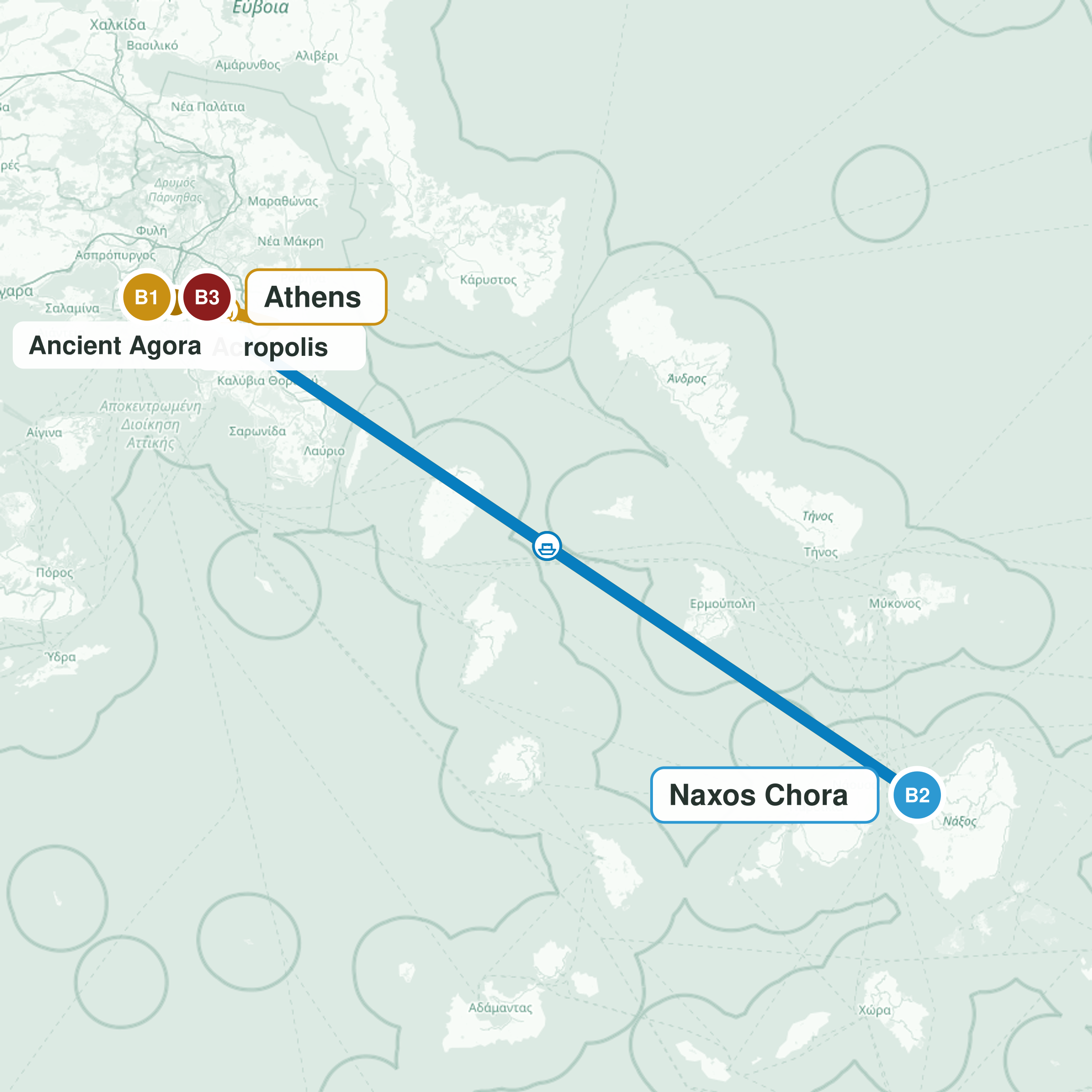
Start by treating Greece as several distinct trips
Start by treating Greece as several distinct trips. Then choose one. Give Athens three nights. From Athens International Airport, head west to a central base by metro or other public transport. Stay close enough to walk around the historic centre. Athens is more than a stop before the islands. It gives you the historical frame for the rest of the country, while remaining a busy modern capital with neighbourhood life and a serious food scene.
On your first full day, walk south through the historic centre to the Acropolis and the Acropolis Museum. The Acropolis is the fifth-century B.C.E. monumental complex built around the cult of Athena. It includes the Parthenon, the Erechtheion, and the Propylaia. The museum helps turn those buildings from an iconic skyline into a coherent story of the ancient citadel and the city beneath it. Book the Acropolis for its selected timed-entry slot, and let it anchor the day.
The following day, walk northwest from the Acropolis area to the Ancient Agora, the civic and commercial centre of ancient Athens. It complements the ceremonial scale of the Acropolis with the spaces where political and everyday life happened. Leave one evening for a contemporary neighbourhood and dinner. Don’t treat Athens as an archaeological museum with traffic around it.
Then move from the capital to the islands. Take a ferry from the Athens-area port system southeast into the Cyclades, and base yourself for three nights in Naxos Chora, Naxos’s main town. Ferry schedules and crossing times vary by vessel and season, so the important decision is to give the transfer its own day. The crossing is part of the route. It makes the shift from capital life to island geography visible.
The Odyssey is a useful companion here
The Odyssey is a useful companion here. Not because modern Greece is a Homeric museum, but because it prepares you to see islands and sea crossings as separate worlds, connected by movement, arrival, and return. Naxos is the strongest all-round island choice for this first trip. It is the largest and most fertile island in the Cyclades, so it combines the whitewashed maritime image many visitors expect with a greener interior, farming, villages, and a more varied food culture.
In Chora, begin at the Portara, the monumental marble gateway beside the harbour. It gives you an immediate meeting point of sea and history, then leads naturally into the town’s older streets and Venetian layers. Use one day to combine a beach with an inland village or agricultural landscape. From Chora, local transport or a short-term vehicle arrangement opens up the coast and interior.
The point is not to collect beaches. Pair swimming with a village meal, or a look at the fertile terrain that makes Naxos different from the drier Cycladic stereotype. On another day, make food part of the geography. Local cheeses, potatoes, and island cooking explain why this is more than a resort stop.
For day seven, return northwest by ferry to Athens. If your international flight leaves early, spend the previous night back in Athens rather than building the departure around a same-day ferry return. That final night protects the route from becoming a transfer gamble. For a different first week, choose mainland Greece rather than trying to add it to this itinerary. Athens, Delphi, and Meteora suit travellers who care more about sanctuaries, mountain landscapes, and Orthodox heritage than swimming.
Key stops and decisions
Delphi is Apollo’s ancient sanctuary on the slopes of Mount Parnassus, where the landscape is inseparable from the site’s meaning. Meteora, farther north, places Orthodox monasteries on dramatic sandstone pillars. This is a road-trip route, best approached by car or carefully coordinated road and rail or bus travel, with Athens, Delphi, and a base around Kalabaka or Kastraki.
Keep Cape Sounion as an optional Athens extension. It adds the coastal Temple of Poseidon and works best by replacing a second museum or neighbourhood day. For the main route, resist adding Santorini, Mykonos, Crete, or a second Cycladic island simply for name recognition. Crete deserves its own longer trip, and another island can repeat what Naxos already delivers well.
Remember three decisions. Choose one coherent route. Let Athens provide the historical frame and Naxos the lived island contrast. And leave room for ferry travel and a return to Athens before an early flight.
To continue, you can generate Athens beyond the Acropolis: neighbourhoods, food, and museums. To explore further, you can generate Greece’s mainland heritage route: Delphi and Meteora.