

Introduction
This is Five Cents: travel guide to Galicia. Let's plan a first week combining historic cities, sheltered coastal inlets, Atlantic islands and open coastline, without trying to explore the whole region from a single base.
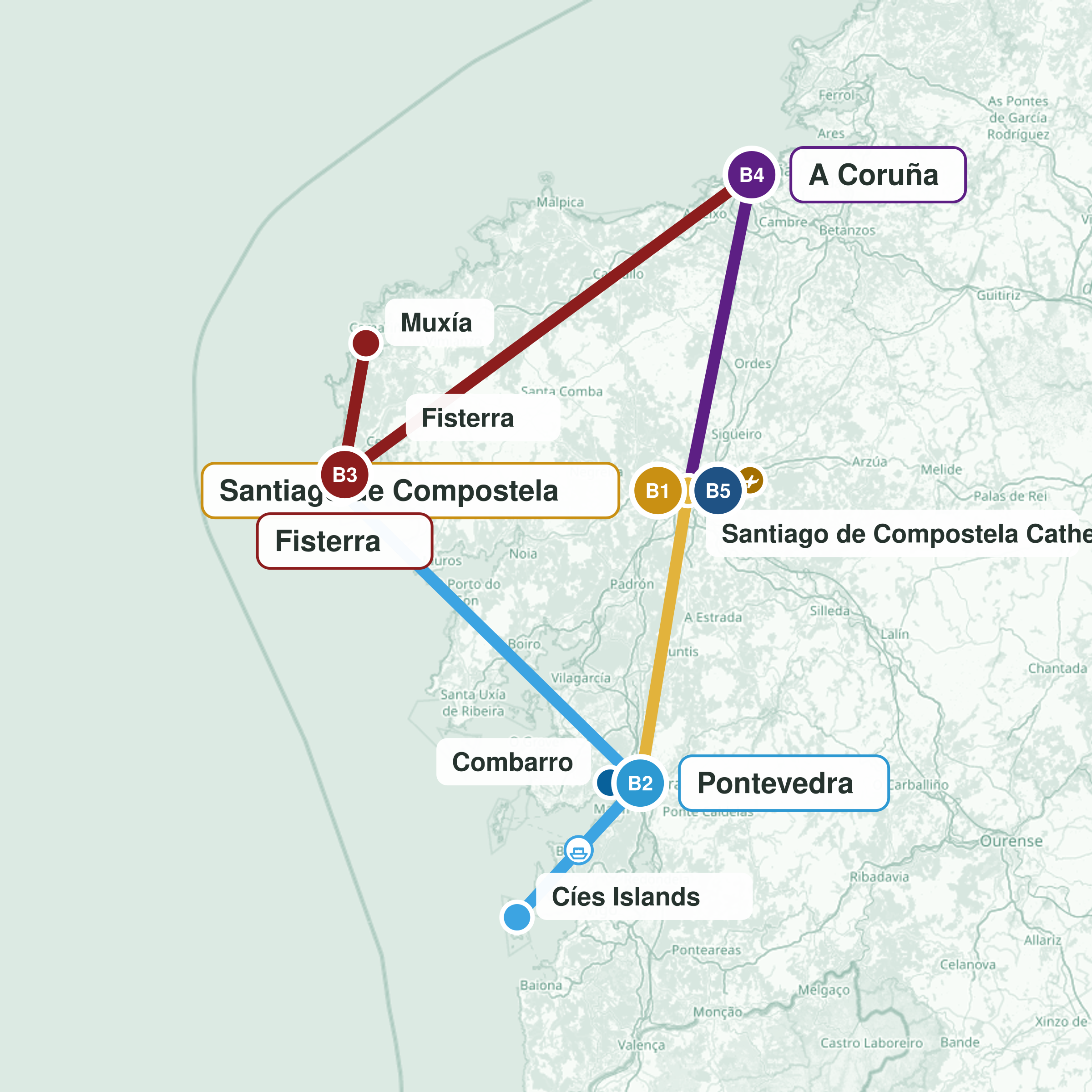
The route follows an arc
The route follows an arc: start in Santiago, head south to the Rías Baixas, return along the Costa da Morte and finish by the sea in A Coruña. Santiago is the best starting point. A rental car gives you the freedom to connect coastal stops, change bases and explore scattered landscapes. Begin with two nights in Santiago de Compostela. Its World Heritage old town brings together centuries of architecture around the cathedral. But the key is to walk beyond Obradoiro Square.
Explore the streets and smaller squares to understand how pilgrims, students, residents and visitors share the city. The Camino de Santiago is more than a walking route. It explains why Santiago became a European centre and still shapes much of its cultural life. Make time to eat, too. This is your introduction to a cuisine combining seafood, bread, cheeses, empanada, a filled pastry, and Galician wines.
From Santiago, drive south to Pontevedra, your second base for two nights. It's a compact historic city made for exploring on foot, and marks your arrival in the Rías Baixas, coastal inlets where the sea is more sheltered than along the western coast. From there, make a short visit to Combarro. Its hórreos, traditional raised granaries, and houses beside the inlet reveal a local architecture shaped by storage, fishing and life along the waterfront.
There's no need to string together similar villages. Pontevedra and Combarro already give you a clear contrast between historic city and coastal settlement. Set aside the whole following day for the Cíes Islands, part of the Atlantic Islands National Park. You'll combine a drive and a ferry journey from your Rías Baixas base.
The route step by step
Cíes is the main choice for a first visit because it brings together beaches, walking trails and views across the Vigo inlet within a protected island landscape. The experience goes beyond swimming. Walk around the island to see how the beaches and slopes change as they face the open ocean. Day visits require advance authorisation and travel with an authorised ferry operator, so settle this day's arrangements before finalising the route.
Afterwards, leave the inlets behind and drive northwest to Fisterra, where it's worth spending a night. The change matters: sheltered waters give way to the Costa da Morte, a stretch of open Atlantic coastline shaped by headlands and seafaring traditions. Fisterra offers the horizon of the ancient Finis Terrae, or land's end. The point isn't to collect lighthouse visits, but to pause at a cape that brings together land, navigation and ocean.
From Fisterra, continue north to Muxía. The sanctuary of Virxe da Barca adds a religious and legendary dimension to this coastal endpoint. The Camino to Fisterra and Muxía symbolically extends the pilgrimage from Santiago to the sea. These two stops therefore make more sense as a connected route than as isolated viewpoints.
Allow time to walk and eat locally, rather than turning the day into a succession of drives. The next day, continue north to A Coruña, the final coastal base. This is an Atlantic city where the sea is part of the urban experience. The Tower of Hercules, seafront promenade, glass-fronted galleries and old town reveal a different Galicia: a port city rather than a rural landscape.
Key stops and decisions
The tower, a Roman lighthouse, captures that continuity between heritage and coast. Then return southeast to Santiago for the final night and one last walk or meal. The major extension belongs outside this week: Ribeira Sacra needs two days of its own. Its river canyons, monasteries, hillside vineyards and viewpoints reveal an inland Galicia that doesn't work as a quick excursion from the coast.
Add it only if you can extend the trip or replace A Coruña and part of the Atlantic route. Remember three decisions: start in Santiago and understand the Camino by walking the city; choose Cíes and give it a full day; and prioritise Santiago, the Rías Baixas and the Costa da Morte before adding the interior.
To continue, you can generate another Five Cents: How can you explore Ribeira Sacra's vineyards, monasteries and canyons in two days?
To explore the coast further, you can generate: How can you take a leisurely Costa da Morte route between Fisterra and Muxía?