

Introduction
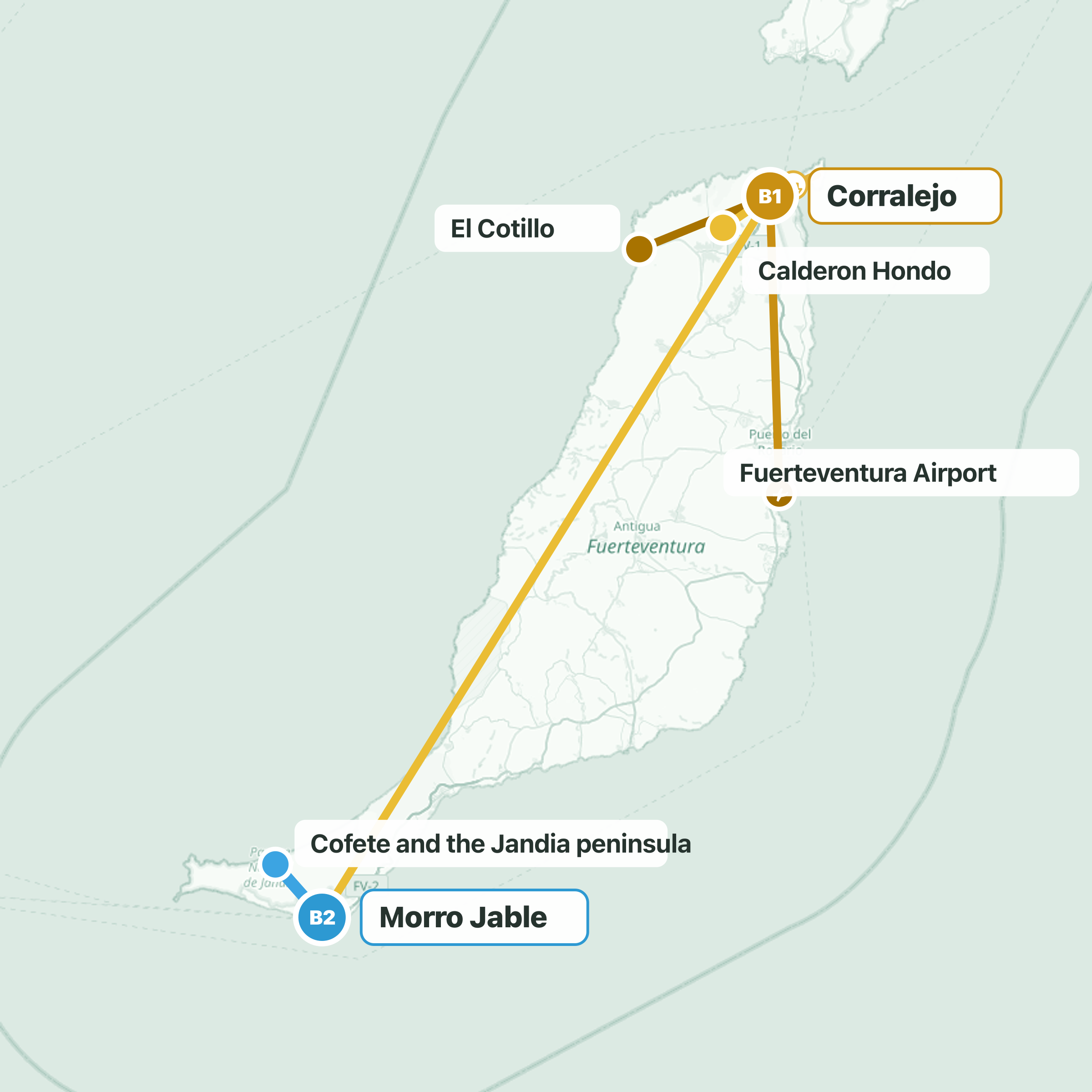
This is Five Cents: travel guide to Fuerteventura. Plan a first stay of four or five nights around the north, where Corralejo, the dunes, Isla de Lobos and El Cotillo give you the island’s clearest contrasts without turning the trip into a race. Start at the airport near Puerto del Rosario, hire a car and head north to Corralejo. Puerto del Rosario is the capital and works well as an arrival point, but Corralejo is the stronger base: it has a harbour, restaurants, cafés, shops, surf schools and enough life for several days. Boats to Lobos leave from here, and the north’s two main outings begin nearby. A car matters because beaches and towns are scattered across the island, and the drive through dry, low, almost treeless terrain is part of understanding Fuerteventura.
Do not expect a tropical island
Do not expect a tropical island. Its appeal is in the light, open horizons and the meeting of sand, rock and Atlantic water. On your first full day, drive south from Corralejo to Corralejo Natural Park, a protected field of pale dunes beside the coast. The Grandes Playas are a long run of sand rather than one cove, so you can stop where you like, walk between dunes and sea, and choose a stretch for swimming or simply resting.
From the beach, Isla de Lobos and Lanzarote sit on the horizon. You also see why wind is central to the island: it shifts the sand and supports windsurfing and kitesurfing. The dunes reaching the water are Fuerteventura’s defining image.
The next outing starts at Corralejo harbour. Isla de Lobos is a protected, almost uninhabited islet reached by a short boat ride. Make it a full-day trip: arrive at the pier, follow volcanic trails and head towards Puertito, a small inlet with calm water. Leave time for an easy walk or a swim before returning to Corralejo. The point is not just the crossing; for a few hours, you trade a lively town for a near-empty landscape with views back to Fuerteventura and across to Lanzarote. Prior authorisation is required for Lobos, separate from the boat ticket.
Then cross to the west coast. El Cotillo is around 20 minutes from Corralejo by the direct route. The change is immediate: harbour, dunes and long beaches give way to a smaller, quieter town, known for surfing but less intensely touristy. El Cotillo earns the stop for its slower pace, nearby cliffs and west-coast sunsets. Continue towards Playa de Esquinzo for a wilder beach, approached through a less urban landscape and framed by cliffs. It offers a more rugged coast than the Grandes Playas.
The route step by step
Behind those coasts is a rural island shaped by limited water and goat farming. Majorero cheese, made with goat’s milk, is a useful way to connect the dry landscape seen from the road with a long-standing way of using the land.
With a week or more, add the south, but change accommodation. Jandía is far enough from Corralejo that repeated journeys would unbalance the trip. A second base lets you choose between beach and hotel areas around Costa Calma, or the more remote feel around Morro Jable and the Jandía Peninsula. For a short first visit, keep the north.
Remember the route: base yourself in Corralejo, use the dunes and Grandes Playas to understand the island, then pair Isla de Lobos with El Cotillo for protected nature and the wilder west coast. Next, you could create a Five Cents episode on Surfing in northern Fuerteventura or Lanzarote and Fuerteventura: which island to choose.