

Introduction
This is Five Cents: travel guide to Egypt. A first visit makes most sense as two journeys connected by the Nile: Cairo’s monumental scale and layered city, followed by Upper Egypt’s concentrated temples, tombs, and Nubian landscapes. We’ll build a southward route, protect time for its different experiences, and leave one longer archaeological excursion until the end.
Start by giving the distances enough room
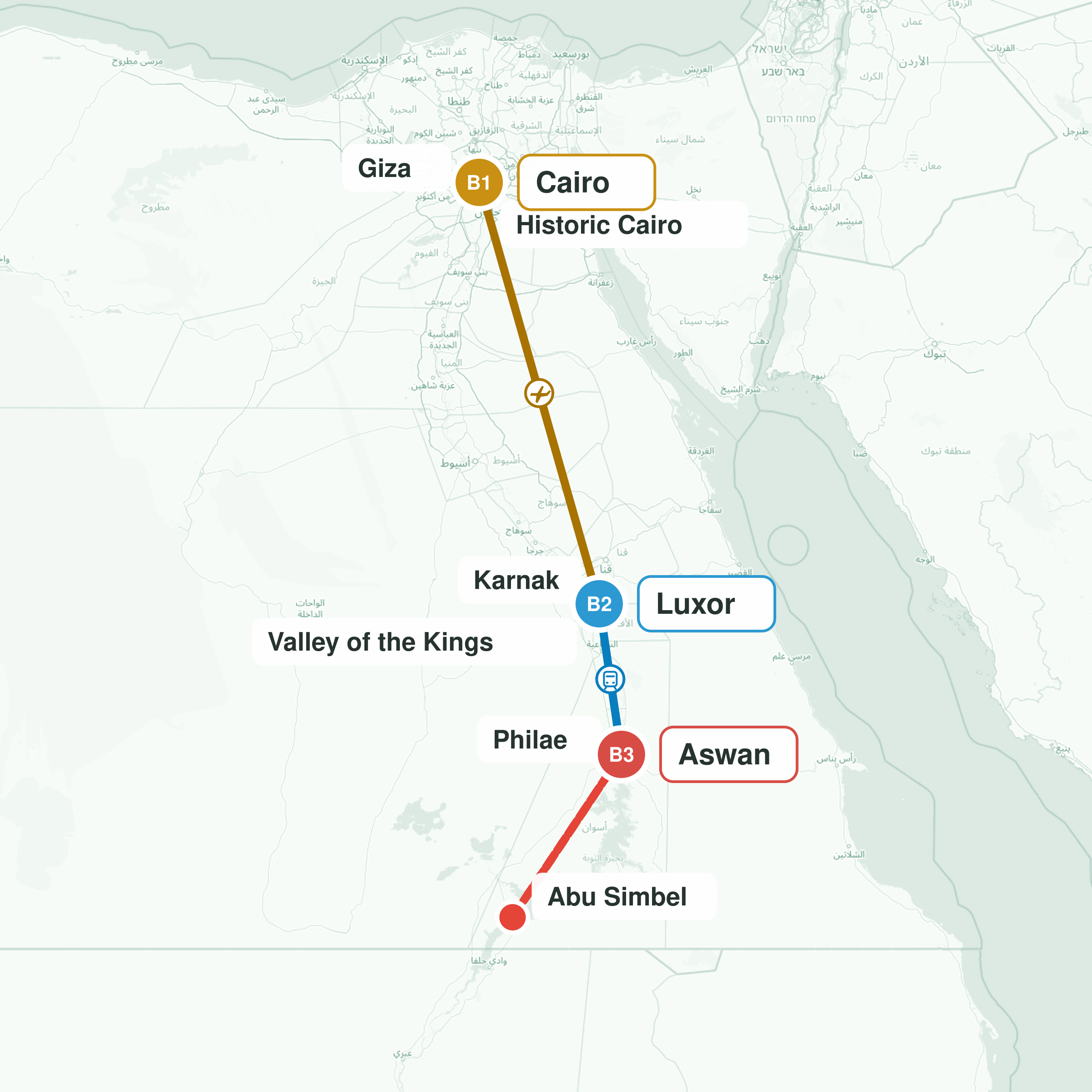
Start by giving the distances enough room. Allow nine to ten days, with three nights in Cairo, three in Luxor, and two or three in Aswan. These are your three sleeping bases along a long river corridor. Fly from Cairo to Luxor to preserve sightseeing time, then take the train farther south to Aswan.
Give the fourth and seventh days to those moves, rather than treating them as full sightseeing days. Departure from Aswan depends on your onward flight arrangements. The route may finish with a return to Cairo. Season affects the pace, especially in Upper Egypt. Winter is broadly milder, while summer heat can make prolonged outdoor visits demanding. That matters when choosing when to travel and how much to fit into a day.
Arrive through Cairo International Airport and continue by road into the capital. Cairo is a vast metropolis, so organize each day around one area. Use road transfers between areas and walk within the historic district. This keeps the journey manageable and leaves time to understand what you’re seeing.
Give Giza, the pyramid plateau beside Greater Cairo, its own day. The pyramids and Sphinx belong to a royal burial landscape. Seeing them together helps explain their purpose and scale more clearly than rushing between several pyramid fields. Make this your first encounter with ancient Egypt: a dedicated visit to a monumental burial ground, rather than one stop among many.
Then change historical periods in Historic Cairo, the capital’s medieval and Islamic district. Walk through its streets and among its monuments to encounter a city whose history continued long after the pyramids were built. This day earns its place because it broadens the trip. Egypt is also a living capital shaped by Islamic history, not simply a setting for ancient remains.
The route step by step
From Cairo, fly south to Luxor, the modern city occupying the area of ancient Thebes. Here, geography makes the history easier to understand. The Nile separates the east-bank temples from the west-bank royal burial sites. Keep a full day for each bank, with local road transfers taking you to the principal sites.
Begin on the east bank at Karnak, a vast temple complex whose immense columned spaces reveal Thebes as a religious centre. The experience is about moving through monumental spaces built for worship. Allow that scale to register, rather than treating the visit as a quick photograph before another temple.
On the following day, cross to the west bank for the Valley of the Kings, a royal burial ground with painted tombs cut into the rock. The contrast is the point. After Karnak’s enormous architectural spaces, you encounter funerary interiors. These are different kinds of places, serving different purposes. Separating the two days gives both experiences the attention they deserve.
Next, take the train from Luxor farther south along the Nile to Aswan. This southern river city changes the landscape and introduces Nubian historical context. Keep two or three nights here, so the final stage has its own rhythm, rather than becoming merely a departure point. Prioritize Philae, an island temple complex reached by boat from the Aswan area. The water journey makes its setting part of the visit.
Its present location also tells a modern story. Philae was relocated during the international campaign to rescue monuments from rising waters associated with the Aswan High Dam. What you see reflects both ancient construction and a major preservation effort.
Key stops and decisions
Leave room for a short Nile crossing and a walk beside the river in Aswan. From the water, the river’s role in connecting settlements becomes tangible. Agatha Christie’s Death on the Nile offers a recognizable literary introduction to that travel corridor and its cruise setting, though it is not a portrait of contemporary Egyptian life or Nubian culture.
The optional extension is Abu Simbel, monumental temples farther south. Reserve the tenth day for this longer road excursion from Aswan, returning there to sleep. It suits a strong archaeological interest and adds another chapter in the rescue and relocation of Nubian monuments. The main route remains complete with Philae and time in Aswan.
Remember three decisions: follow Cairo–Luxor–Aswan southward over nine to ten days; separate Luxor’s temple bank from its tomb bank; and make room for Egypt’s Islamic and Nubian histories alongside its pharaonic past.
To continue, you can generate another Five Cents answering either of these questions: How does Saqqara explain the development of pyramids? Or, how should you choose a Luxor–Aswan Nile cruise?