

Introduction
This is Five Cents: travel guide to Dublin. Dublin is a compact social capital, best understood as a progression from river streets and music to modern canals and an easily reached coast. In two days, walk its centre and canal district. With a third, give the day to Howth. Start with the river, because it makes the city immediately legible.
How to plan the route
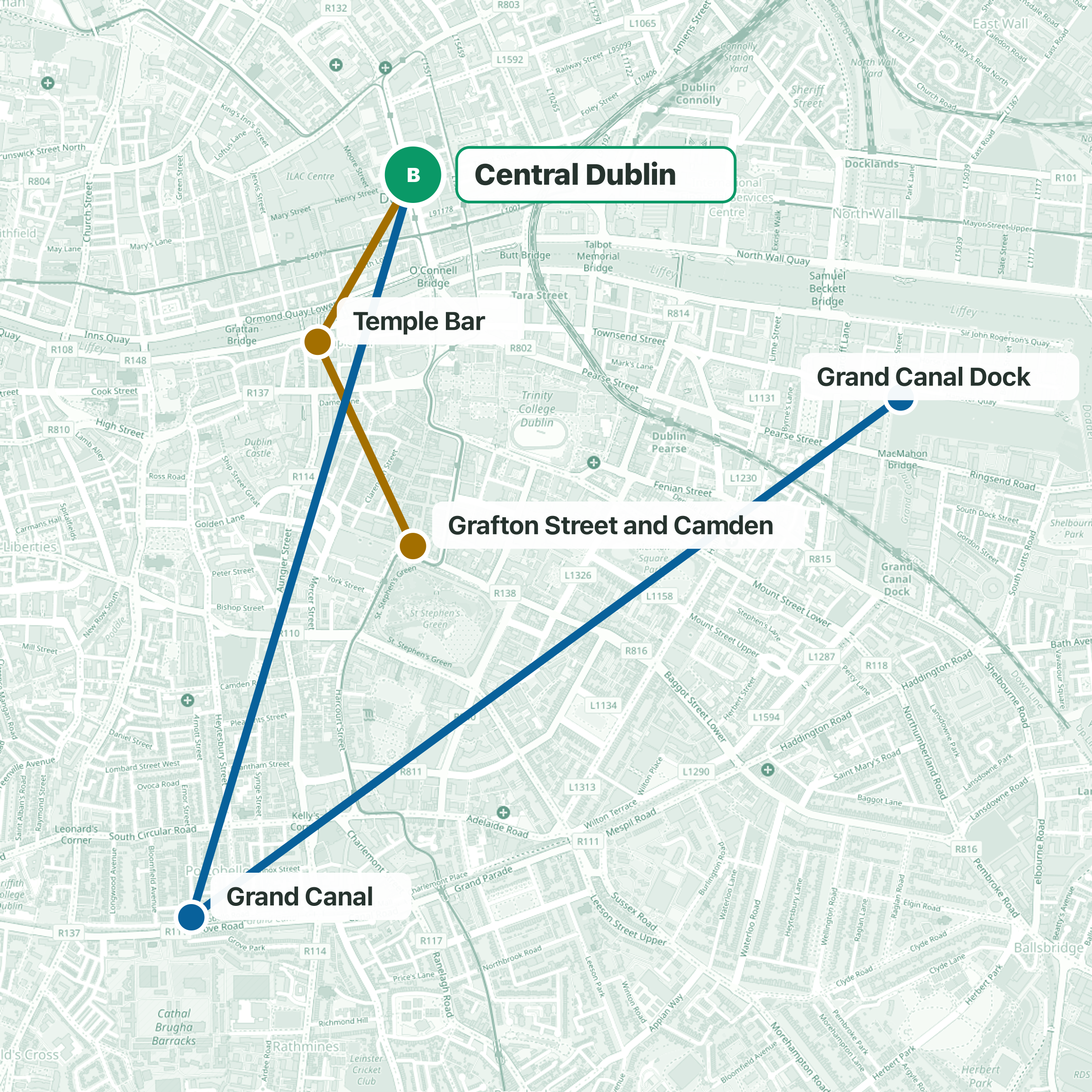
The River Liffey runs west to east through central Dublin and is the simplest dividing line. Most of this route is south of it, while O’Connell Street and Parnell Street lie to the north. O’Connell Street is the main commercial avenue, marked by the Spire, the tall metal needle that helps with orientation. Cross or walk beside the river, and you quickly see how close the centre’s main areas are.
From the south bank, enter Temple Bar, the cobbled pub quarter beside the Liffey. It is the city’s most tourist-focused nightlife district, but it can still be a fun first taste of Dublin. Crowds often sing familiar songs together. Just recognise that this is different from a traditional music session, where Irish instruments and repertoire are the point. Choose one music-led evening: Temple Bar for communal energy, or a more music-focused session for a different side of pub culture.
Continue south on foot to Grafton Street, one of Dublin’s main pedestrian shopping streets. Its real value is the flow of people and its buskers, not the international shops. It leads directly to St Stephen’s Green, a compact urban park that works as a pause rather than a major destination. From there, keep walking south to Camden Street, a lively area of pubs, restaurants and evening life with a less visitor-dominated feel. It is the natural place for dinner or drinks after the central walk.
Food should support the route, not organise it. Pub menus are often expensive and repetitive, built around burgers, fries, wings and simple dishes. Try a Guinness stew, a stew made with stout, or a creamy seafood chowder once if you are curious. But Dublin’s stronger reasons to visit are its streets, music and social life.
On the second day
On the second day, head east from the southern centre to Grand Canal Dock. This is the basin where the Grand Canal meets the eastern city: a former port area now rebuilt with offices, apartments, cafés and waterside terraces. It gives you a modern, international Dublin that contrasts clearly with Temple Bar’s narrow streets.
Spend time by the water, then follow part of the Grand Canal west or south-west. The canal-side path is a slower slice of city life, with trees, water and people sitting out when the weather allows. Ranelagh, a residential neighbourhood south of the canal with cafés and bars, is worth a brief extension only if you have extra time.
For the coast, use the DART, Dublin’s electric suburban railway. It links central stations, including Connolly, Tara Street and Pearse, with coastal towns north and south of the city. Your best third day is Howth, a harbour town on a peninsula north of Dublin. The journey takes roughly half an hour from the centre, and the change of scene is substantial.
Walk through Howth’s working harbour, then take a signed short-to-medium cliff circuit. The standard loop is around seven point eight kilometres and takes about two hours. It follows sea cliffs with views across Dublin Bay, the islands and the Baily Lighthouse from the trail. Return to the village for fish or seafood, then take the DART back. Before setting out, confirm that your chosen signed loop is open.
Dún Laoghaire is the alternative for a calmer coastal half-day
Dún Laoghaire is the alternative for a calmer coastal half-day. It is a port town south of Dublin, also reached by DART, where the plan is a long pier, seafront promenade and People’s Park. On Sundays, its food and craft market gives the outing a gentler harbour-and-stroll character. Choose it over Howth only if you prefer a promenade and market to cliffs and a coastal walk.
Keep three decisions in mind: use the Liffey to orient yourself, make one continuous southern walk with a music-led evening, and save a third day for Howth rather than adding more neighbourhoods. You can create a new Five Cents episode about Dublin’s pubs and live music, or about the Dublin coast by DART: Howth and Dún Laoghaire.