

Introduction
This is Five Cents: travel guide to China. For a first trip, spend ten days travelling by train from Beijing’s imperial centre to Xi’an’s archaeology, then on to modern Shanghai. The aim is to understand three different chapters of China, rather than squeeze the country into one itinerary. High-speed rail connects them, making the journey between cities part of the experience.
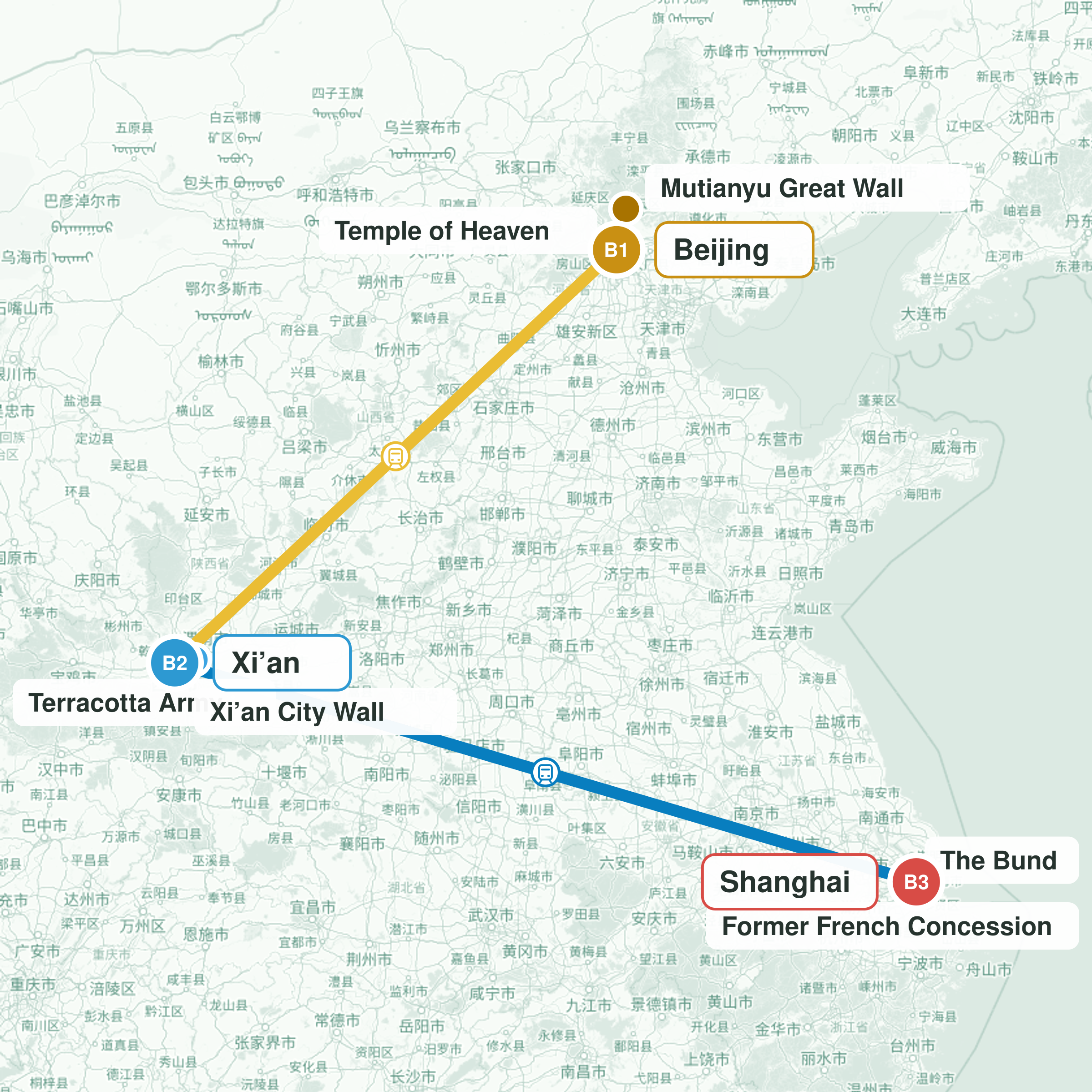
You’ll begin in Beijing
You’ll begin in Beijing, head southwest to Xi’an, then continue east to Shanghai. Each stop has a clear role: imperial power, ancient unification and exchange, and contemporary urban life. Arrive at Beijing Capital International Airport and spend four nights in the city, getting around by metro and local transfers. Beijing comes first because its ceremonial layout makes imperial power visible. The arrangement of buildings and spaces is part of what you’ve come to see.
Give the Forbidden City a full morning, or most of a day. This former imperial palace unfolds through gates, courtyards and formal spaces designed to control movement and display hierarchies. Follow that sequence rather than treating each courtyard as a separate attraction. Explore the surrounding imperial centre alongside it, keeping the focus on this experience rather than adding several palaces that tell similar stories.
On a separate day, head northeast of central Beijing to the Mutianyu Great Wall. This restored mountain section follows the ridges between closely spaced watchtowers. Walking it gives you more than a photograph: you experience part of a defensive system built and expanded over centuries across northern China.
Set aside the whole day for the Wall. Keeping it separate from the Forbidden City gives both visits the time they deserve. For a quieter cultural contrast, choose the Temple of Heaven on your remaining day. Its ritual architecture and landscaped grounds shift the focus from court life to ceremony. Next, take a high-speed train southwest to Xi’an and stay three nights. The journey makes the scale of contemporary China tangible while connecting cities shaped by very different historical periods.
The route step by step
Xi’an was an ancient capital and an eastern endpoint of Silk Road exchange. Here, the story moves from late imperial ceremony to unification, trade and food. From central Xi’an, travel east to the Terracotta Army, allowing most of the day. This is the funerary complex of Qin Shi Huang, the first emperor to unify China.
In Pit One, take time to grasp the scale of the military formation. Life-size soldiers, horses, chariots and weapons reveal an archaeological undertaking much larger than a single hall of statues. The formation, not just an individual figure, is what makes this one of the route’s essential experiences.
Back in the historic centre, walk or cycle along Xi’an’s city wall. This surviving Ming defensive wall gives you a view of the old city from above and a sense of its scale. Afterwards, eat dinner in the Muslim Quarter, where Hui Muslim heritage gives the Silk Road story an everyday dimension. Try roujiamo or lamb dishes. The point is more than finding something to eat: this is another way to notice how regional cooking changes with each city’s history.
Continue east by high-speed train to Shanghai for three nights. Its commercial, financial and outward-looking character provides the journey’s final contrast, rather than a summary of the whole country. Begin on the Bund at dusk. This historic riverside promenade faces Pudong across the Huangpu River. Older commercial architecture and the contemporary financial district’s towers come together in a single view.
The following day, slow down in the former French Concession
The following day, slow down in the former French Concession. Its tree-lined streets and older urban fabric offer a walkable counterpoint to the scale of the Bund. Leave an ordinary urban afternoon in each city for public spaces, meals and daily life, using the metro to get around. Shanghai is more than a skyline, just as Beijing and Xi’an are more than monuments.
A nearby water town only makes sense after you’ve given Shanghai enough time. For this trip, stay with the three cities rather than add a picturesque detour. Chengdu, Jiuzhaigou, Guilin, Yangshuo, Zhangjiajie, Tibet, Xinjiang and Yunnan deserve separate journeys, not rushed additions. Remember three ideas: these cities are distinct chapters, not a checklist; the Great Wall and Terracotta Army deserve full experiences; and high-speed rail connects imperial history, Silk Road exchange and modern urban China.
To continue, you can generate another Five Cents answering: How can I explore Sichuan through Chengdu, pandas and Jiuzhaigou? For a different landscape, generate: How can I explore southern China through Guilin and Yangshuo?