

Introduction
This is Five Cents: travel guide to Busan. Plan four days around a city shaped by the sea, steep hills, trade, and post-war reconstruction. Don’t try to collect beaches and photo stops. Start in the old western port, move through the refugee-era hills, then change base for the beaches and open coast in the east. The route begins where Busan’s identity is easiest to read.
Four days is the best pace
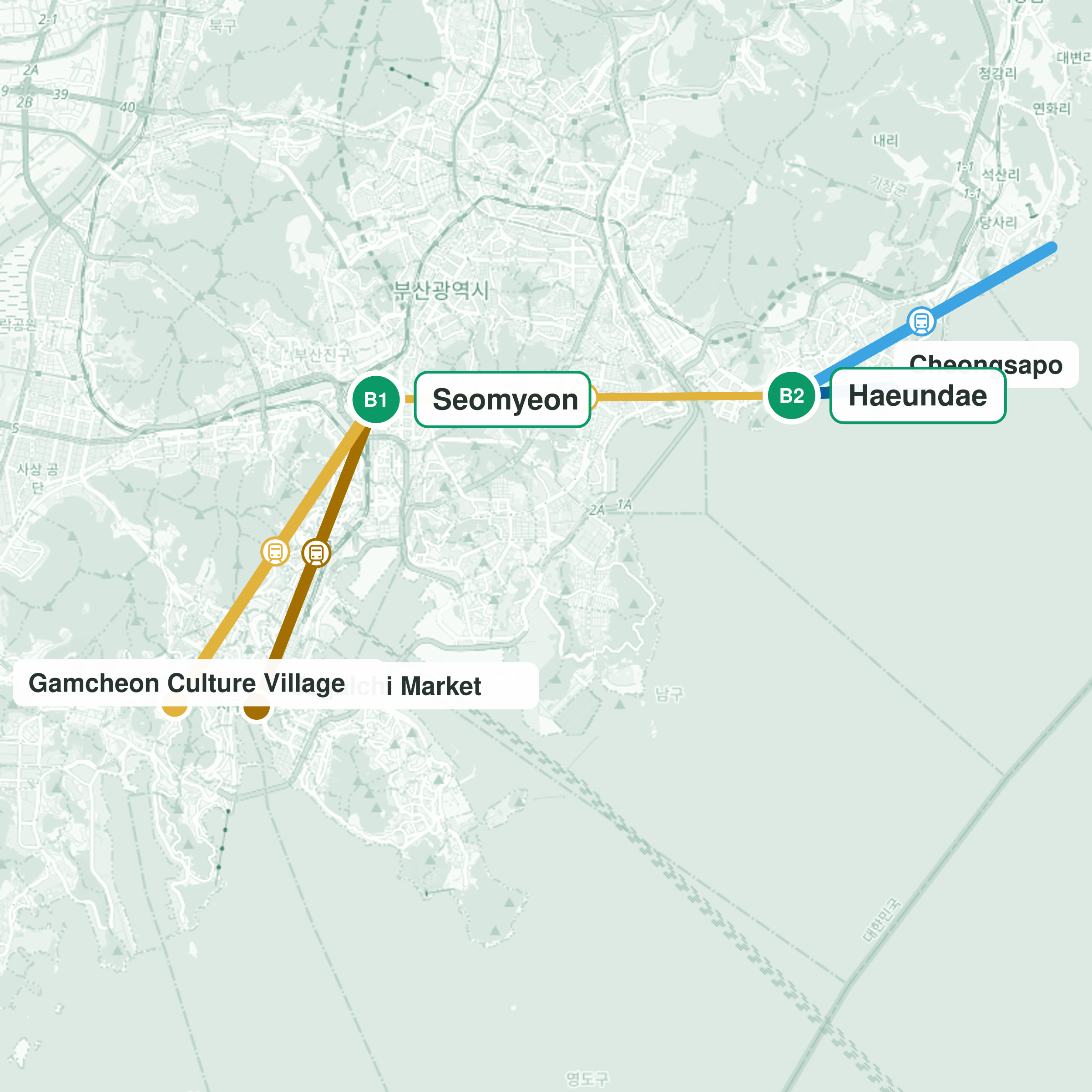
Four days is the best pace. Three full days is the minimum. From Gimhae International Airport, use the light rail and metro toward Seomyeon, a central interchange that works well for your first two nights. The metro is the backbone of this trip. Add local buses or taxis for Gamcheon and the eastern temple.
After the hillside day, move east to Haeundae for two nights. That single change prevents repeated journeys across a city that is much more spread out than it first appears. Begin southwest of Seomyeon, around Nampo-dong, Busan’s historic commercial district beside the port. If you arrive by train, Busan Station also puts this area within easy reach.
Walk toward Jagalchi Market, the city’s best introduction to its maritime character. This is a seafood market where the working port remains visible in live seafood trading and in the restaurants built around it. Nearby Gukje Market and Bupyeong Kkangtong Market belong to the same walk. They extend the commercial energy of the district rather than requiring separate headline visits.
Finish uphill at Yongdusan Park, a compact elevated park that gives you a clearer sense of how tightly the old city, harbour, and surrounding slopes fit together. Busan is a port city before it is a beach city, and this first day makes that clear. On day two, head west into the hills above the port for Gamcheon Culture Village. Take Line One and continue by local village bus.
The route step by step
Gamcheon is a residential hillside settlement known for its layered houses, narrow alleys, stairways, small galleries, and workshops. But its real value is historical. During the Korean War, Busan became South Korea’s temporary capital and received large numbers of refugees. Gamcheon’s dense form reflects that era, and its later community regeneration gave the village its colourful visual identity.
Walk it as a neighbourhood, not a photo circuit. The steep lanes and viewpoints show how the city had to build upward around a crowded port. Respect the quiet and cleanliness of this lived-in area, and do not use drones. The film Ode to My Father is useful preparation here and around the markets. It connects Busan’s commercial streets with refugee and family histories, adding context to places that can otherwise look like simple sightseeing stops.
Then shift your base east to Haeundae. The change is also a change in Busan’s character: from market streets and hillsides to broad sand, hotels, cafés, and a contemporary waterfront. Haeundae is the city’s classic beach district and the best first coastal base. Give day three to the Haeundae–Cheongsapo corridor. Follow the shoreline on foot, or use the Blueline Park system where it fits your day, to reach Cheongsapo. It’s a smaller coastal stop that carries the route beyond the beach district and toward open water.
This is the right place to slow down rather than add another beach. Haeundae supplies the classic beach experience. Cheongsapo adds a more coastal rhythm and a reason to keep moving east. For one evening, Gwangalli is the distinct alternative. Go for the urban waterfront atmosphere and views of the illuminated Gwangan Bridge, not as a second main beach day.
Reserve day four for Haedong Yonggungsa Temple
Reserve day four for Haedong Yonggungsa Temple, northeast of Haeundae in Gijang. Reach it by bus or rail connections via Osiria. Treat it as a half-day eastern-coast outing, not an extra stop squeezed into the port-and-Gamcheon days. This Buddhist temple is selected for its setting directly against the shoreline. Its coastal path and sea views make it fundamentally different from a temple hidden in a mountain valley. Architecture and open water are part of the same visit.
With the core route complete, Yeongdo and Taejongdae are the worthwhile optional extension. They add cliffs and maritime scenery in southern Busan, but they deserve a separate day rather than being forced into this four-day sequence. Remember the three decisions that make Busan coherent: begin with the port, understand Gamcheon through refugee history, and separate the old city from the eastern coast by changing base once.
To continue, you can generate “Yeongdo and Taejongdae: Busan’s Southern Coast.”
To explore the city’s food culture, you can generate “Busan Markets and Seafood: A Practical Food Route.”