

Introduction
This is Five Cents: travel guide to Bucharest. Plan this as a compact two- or three-day break, not a monument checklist. The city makes sense when you walk from its commercial past into its Belle Époque ambition, then confront the communist redevelopment built through demolition.
We’ll set one central base
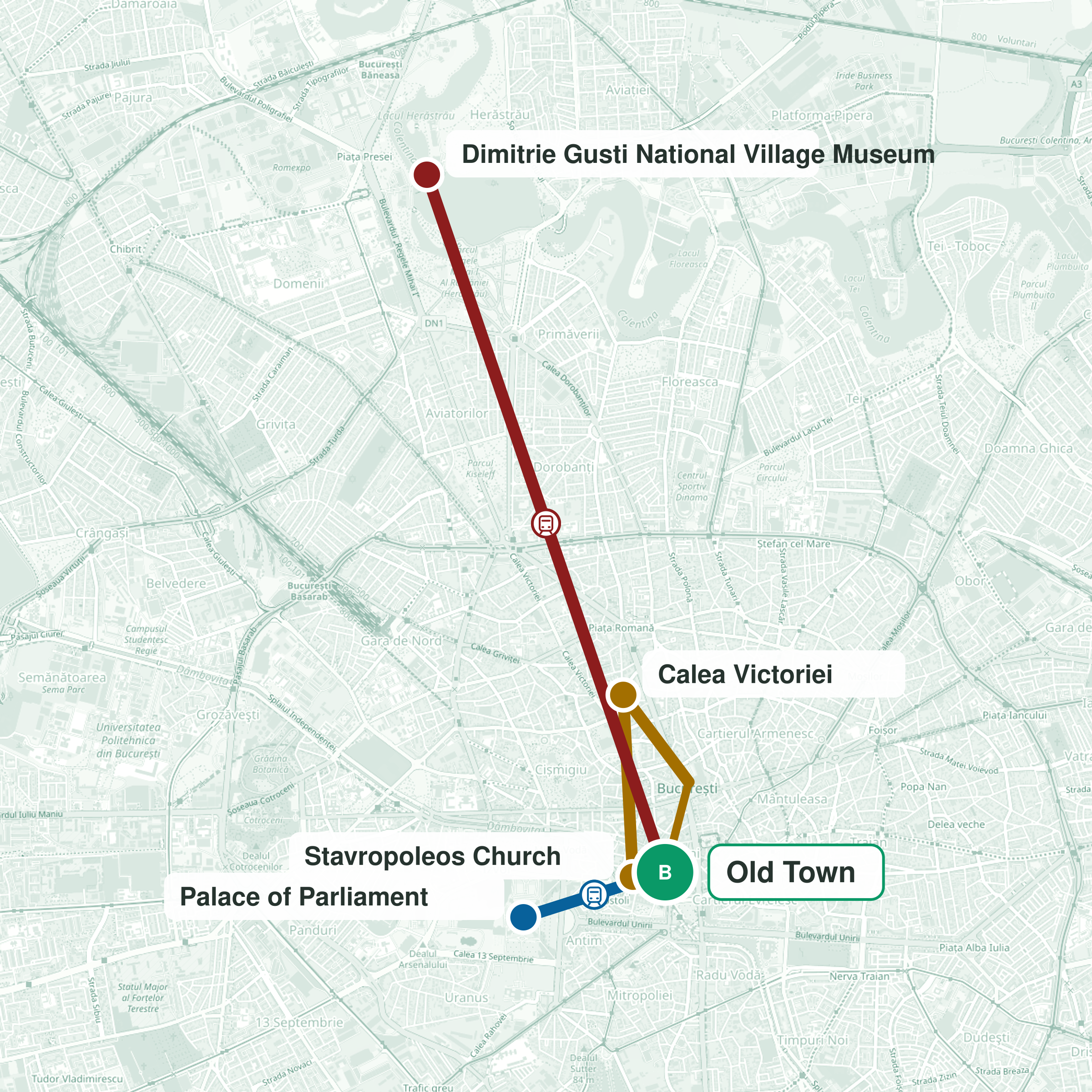
We’ll set one central base, follow the main historical corridor, and save one northern extension for a third day. Start by staying near the Old Town, so the central route is walkable. Longer north-south crossings can happen by metro. From Henri Coandă International Airport, the rail link reaches Bucharest North Station. Once you are in the centre, walking is the best way to understand the city.
Begin in the Old Town, Bucharest’s historic commercial centre around Lipscani. Its narrow streets still carry the traces of merchants and guilds, although today they are also packed with restaurants, bars and nightlife. Treat it as an orientation point, not the whole destination. Look for Stavropoleos Church, a small Orthodox church whose carved details give the district more texture than its busiest streets suggest.
Nearby, the Curtea Veche area recalls the older princely city. Macca–Villacrosse Passage is a covered arcade that shows how much of Bucharest’s character sits between its larger landmarks. From here, walk north along Calea Victoriei. This is the city’s historic ceremonial and cultural avenue. It is also the clearest way to read the nineteenth- and early twentieth-century capital.
The boulevard links commercial Bucharest to royal institutions, museums and the Romanian Athenaeum. The old nickname “Little Paris” belongs here, as an explanation for French-influenced architecture and urban ambition, not as a complete description of the city today. Continue to Revolution Square, where the royal and modern layers meet more recent political history. The route works because it turns architecture into chronology: an old trading centre, a European capital in formation, and a city repeatedly reshaped by the twentieth century.
The route step by step
Near University Square, make your one museum choice the Museum of Bucharest at Suțu Palace. It is a city-history museum, so it gives context to the streets you have just walked rather than sending you into a long list of national collections. Its exhibitions help connect Bucharest’s changing urban form with the political and cultural shifts behind it.
Give the second day to the Palace of Parliament and the Civic Centre, southwest of the central core. Use the metro or surface transport for this longer crossing. The Palace matters less as a giant building than as the centrepiece of Nicolae Ceaușescu’s redevelopment project. In the nineteen eighties, much of the Uranus neighbourhood was demolished to make way for this political-administrative landscape. Streets, homes and churches disappeared beneath broad boulevards and monumental space.
That is the key to this visit. Look at the Palace alongside its setting and understand it as a record of power, displacement and absence. An interior visit can add scale and detail, but book ahead if that is part of your plan. Afterwards, let the Civic Centre’s disrupted street pattern explain why Bucharest can feel uneven. Grand buildings, traffic-heavy roads, neglected façades and communist blocks coexist rather than forming one polished historic scene.
On a third day, head north by metro or surface transport to King Michael the First Park and the Dimitrie Gusti National Village Museum. This open-air ethnographic museum gathers examples of Romanian regional rural architecture and village life. It adds something the central route cannot: a concentrated view of how domestic buildings and traditions differed across the country.
Key stops and decisions
Pair it with the park for a slower change of pace, but keep it as an extension. With only forty-eight hours, protect the Old Town–Calea Victoriei walk and the Palace of Parliament instead. Keep three decisions in mind: base yourself centrally, use the Old Town as a starting point before continuing north along Calea Victoriei, and read the Palace of Parliament through the erased Uranus neighbourhood.
Three days are enough when you choose one museum and add the Village Museum selectively.
To continue, you can generate Bucharest’s communist architecture and Revolution history. To explore further, you can generate Romania beyond Bucharest: a first-week route.