

Introduction
This is Five Cents: travel guide to Berlin. Allow four or five full days for a capital whose history is spread across neighbourhoods rather than concentrated in one old town. Start with the symbolic centre, understand the physical reality of division, then explore the neighbourhoods that emerged afterwards. That sequence makes Berlin easier to understand.
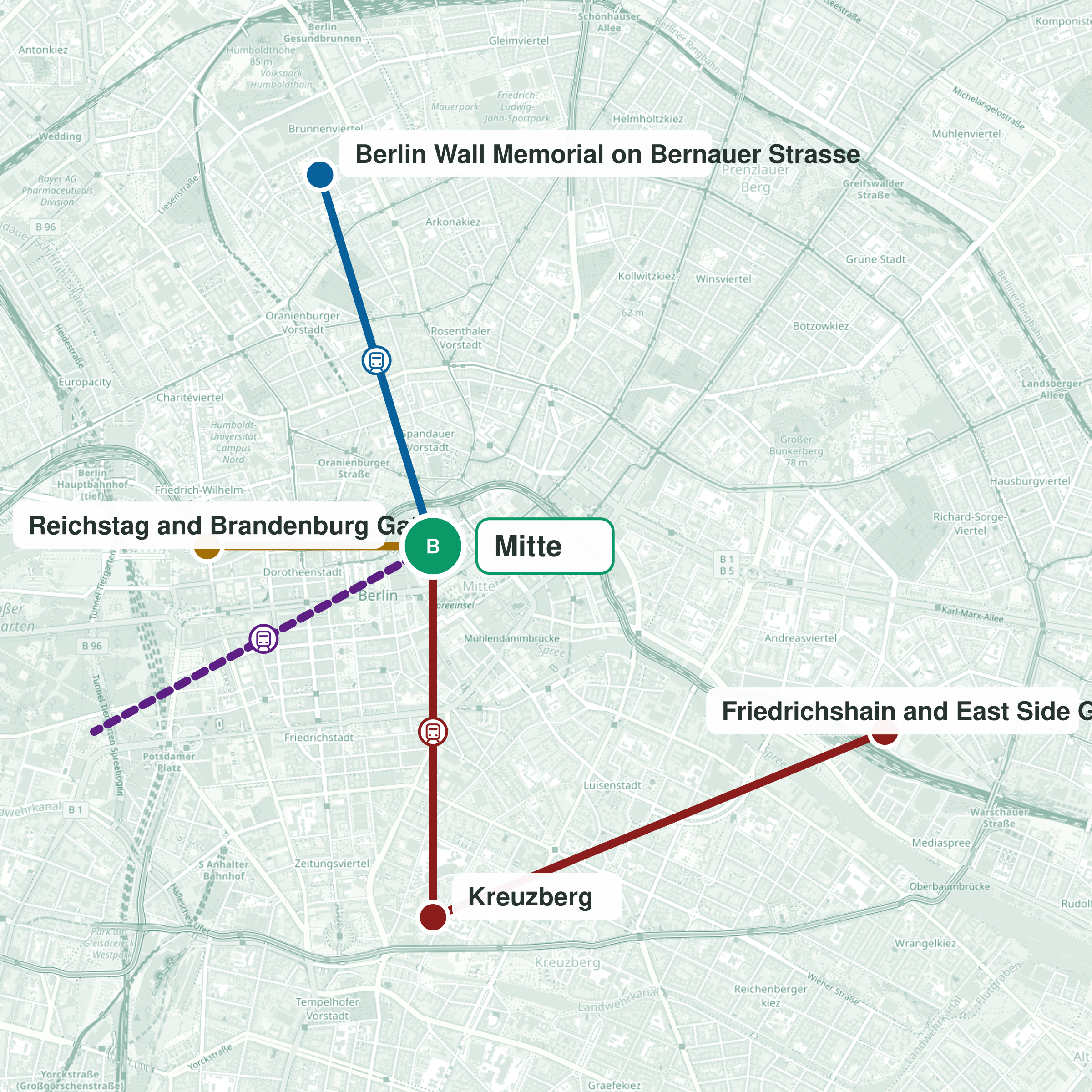
Begin by choosing one base for your whole stay
Begin by choosing one base for your whole stay. Mitte is the simplest option for a first visit, close to the main historical route. Kreuzberg or Friedrichshain work better for a stay focused on neighbourhood life. From Berlin Brandenburg Airport, the Airport Express or a regional train reaches Hauptbahnhof, the central station, in about twenty-three minutes. In the city, use public transport: the S-Bahn for longer journeys, the U-Bahn within central districts, and walk where the route naturally connects.
Start in the government quarter near Hauptbahnhof and walk east. The Reichstag area establishes Berlin’s role as the capital of reunified Germany. Next, the Brandenburg Gate brings together Prussian history, division and reunification. A few minutes away, the Memorial to the Murdered Jews of Europe changes the tone completely. Its field of concrete slabs places Holocaust remembrance at the heart of the modern city, rather than on its margins.
Continue along Unter den Linden, the broad avenue connecting state institutions with Museum Island. This UNESCO World Heritage complex began as a public cultural project, so its buildings matter as much as its collections. Choose one museum rather than rushing through several. The Neues Museum is the strongest all-round choice. Its Egyptian, prehistoric and classical collections occupy a building whose restoration also tells the story of wartime damage and Berlin’s reconstruction.
Finish at Alexanderplatz, where the city opens into a broad urban landscape from East Germany’s socialist era. The Fernsehturm, the television tower, is an optional viewpoint, but the square matters more as urban context than as a main stop. On day two, head north from the centre by U-Bahn or S-Bahn to Bernauer Straße. The Berlin Wall Memorial extends along 1.4 kilometres of the former border strip, with preserved fortifications, documentation and viewpoints.
Give it time
Give it time. Here, the Wall stops being an isolated object: you can understand how it cut through a residential street, separated homes and transformed everyday life. Before visiting, watch The Lives of Others for context. The film explores surveillance and the moral pressure associated with East Berlin before reunification. At Bernauer Straße, that political history becomes something spatial and personal.
Next, head southeast to explore contemporary Berlin. Start in Kreuzberg, a district shaped by its former position beside the Wall, migrant communities, independent businesses and alternative culture. The point is not to work through a checklist. Walk its streets and canals, pause where neighbourhood life is happening, and notice the scale of the Kiez: the local social world of each area. Berlin often functions through these neighbourhood settings rather than a single central urban scene.
Continue east, on foot and by U-Bahn, to Oberbaum Bridge, which connects Kreuzberg with Friedrichshain. Crossing it reveals how the old border geography remains visible in today’s city. Nearby, East Side Gallery adds murals painted on a surviving section of the Wall. It is worth visiting for its visual impact and later cultural significance, but Bernauer Straße remains the place to understand how division actually worked.
Reserve the final day for going deeper rather than adding another hurried route. If art is your priority, head southwest from Mitte to Kulturforum, near Potsdamer Platz. Its major collections, including the Gemäldegalerie painting gallery, also explain how West Berlin created cultural institutions during division. This focused extension complements Museum Island without duplicating it.
If you have five days and want a different pace
If you have five days and want a different pace, Potsdam is the one optional excursion to add. It needs a full day and brings together palaces, gardens and the former setting of the Prussian monarchy. Save it for a longer stay or a particular interest in architecture and royal history. Remember three decisions: follow the central axis rather than looking for an old town; choose Bernauer Straße to understand the Wall; and leave time for a Kiez, because contemporary Berlin is decentralised.
To continue, you can create another Five Cents on The Palaces and Gardens of Potsdam or Berlin’s Museums Beyond Museum Island.