

Introduction
This is Five Cents: travel guide to Beijing. Plan five full days around a capital that makes sense from the inside out. Begin with the imperial axis. Move into the hutong. Then leave the centre for the Great Wall and an imperial garden landscape.
You will need one central base
You will need one central base, the metro for the historic core, and separate days for the city’s biggest sites. Start in Wangfujing, Dongcheng, or Xicheng. Stay close enough to the historic centre to avoid turning every day into a cross-city journey. Use the metro for central Beijing. Take road transport for Mutianyu.
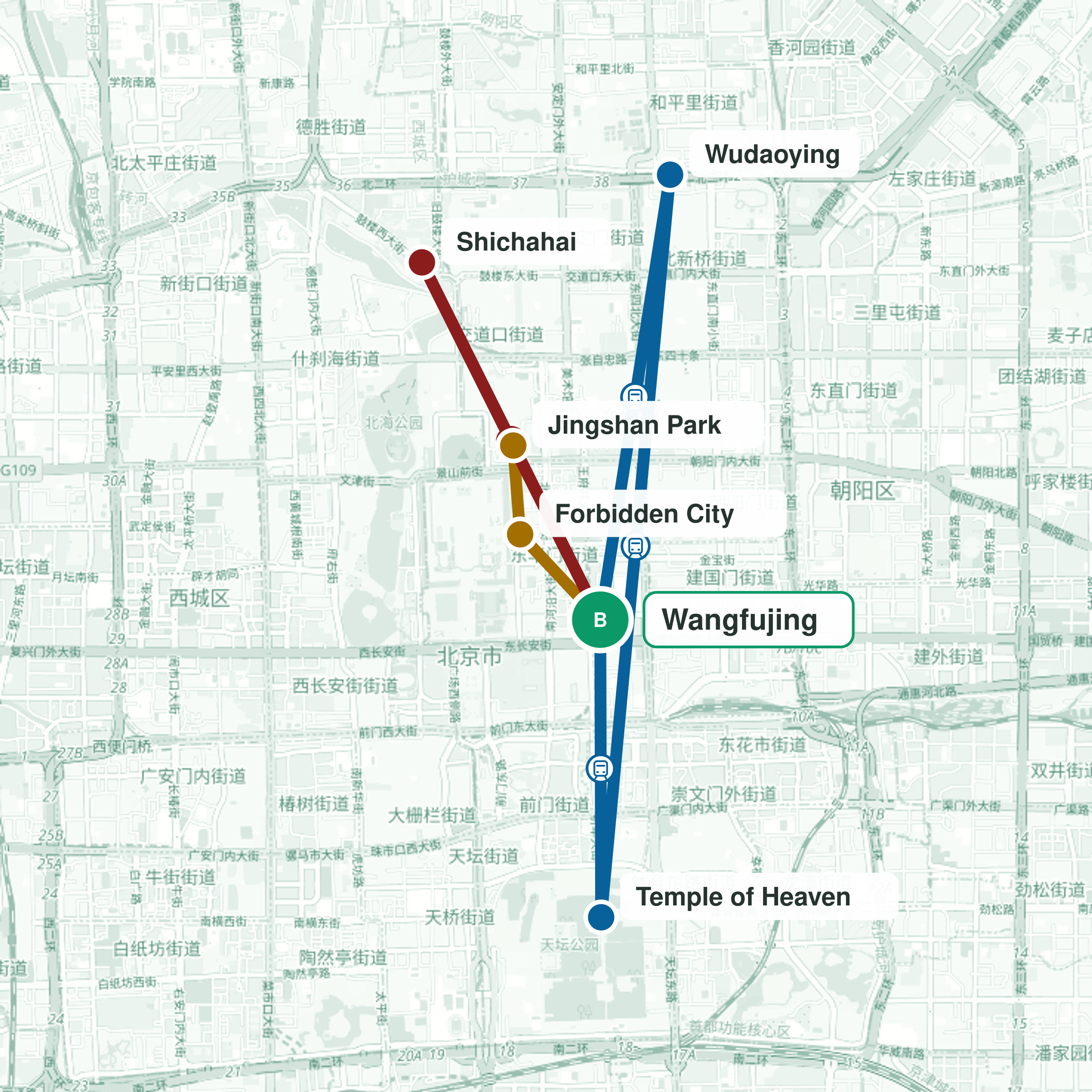
The key is to read the city as a former imperial capital. Its palaces, ceremonial spaces, and viewpoints were arranged along a north-south axis. Begin with the Forbidden City, the former Ming and Qing imperial palace. Give it a long morning: three to four hours to pass through its gates, courtyards, halls, and gardens. Notice how its architecture expressed hierarchy and political power.
This is one visit to plan ahead. It is normally closed on Mondays, and does not sell same-day tickets. Exit north into Jingshan Park, the hill directly behind the palace. In under an hour, its viewpoint turns the Forbidden City from a sequence of rooms into a city plan: a dense field of roofs aligned along the imperial axis.
That pairing is Beijing’s first essential experience. See the centre of power from inside, then from above. From Jingshan, continue northwest on foot to Shichahai, the historic lakes and surrounding hutong lanes. Here, Beijing shifts from ceremonial scale to residential scale: narrow alleys, courtyard houses, and neighbourhood streets.
Spend the late afternoon walking rather than chasing a checklist of hutong. Shichahai gives you the texture that the palace cannot. Keep Nanluoguxiang out of the main route. Its main street is heavily commercial. On the next day, take the metro south from your central base to the Temple of Heaven. This was the imperial ritual complex where Ming and Qing emperors performed ceremonies connected to heaven and harvests.
Its open grounds and circular architecture make it a real complement to the enclosed geometry of the Forbidden City. Allow two to three hours. Then return north by metro to Wudaoying, a quieter hutong street where cafés and small businesses sit within the older lane network. It is a useful way to see how traditional urban fabric and contemporary city life now overlap.
The route step by step
Keep a third city day for Shichahai if you want more time there, for a museum, or simply to absorb the scale of Beijing without packing another major monument into the schedule. The route works better when the large sites remain separate. Day four is for Mutianyu, northeast of central Beijing. Take road transport and treat it as a full-day excursion.
Mutianyu is the right first choice because it combines a restored section of wall with a mountain setting. The experience is walking along ridges, moving between watchtowers, and seeing how the fortification follows the terrain rather than sitting apart from it. Give Mutianyu a full day, not a rushed detour. It is the moment when Beijing’s imperial story expands into landscape.
Finish west of the centre at the Summer Palace. Allow three to four hours for this imperial garden arranged around Kunming Lake and Longevity Hill. After the closed courtyards of the Forbidden City, this is the court’s landscape architecture: water, pavilions, corridors, and long views across a built version of nature.
Reach it by metro and walk. Then return to your central base for a final evening. Remember three decisions: read Beijing along its imperial axis, pair the Forbidden City’s power with the human scale of the hutong, and give Mutianyu a full day.
To continue, you can generate “Beijing’s Hutong: History, Food and Everyday City Life.”
To explore further, you can generate “Contemporary Beijing: Art, Architecture and 798 Art District.”