

Introduction
This is Five Cents: travel guide to Barcelona. This four-day route helps you understand the city without turning it into a race between monuments. You will move through the old city by the sea, the Modernist Eixample, and the heights of Park Güell and Montjuïc. Start by choosing one base that connects all three. Stay in Eixample, around Passeig de Gràcia, Universitat, or Sant Antoni. This planned expansion beyond the old walls, with its regular blocks and chamfered corners, is the most practical base for a first visit. You can walk into the centre and use the metro or bus for the higher areas. From Barcelona-El Prat Airport, the trip to the centre takes around half an hour by metro, train, bus, or Aerobús. Within the city, walking and public transport are enough.
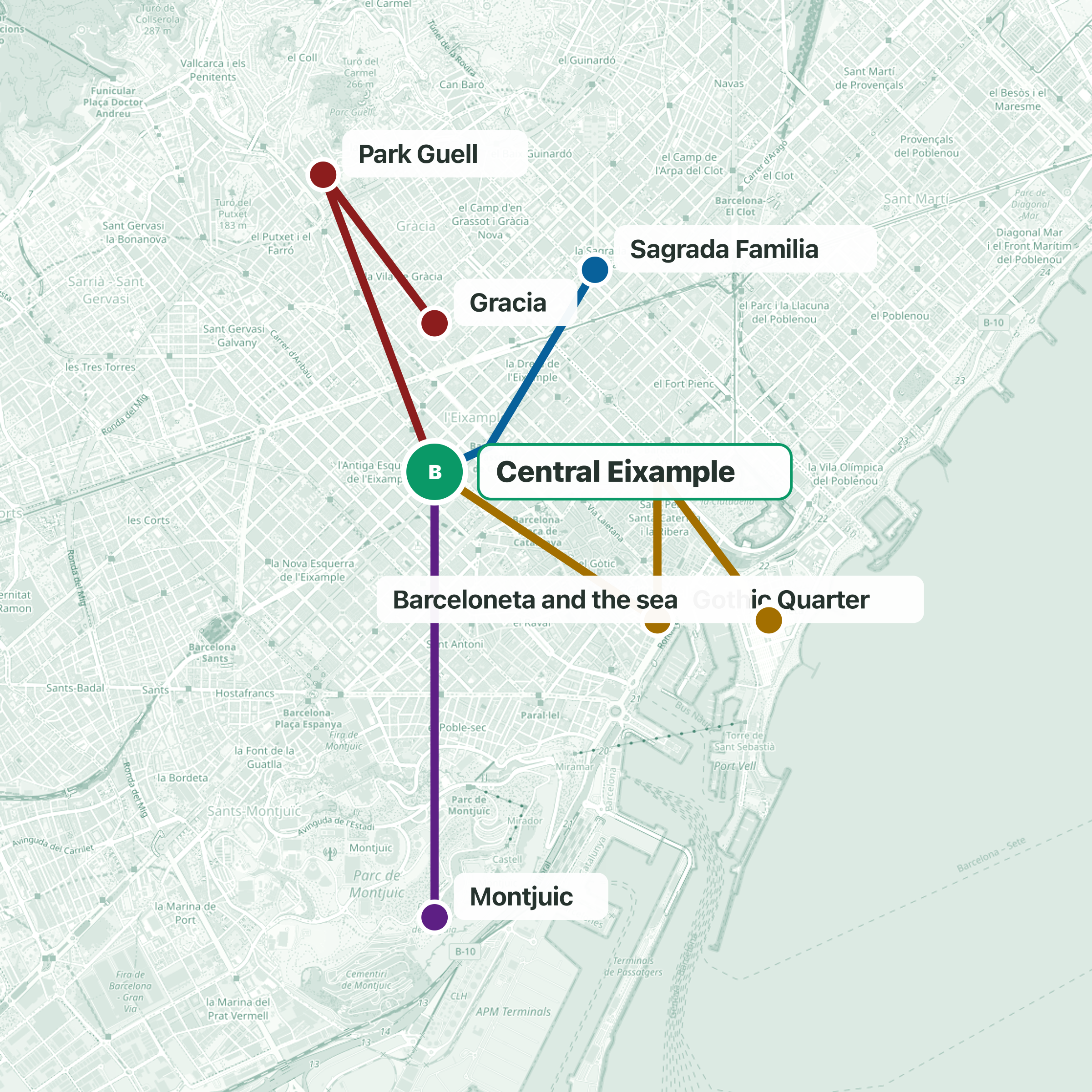
How to plan the route
On day one, head southeast from Eixample towards Ciutat Vella and the sea. The Barri Gòtic is the medieval core: narrow streets, Roman remains, and buildings that recall a Barcelona enclosed by walls for centuries. Do not make La Rambla the main goal. Use it, if it suits your route, as a passage towards the port.
From the Gothic Quarter, continue on foot to El Born. This former merchants’ district keeps streets tied to old guilds and offers a clearer sense of Barcelona’s commercial past. Santa Maria del Mar, a Gothic church connected to that maritime city, helps explain its medieval scale. Finish in Barceloneta, not as a beach day but as a port and residential neighbourhood where the historical walk reaches the Mediterranean.
Day two is for Eixample and Modernisme, Catalan Modernism. Begin on Passeig de Gràcia, where Casa Batlló and La Pedrera show how bourgeois architecture transformed a regular urban grid. The experience lies in the façades, but also in the contrast between their forms and the avenue’s geometry. If you visit one house, Casa Batlló is the more narrative and colourful choice. La Pedrera offers a more architectural reading through its interiors and rooftop. But the day’s central visit is Sagrada Família.
Give it its own block of time. Going inside makes it far easier to understand how Gaudí uses columns, light, and natural references to create a religious space. The basilica remains under construction, and that continuity is part of its history. Before or after, include Hospital de Sant Pau, designed by Lluís Domènech i Montaner. It is the best way to avoid reducing Modernisme to Gaudí alone. The movement expressed an industrial city, a powerful bourgeoisie, and a Catalan culture looking for its own forms of representation.
On day three, take the metro or bus north to the upper part of the city. Park Güell is a monumental park where architecture, ceramics, and landscape form one experience. It began as a private urban project and became a public space. Give it half a day, and do not combine it with Sagrada Família as a rushed visit. Both need time of their own.
Walk down towards Gràcia
Then walk down towards Gràcia, a neighbourhood of squares and a more everyday scale than Eixample’s avenues. A meal or a stroll through its squares is enough to feel the change of pace without adding another list of districts. On day four, cross southwest from Eixample to Montjuïc, the urban mountain that changes Barcelona’s scale. It brings together gardens, views, the legacy of the 1929 International Exposition, and the venues of the 1992 Olympic Games.
Choose MNAC, the Museu Nacional d’Art de Catalunya, for a broad view of Catalan art inside the Palau Nacional. The lighter alternative is the Olympic Ring, or Anella Olímpica, which shows how the Games transformed this part of the city. Montjuïc deserves priority over another central museum because it combines landscape, art, and urban memory in one stage.
The one practical warning is to plan Sagrada Família and Park Güell in advance, as access conditions and opening times can vary. With five days or more, Montserrat can become an optional full-day trip. It adds mountains and a monastery, but shifts the trip away from the city. Include it only without cutting Montjuïc or the central experiences.
Remember three choices: see Barcelona in layers, keep Sagrada Família and Park Güell on separate days, and use Eixample as your base before ending at Montjuïc.
To continue, you can generate a Five Cents on Montserrat from Barcelona in one day. To explore another angle, you can generate a Five Cents on Barcelona Modernisme beyond Gaudí.