

Introduction
This is Five Cents: travel guide to Bangkok. We’ll organize a first visit around a river-shaped capital, where royal landmarks, trading neighborhoods, and a modern commercial center belong to one living city. The route starts with the historic riverbanks, gives Chinatown its own evening, and finishes with a deliberate change of scene.
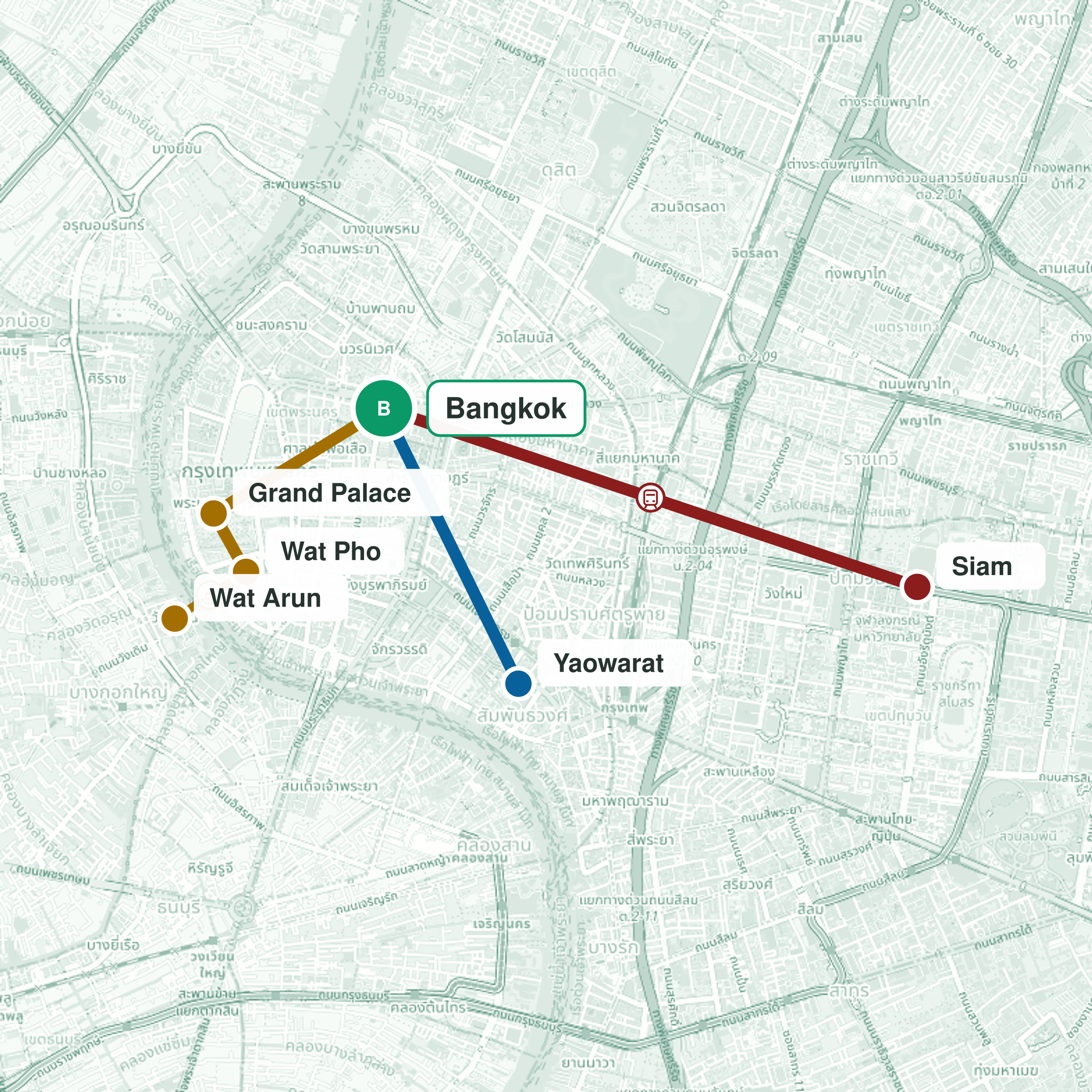
Start by giving each area enough time
Start by giving each area enough time. Plan three full days, with arrival time outside that sightseeing schedule, and keep one hotel base throughout. That lets you explore a different part of Bangkok each day without moving your luggage or repeatedly crossing the city between visits. The Chao Phraya, the river running through Bangkok, is your main geographic reference. The royal historic core lies on its east bank. The crossing to the west bank will be part of your first day.
Use transport to suit that geography. Walk between neighboring historic sights, take a boat across the river, and use the BTS elevated railway or MRT metro where their routes fit your journeys. Road travel across the city can take an unpredictable amount of time, which makes grouping nearby places especially useful.
For arrivals at Suvarnabhumi Airport, the Airport Rail Link connects with Phaya Thai, a station in the city. Don Mueang, Bangkok’s other airport, has different connections, so those arrival journeys are separate from the route we’re following. On day one, head from your hotel into Rattanakosin, the historic district on the east bank. Bangkok became the capital in seventeen eighty-two, when the royal center moved here. That helps explain why the palace and major Buddhist landmarks sit together beside the river.
Make the Grand Palace your main visit. This royal compound contains Wat Phra Kaew, the Temple of the Emerald Buddha. Give it a substantial part of the day. The value is in exploring the compound and understanding the connection between royal and religious architecture, rather than treating it as a quick photo stop.
The route step by step
From the palace, walk south through the adjoining historic cluster to Wat Pho. This Buddhist temple is known for its reclining Buddha, but leave time for the temple grounds as well. The religious art and surrounding buildings give the visit more depth than seeing the headline image alone. Its location beside the palace also keeps the day coherent. You’re continuing through the same historic area.
Then cross the Chao Phraya by boat to Wat Arun, a major riverside temple on the west bank, in the area known as Thonburi. Here, the movement matters as much as the destination. You leave the royal east-bank core, travel over the water, and arrive at a temple whose setting makes the river’s place in Bangkok immediately clear.
Together, these visits fill a historic-core day. Allow time to explore each site instead of rushing between them. Day two shifts from monumental Bangkok to a trading neighborhood. From your hotel, head to Yaowarat, Bangkok’s Chinatown, southeast of the royal historic core and still on the east-bank side. Use the MRT where the connection suits your base, then explore on foot.
Give Yaowarat an afternoon and evening. Begin with its commercial streets and shrines, taking time to see how businesses, food, and religious life share the neighborhood. Its Thai-Chinese character comes from a long history of trade and migration, with crafts and community life alongside commerce.
Stay into the evening for the street-food atmosphere
Stay into the evening for the street-food atmosphere. Make eating part of your walk through the area, rather than treating Chinatown simply as somewhere to have dinner. The point of this outing is the relationship between the food and the streets around it. You’re seeing a commercial neighborhood whose daily life adds something different from the palace and temples.
Keeping the afternoon and evening together also gives you time to explore without making a separate return journey. For day three, head east of the historic riverfront districts to Siam, Bangkok’s modern commercial center. Travel by rail where the connection fits, then continue on foot.
This is the final day’s main contrast. After the royal compound and Chinatown’s trading streets, spend time exploring the commercial center to understand Bangkok as a present-day metropolis. The change of setting broadens the trip beyond its temple image. Give this part of the city room in the schedule, rather than adding another circuit of religious landmarks.
Keep three decisions in mind: one hotel base and three full days organized by area; a historic-core day that crosses the river to Wat Arun; and a Chinatown evening followed by a modern contrast. To explore further, you can generate another Five Cents asking: How did trade and migration shape Yaowarat? Or: How can you explore Thonburi’s canals and waterside neighborhoods? The first develops Chinatown’s history. The second focuses on the smaller waterways, with current excursion logistics established for that trip.