

Introduction
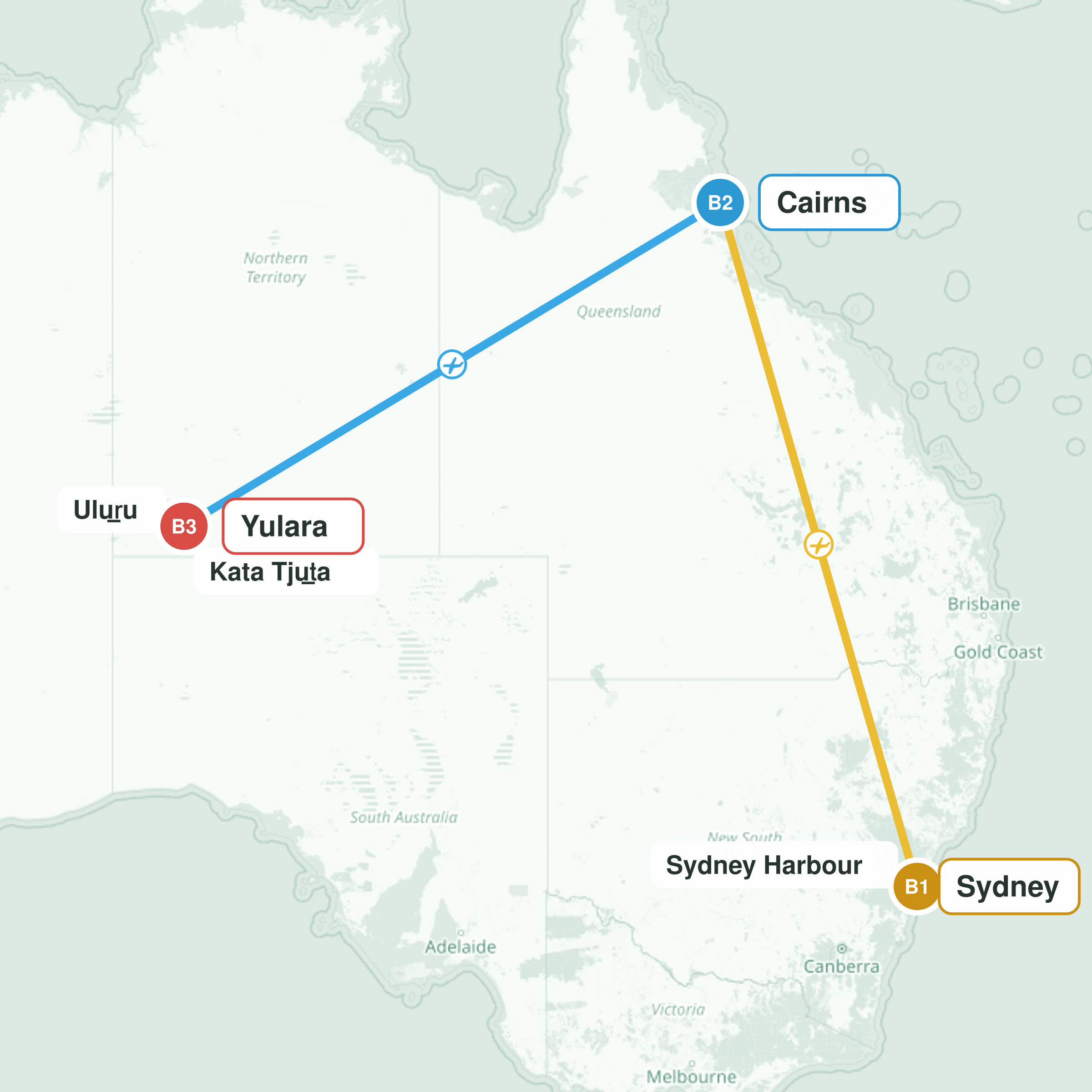
This is Five Cents: travel guide to Australia. This guide helps you plan a first visit through three contrasting regional journeys, connected by flights rather than a drive across the continent. The route moves from a coastal city to a tropical marine ecosystem, then inland to a desert landscape whose cultural meaning is central to the visit.
How to plan the route
Start by giving each region enough time to justify the journey. Allow roughly two weeks overall: four days in Sydney, four around Cairns, and three near Uluṟu–Kata Tjuṯa, with another two or three days for international travel, connections, and recovery. Those eleven regional days offer a coherent introduction, rather than coverage of the whole country. With just one week, concentrate on one region.
Sydney, a coastal city organised around its harbour, is the recommended international entry point. From there, fly north along the east coast to Cairns, a tropical Queensland base for the Great Barrier Reef. The final regional move takes you southwest into the interior, to the Red Centre. Flights handle the long distances. Public transport, a reef boat excursion, and local travel handle the experiences within each stay.
Begin in Sydney by taking the airport train into the city, then use public transport for the wider urban area. Make Sydney Harbour, the waterway around which much of the city is arranged, the focus of your four days. Its public waterfront gives you a clear way to explore on foot, without turning the visit into a scattered checklist.
The main experience is simple: spend time walking beside the harbour, seeing how the city meets the water, and using its public spaces. Build your days around stretches of waterfront rather than rushing between unrelated attractions. This gives the opening stage a recognisable character: an urban visit where the harbour provides both orientation and room to spend time outdoors.
Four days also leave space to settle after arrival. You can get to know the waterfront gradually, with public transport connecting the parts that sit beyond a comfortable walk. The point of this first stay is to understand a coastal city before the route changes scale and setting. Your next base is Cairns. Give this tropical stage four days, including the regional transfer, and make a full-day boat excursion to the Great Barrier Reef its centrepiece.
The route step by step
The reef is an immense marine ecosystem extending along Queensland’s coast, rather than one interchangeable snorkelling spot. Cairns provides an established starting point for experiencing a small part of it. Staying in one base keeps your time focused on the marine outing, instead of repeated moves between coastal towns.
The excursion takes you offshore by boat, with snorkelling as the main way to experience the underwater environment directly. Diving offers a more involved alternative. Set aside the whole day. The boat journey and time in the water belong together, rather than being squeezed into a brief stop between flights. What matters here is giving the ecosystem meaningful attention, not claiming to have seen the entire reef.
Keep some flexibility within the Cairns stay for the outing. Seasonality matters specifically in this tropical region: the north broadly has wet and dry seasons, with May to October generally the dry-season period. That helps frame the northern leg. It does not establish one best season for the whole country.
The final stay takes you inland to Uluṟu–Kata Tjuṯa, a Red Centre landscape recognised for both natural and cultural values. Stay near the park for three days, keeping journeys local once you arrive.
Begin at the Cultural Centre, where interpretation introduces Aṉangu culture and the natural environment. Aṉangu are the Traditional Owners here, and their relationship with Country is essential to understanding what you will see. Tjukurpa connects traditional law, stories, spirituality, land, and behaviour. This is a living cultural landscape, with meanings that extend beyond its geology.
Follow that introduction with a walk at Uluṟu
Follow that introduction with a walk at Uluṟu, then devote time to Kata Tjuṯa, the other principal landscape within the park. Let the interpretation shape how you approach both places. These traditions belong to this Country. They should not be treated as a summary of all Aboriginal and Torres Strait Islander cultures.
Current track access needs checking before you settle on a particular walking route. The broader sequence remains straightforward: cultural understanding first, time at Uluṟu next, and Kata Tjuṯa as a distinct part of the stay. Remember three decisions: choose three regions for roughly two weeks, give the reef a full day from one deliberate base, and understand Uluṟu as living Aṉangu Country.
To continue, you can generate another Five Cents answering either of these questions: How should you combine Melbourne and the Great Ocean Road? Or, how can Aṉangu interpretation deepen a visit to Uluṟu–Kata Tjuṯa? The first develops a separate city-and-coastal-drive journey. The second explores the cultural understanding behind the final stage.