

Introduction
This is Five Cents: travel guide to Argentina. Let’s plan a first trip that combines Buenos Aires, Patagonia and, only if you have extra time, Iguazú—without turning the journey into a chain of airports. You’ll start in the capital, drive through the northern Patagonian lakes, hike and see glaciers in the south, then decide whether to finish in the subtropical northeast.
The best place to begin is with scale
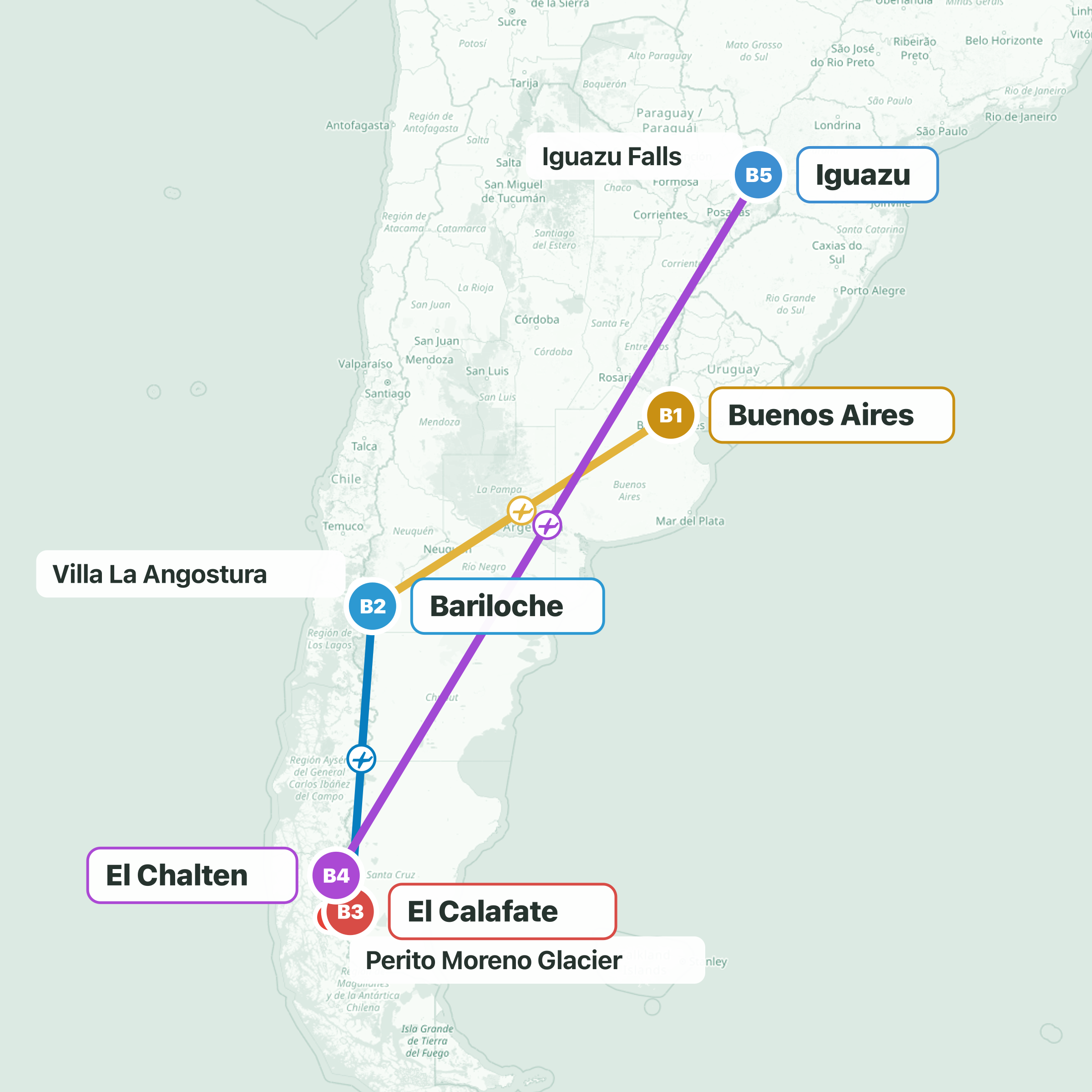
The best place to begin is with scale: Argentina works best when you choose a few geographic blocks and give them proper time. Allow ten to twelve days for Buenos Aires and Patagonia: two in Buenos Aires, three in Bariloche, three nights in El Chaltén, and two or three days in El Calafate. Add two days for Iguazú.
Buenos Aires is the international gateway and gives the trip its urban and cultural context before the move south. It is a city with an intense cultural life, and it helps explain a country where the capital sits alongside very different regional identities. Give it two days, but do not turn this into a neighbourhood-by-neighbourhood guide. Its role here is to open the journey and connect you with Patagonia.
From Buenos Aires, fly to Bariloche, the northern Patagonia base for lakes, forests, mountain scenery and road trips. This is where a car matters: it lets you move freely between viewpoints, lakes and forest roads. Start with Circuito Chico, an easy-going loop around Bariloche that gives you a first sense of the lake landscape without taking up a full day. Then set aside two or three days for the Route of the Seven Lakes, linking Bariloche with the areas around Villa La Angostura and San Martín de los Andes through Andean forests and lakes.
The point is not to arrive quickly. It is to drive, stop, and watch the scenery change along the way. If you enjoy riding, a large rental motorbike can also be a great way to experience this road. With extra days and a desire to hike, Cerro Tronador adds a mountain excursion; an overnight stay in a mountain refuge brings sunrise and sunset into the experience.
The next move changes the character of the trip completely
The next move changes the character of the trip completely. If it operates on your dates, consider the direct flight from Bariloche to El Calafate, rather than returning to Buenos Aires to connect between two flights. From El Calafate, continue overland to El Chaltén. Both sit within the Los Glaciares system, but they serve different purposes. El Chaltén is a hiking base, and it deserves three nights rather than a rushed visit. You do not need a car here, because the main trails begin in town.
The priority is Laguna de los Tres, the main hike to the Fitz Roy massif. It crosses Andean forest and passes Laguna Capri before reaching the final viewpoint. Do it early in your stay, when your legs are fresh, and set off early. The final climb is demanding, so it is worth allowing enough time for it. If you have another full day, Laguna Torre offers a second view of the mountain range. El Chaltén has restaurants and breweries, but the number of nights should be shaped by the trails you want to walk.
Then return overland to El Calafate, the base for the glaciers of southern Patagonia. A car is usually unnecessary here, as organised excursions handle the transport. Perito Moreno Glacier is essential, but do not reduce it to a walk along the viewing platforms. The walkways let you observe the glacier front from different levels. A boat trip changes the scale, bringing you closer by water to its ice walls.
Ice trekking is the most distinct option: walking among blue tones, crevasses and shapes that you can only partly make out from outside. If time and operations allow, pair the platforms with either ice trekking or a boat trip. With an additional day, a navigation trip among several glaciers broadens the experience to other fronts in the system.
Once Patagonia is covered
Once Patagonia is covered, Iguazú is the extension that truly changes the trip. Flying northeast from El Calafate takes you from mountains and ice to subtropical rainforest. Spend one day on the Argentine side, where the circuits bring you close to the falls, and another on the Brazilian side, where the panoramic view completes the scale of the whole system. You can cross during the day and stay in Puerto Iguazú.
Mendoza and Salta deserve trips of their own: Mendoza for wine, the Andes and dry landscapes; Salta for its Andean north and quebradas, or mountain valleys. Do not take days from this route just to add them too quickly. Keep three decisions in mind: choose a few regions and link them with domestic flights; use Bariloche for roads and lakes, then El Chaltén and El Calafate for mountains and ice; leave Iguazú until the end, without sacrificing Patagonia.
For cultural preparation, El peronismo explicado a los españoles helps explain how deeply politics runs through Argentine society and the weight of contemporary Peronism. For your next Five Cents episode, you could explore Los trekkings de El Chaltén: cómo elegir entre Laguna de los Tres y Laguna Torre, or Glaciares de la Patagonia: pasarelas, navegación y trekking sobre hielo.