

Introduction
This is Five Cents: travel guide to Amsterdam. This guide organises four nights around the city’s underlying logic: water, trade and urban planning. We’ll explore the canal ring, the Jordaan, the Museum Quarter and De Pijp, without turning the trip into a race between museums or nightlife spots.
How to plan the route
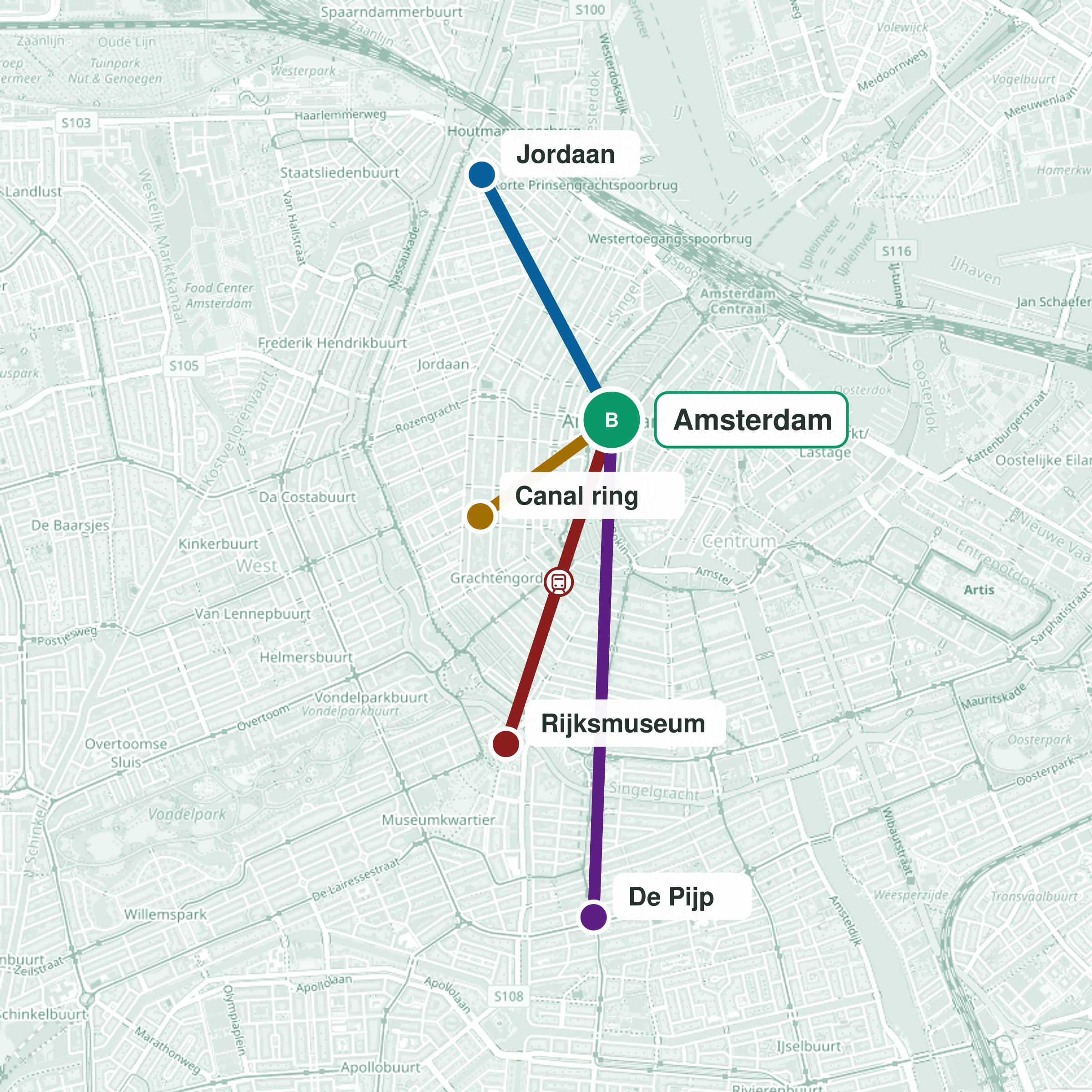
The best starting point is to understand that the canals aren’t just scenery: they form Amsterdam’s structure. Arrive at Schiphol and take the train north to Amsterdam Centraal. The journey takes fourteen to seventeen minutes. Centraal is the natural place to get your bearings, but then head south and west into the historic centre. Stay in the canal ring, the Jordaan, Oud-Zuid or De Pijp to keep the central route within walking distance. Explore the centre on foot, using trams or the metro for longer journeys.
Your first priority is a canal cruise, ideally early in the visit. Allow around an hour. From the water, the concentric canals, bridges, narrow merchants’ houses and former trading districts make sense as a connected system. This was a planned seventeenth-century expansion: water management, housing and commerce were designed together for a city trading around the world.
Walking reveals the details; the boat explains the layout. Next, walk west through the Nine Streets and into the Jordaan. The Nine Streets are a compact cluster of small streets crossing the main canals. They combine independent shops and cafés with canal-side architecture. Think of them as a link between neighbourhoods rather than a shopping mission.
The Jordaan, just beyond, was historically a working-class neighbourhood. Today, it offers quieter canals, small galleries and a more lived-in atmosphere than the busiest parts of the centre. Allow two to four hours for this stretch, including time along Prinsengracht and Brouwersgracht. Within the Jordaan, the Anne Frank House adds an essential historical dimension. The museum uses the original building, objects, photographs and personal accounts to tell Anne Frank’s story and explain the persecution of Jews during the Second World War.
Allow around an hour
Allow around an hour, and make it the fixed appointment around which you plan the day. Entry requires a timed ticket through the Anne Frank House’s official website, so arrange your walk around that slot. The next day, head south from the canal ring to Museumplein, the heart of the Museum Quarter, by tram or on foot.
Choose one major museum and give it proper time. For most first visits, choose the Rijksmuseum. Its collection spans around eight hundred years of Dutch art and history, including Rembrandt’s The Night Watch and Vermeer’s The Milkmaid. Through art, it also reveals the wealth that sustained Amsterdam’s Golden Age. Allow two to three hours, or focus on the highlights if you have less time.
The Night Watch is being restored inside a glass chamber visible to visitors, making conservation part of the experience. Choose the Van Gogh Museum instead only if you want a focused account of one artist’s life rather than a broad national collection. Don’t treat both as obligations on the same day.
After the museum, take a break in nearby Vondelpark before continuing through the city. From Museumplein, head south-east to De Pijp for the afternoon and evening. This neighbourhood of cafés, restaurants and market life shifts the focus from monumental Amsterdam to everyday city life. It’s the strongest local extension for a first visit because it stays connected to the main route without repeating the canal ring.
If you have another half-day and want a sharper contrast
If you have another half-day and want a sharper contrast, choose Amsterdam Noord. Take the free ferry from behind Centraal across the IJ to a newer waterfront, with contemporary architecture and former industrial spaces. It’s a worthwhile alternative after the historic centre, but De Pijp is the stronger all-round choice for a compact first trip.
Once you’ve completed the main route, Zaanse Schans is an optional extension. It takes most of a day and adds windmills, traditional industrial heritage and Dutch rural scenery. Include it only after giving the canals, the Jordaan and one major museum the time they deserve. Remember three decisions: see the canal ring from the water before turning it into a photo walk. Choose the Jordaan and the Nine Streets for the lived-in side of the historic city. And give one museum proper time, with the Rijksmuseum as the strongest general choice.
To continue, you can generate another Five Cents: Amsterdam: Comparing the Rijksmuseum, Van Gogh and Stedelijk.
To explore further, you can generate Amsterdam Beyond the Canal Ring: Noord, Oost and Westerpark.