

Introduction
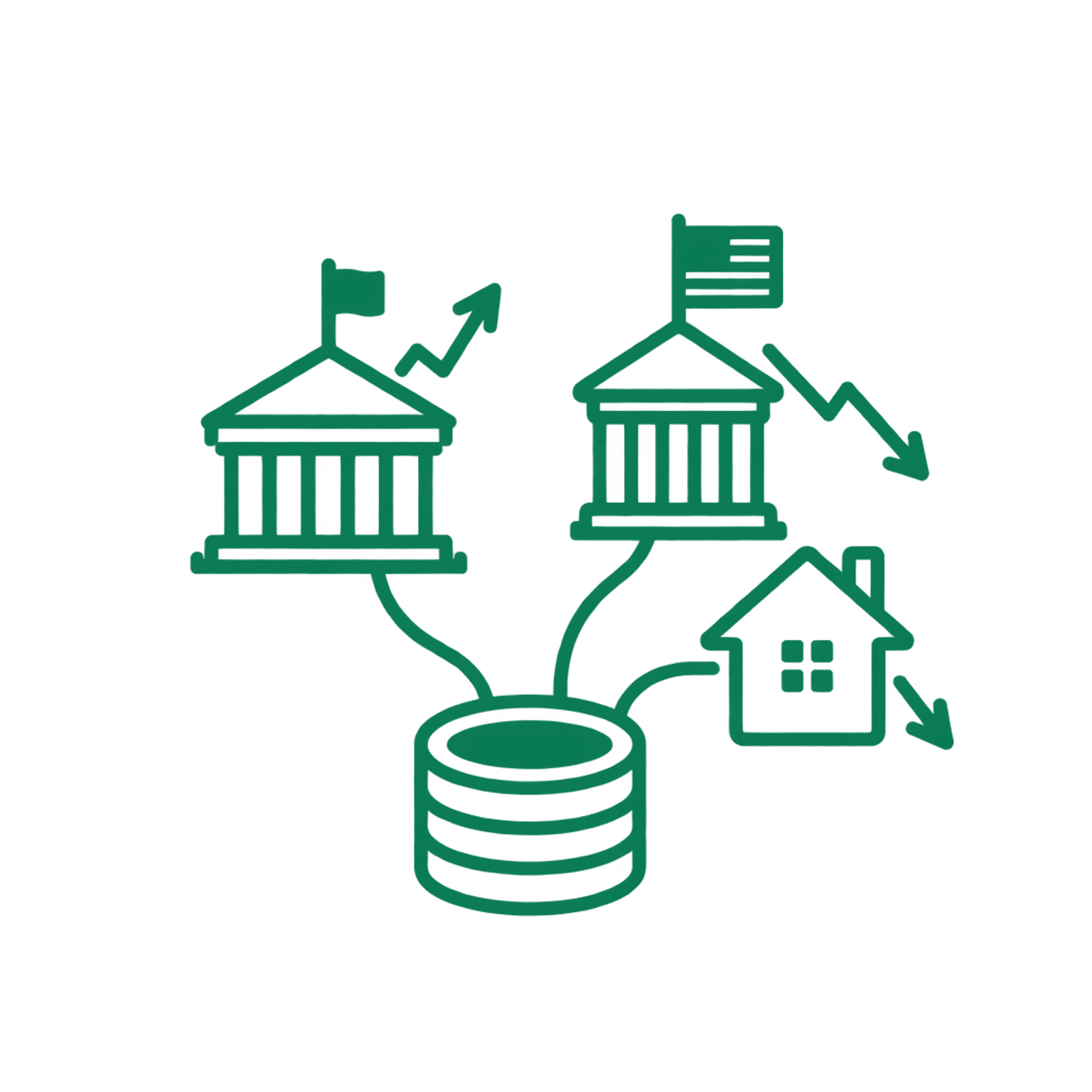
Five Cents explores Borrowing costs to explain why governments and households can face very different interest rates, even when financial markets are closely connected. France’s rising bond yields, easing US Treasury yields and a small decline in American mortgage rates show that divergence. To understand those moves, start with what investors are actually pricing.

There is no single global borrowing rate
There is no single global borrowing rate. Central banks set short-term policy rates, but investors determine government bond yields through market trading. Banks and other lenders then price mortgages and business loans using their funding costs, the borrower’s circumstances and the risk of not being repaid.
A bond yield is the return available at its current market price. When investors sell bonds and prices fall, yields rise. That matters to governments because yields influence the rates they must offer when issuing new debt. Investors consider expected inflation, future central-bank decisions and how long they are lending for. They also assess the borrower’s finances. These shared influences can move markets together, while country-specific concerns pull them apart.
France provides the sharpest example in the supplied October reporting. Its ten-year government bond yield crossed five percent on October twenty-first. It reached about five point one four percent the next day, its highest level since July two thousand two. The pressure was not simply a response to worldwide interest-rate expectations. Investors were also demanding a larger premium to hold French debt rather than German government bonds.
That gap, known as a spread, helps reveal how investors view France’s risks relative to another borrower using the same currency. France’s government and parliament face the task of passing a twenty twenty-seven budget and convincing investors that the deficit can be contained. Political uncertainty and street protests have contributed to market concerns. But that does not establish that protests alone caused the rise. Bond prices reflect several judgments at once.
For the public finances, the effect builds gradually. France does not suddenly pay the latest ten-year yield on every euro it already owes. Existing fixed-rate debt keeps its agreed interest payments. Higher costs feed through as debt matures and the government refinances it, or borrows more.
The context
Over time, that can leave less room for public services, investment or other priorities. A credible budget could reduce the extra return investors demand. But credibility depends on whether measures can pass and deliver results. A central-bank decision cannot, by itself, resolve that domestic fiscal question.
Now compare that with the second development: US Treasury yields eased from their earlier peaks. October reporting put the ten-year yield just below five percent before it moved back towards that level. One interpretation was that demand for Treasuries benefited from unease elsewhere, including France. When more investors want a bond, its price rises and its yield falls.
Expectations about the American economy and Federal Reserve policy also matter. So it would be too simple to attribute the move to money leaving France. The contrast is important internationally. Treasury yields influence financing conditions beyond the United States, including borrowing in dollars. But they do not dictate every country’s rates. Currency movements, local inflation, public finances and credit risk can outweigh a move in the American benchmark.
The third development brings the story into household budgets. The average long-term US mortgage rate fell to seven point three two percent on October twenty-second. It was the first weekly decline since late August. That was modest relief, not a return to cheap borrowing. Fixed mortgage rates are influenced by longer-term bond yields, but they do not match them exactly. Lenders also account for funding expenses, credit risk and the possibility that borrowers repay early.
That is why a central-bank rate cut does not guarantee an equivalent drop in a mortgage offer. The effects differ across countries, too. Someone with a mortgage fixed for many years may feel little immediate change. A borrower approaching a reset or refinancing date can face a much quicker adjustment.
Why it matters
Businesses encounter a similar divide between existing fixed-rate debt and loans that need renewing. The useful distinction is between a market move and its eventual impact. One week of lower yields does not establish a lasting trend. Nor does a higher government yield mean every household or company will immediately pay more.
Watch which rate changed, which borrower it applies to and when existing debt must be replaced. Borrowing costs share global influences, but local risks still matter. France’s premium illustrates that difference. Easing Treasury and mortgage rates show why the direction is not uniform. And the consequences arrive through new borrowing, refinancing and contract resets, rather than all at once.
To explore this further, you can generate two new Five Cents: How Governments Refinance Debt and Fixed Versus Variable Mortgages. And with that, you're up to speed in a few minutes.