


Introduction
In Five Cents Quantum Computing’s Error Bottleneck, we’re unpacking how Google’s Willow experiment produced cleaner magic states, and what that means for reliable quantum computation. We’ll connect the mechanism to two crucial numbers: a fortyfold error reduction and an eight percent acceptance rate. The starting point is why these special states are needed at all.
Error correction does not make every quantum operation equally easy
Error correction does not make every quantum operation equally easy. Some operations fit naturally within an error-correcting code. Others are harder to carry out without compromising the protection that code provides. A useful, general-purpose quantum computer needs both.
One common solution is to prepare a special quantum state separately, check its quality, and then consume it to perform a difficult operation. These are called magic states. They can enable operations such as the T gate, which helps complete the set needed for universal quantum computation.
The practical issue is supply. An algorithm may need these states repeatedly, so preparing one excellent state is not enough. A machine needs to deliver sufficiently reliable states at the rate its computation requires, without devoting unreasonable amounts of hardware and time to producing them.
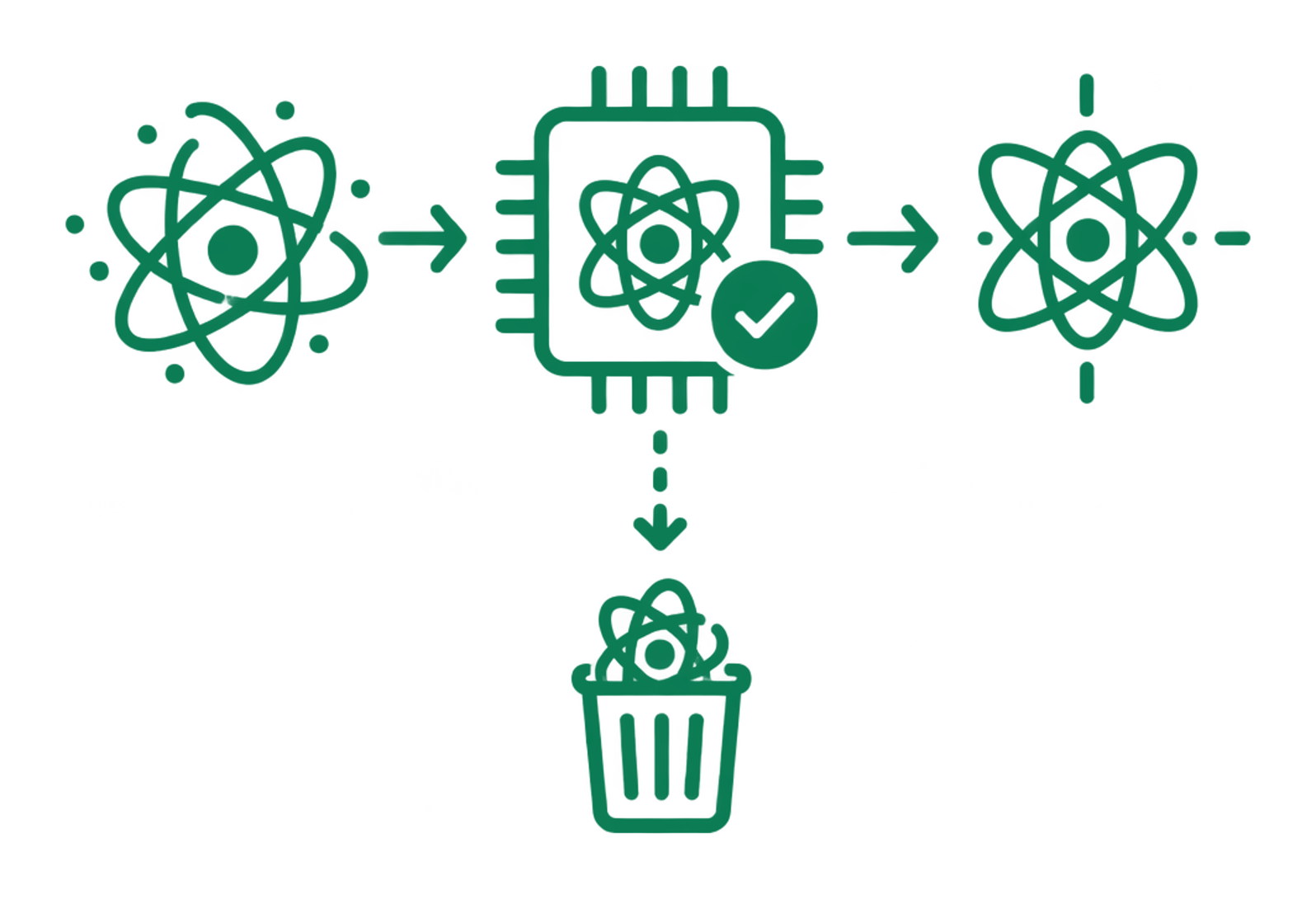
That is the specific problem behind magic-state cultivation. The protocol begins with an imperfect state, encodes it, and uses coordinated measurements to check for errors. Attempts that fail the checks are rejected. The accepted states are the outputs whose quality matters for the reported result.
Those checks must extract information about errors without simply measuring away the quantum state being prepared. That is part of the experimental challenge. The checking operations themselves run on imperfect hardware. The protocol has to improve the surviving state despite noise introduced along the way.
On its Willow superconducting processor
On its Willow superconducting processor, Google demonstrated this process experimentally. The reported accepted outputs had about 99.99 percent fidelity, alongside a fortyfold reduction in error relative to the uncultivated comparison. Eight percent of attempts were retained. All three figures describe the result. None should be read alone.
Fidelity measures how closely a prepared state matches the intended target. Here, about 99.99 percent fidelity describes the reported accepted outputs. It does not mean that Willow as a whole is 99.99 percent accurate, or that a long quantum algorithm would succeed with that probability.
Likewise, fortyfold lower error does not mean fortyfold greater computing power. It is a comparison of state-preparation error under the conditions of this experiment. That is valuable evidence about one component, not a direct measure of the performance of an entire computer. Now consider the eight percent acceptance rate. Out of a hundred attempts, roughly eight passed the checks for this result. The others were discarded. The quality improvement therefore comes with a production cost: unsuccessful attempts still require hardware operations and time.
But rejecting ninety-two percent does not automatically make the method impractical. What matters is the total cost of supplying usable states compared with alternative methods. A low-yield process could still be competitive if attempts are sufficiently quick or inexpensive. This experiment alone does not settle that comparison.
There’s another important part of the demonstration. The team reports transferring a cultivated state from a distance-three color code into a distance-five surface code. These are different ways of encoding quantum information so errors can be detected and corrected.
Why it matters
That transfer matters because a preparation method must connect to the protected computation that will consume its output. Producing a good state in one encoding is less useful if moving it into the working architecture destroys the quality advantage. The demonstration addresses that interface, although it does not establish that the whole process scales economically.
For a larger system, the relevant questions become more demanding. How many accepted states can it deliver per second? How many physical qubits does that require? How much error is introduced while accepted states wait or move? And can production keep pace with an algorithm’s needs?
The result provides hardware evidence for one proposed route to better magic states. It does not demonstrate a scalable, general-purpose fault-tolerant computer, or a useful end-to-end algorithm running on one. Larger-scale cultivation and its integration into sustained computation remain engineering goals.
The takeaway is specific: accepted states became substantially cleaner, acceptance was limited, and useful performance will depend on the combined cost of quality and production. The milestone is real without being a complete machine. To explore the next steps, you can generate two new Five Cents episodes: Magic-State Factories and Their Costs, about sustained production, and Color Codes Versus Surface Codes, about the encoding choices behind that transfer.
And with that, you're up to speed in a few minutes.