


Introduction
With Five Cents, discover how to watch football with fresh eyes by noticing what creates a chance before the final pass arrives. We’ll look at space, pressing, off-ball runs, and the first decisions after possession changes. You don’t need to memorise formations or learn a new vocabulary. The best starting point is to look just beyond the ball. Carry one question through the match: where is the space, who is shaping it, and what happens when possession changes? Start with the gaps between defenders and midfielders. When a commentator says someone is playing between the lines, that means they’re finding room between those opposing units. A player receiving there may be able to turn and attack the defence. But an apparent gap isn’t always usable. The passer needs a clear route, and the receiver needs time. Watch whether defenders move together as the ball travels, keeping those gaps small.
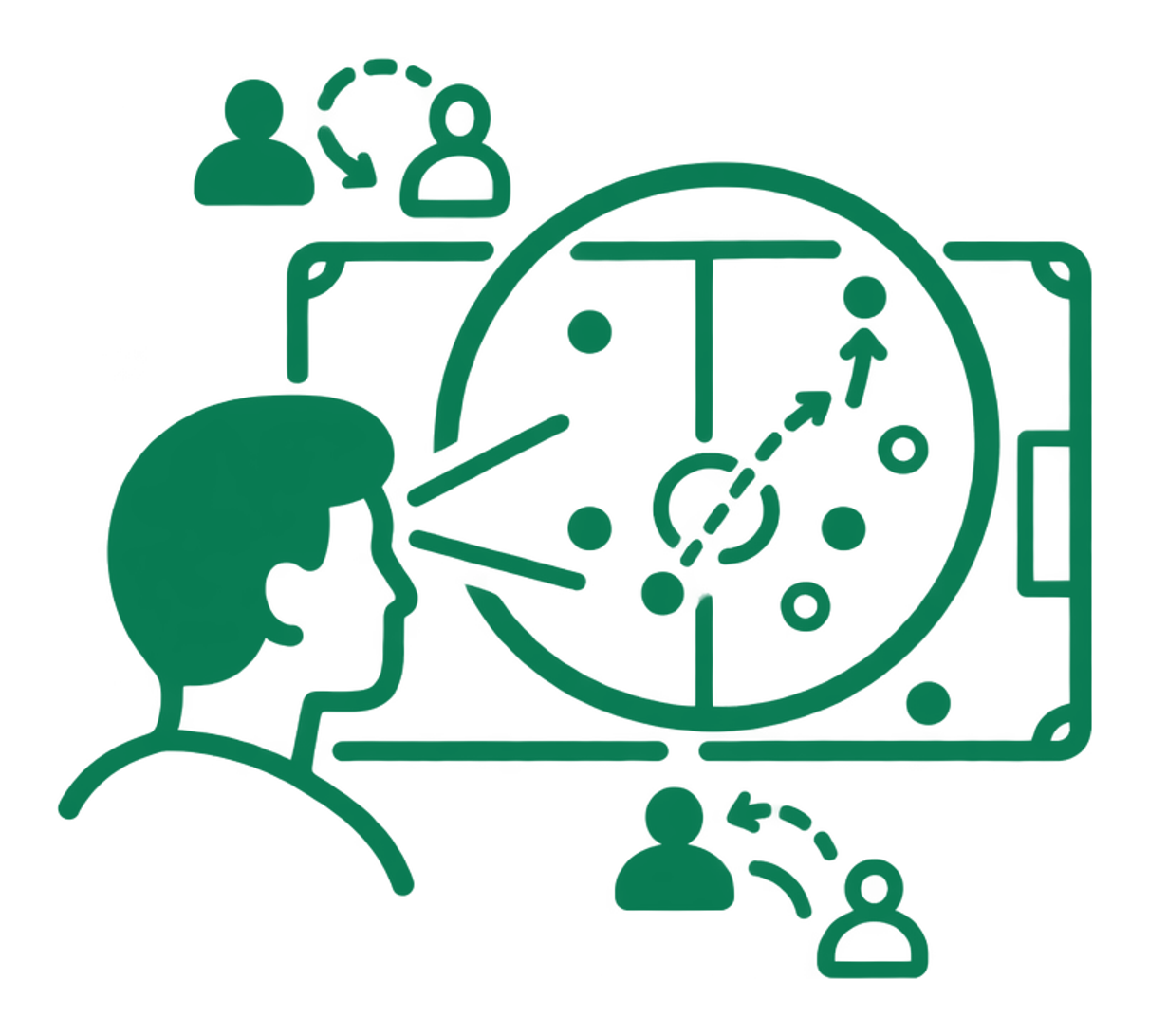
Space also exists around the outside of a team
Space also exists around the outside of a team. If defenders crowd one side, the opposite wing may open up. That’s why a sideways or backward pass can help an attack rather than stall it. It may give someone time to switch the ball across the pitch. Watch the far-side attacker before the switch. Are they staying wide, and does support arrive when the pass reaches them? The opening matters only if the team can use it before defenders recover. A formation gives you a starting arrangement. These movements show you how the team actually plays.
Now look at pressing, and resist the temptation to judge it by the player running hardest. Pressing means putting pressure on the opponent in possession, ideally while teammates restrict the available passes. When a forward closes down a defender, look behind the forward. Has a midfielder moved towards the next receiver? Has the defensive line stepped up to keep the team connected? A backward pass, a heavy touch, or a receiver facing their own goal can be a cue to press.
The approaching player’s angle matters too. They may close one passing route while encouraging another. If teammates don’t support that pressure, a simple pass can take the first defender out of the action. Equally, a team holding a compact shape around midfield isn’t necessarily passive. It may be protecting the centre and waiting for a better moment to challenge.
Follow an attacker who doesn’t have the ball
Next, follow an attacker who doesn’t have the ball. Choose one for a short passage rather than trying to watch everyone. Notice whether they come towards the ball, move into a gap, or run behind the defence. Then watch the defender’s response. A forward coming short might draw a centre-back out, leaving room for a teammate to run through. If the defender stays put, the forward may instead become available to receive.
The movement creates a decision, not a guaranteed opening. Timing makes the difference. A run made too early can be tracked before the passer is ready. You might also spot a third-player combination. One player passes to a teammate, who lays the ball off to another runner arriving in space. The important action began before that runner received anything. A player can make a valuable contribution without touching the ball.
When possession changes, shift your attention immediately. These are transitions: the moments when both teams must adjust to their new roles. Watch the first two or three actions. After winning the ball, does the player look forward, carry it into space, or choose a safer pass? Who offers support, and who runs beyond the ball? A quick attack can exploit opponents who haven’t recovered their positions. But forcing a forward pass into a crowded area can waste the opportunity. Keeping possession may be the better choice.
Watch the team that lost it
Now watch the team that lost it. Nearby players might press immediately to prevent an escape, while others cover passing options. Alternatively, they may retreat and rebuild their defensive shape. Don’t follow only the new ball carrier. The recovering defenders often explain why a promising counterattack succeeds or stops.
To practise, replay one attack three times. First follow the ball. Then follow the nearest defender. Finally, follow an off-ball attacker and ask what their movement changed. On the next turnover, track those first few decisions. Avoid treating every sprint as useful, every backward pass as negative, or every missed chance as evidence of bad tactics. A good sequence can end with a poor finish. And one movement doesn’t reveal a coach’s entire plan. Look for patterns across several attacks. If the television picture hides the far side, leave that part of your interpretation open.
Watch the gaps as well as the ball, judge pressure by its support, and notice how quickly roles change after a turnover. To explore this further, you can generate two new Five Cents podcasts: Reading Midfield Control and How Teams Defend a Lead. And with that, you're up to speed in a few minutes.