


Introduction
In Five Cents How an Idea Becomes a Startup, we’re following the path from a promising idea to a business that customers actually want. We’ll look at finding a problem, choosing customers, building a prototype, testing demand, and deciding how to fund what comes next. These steps overlap, and sometimes you go backwards. The best place to begin is not with what you could build, but with what someone needs.
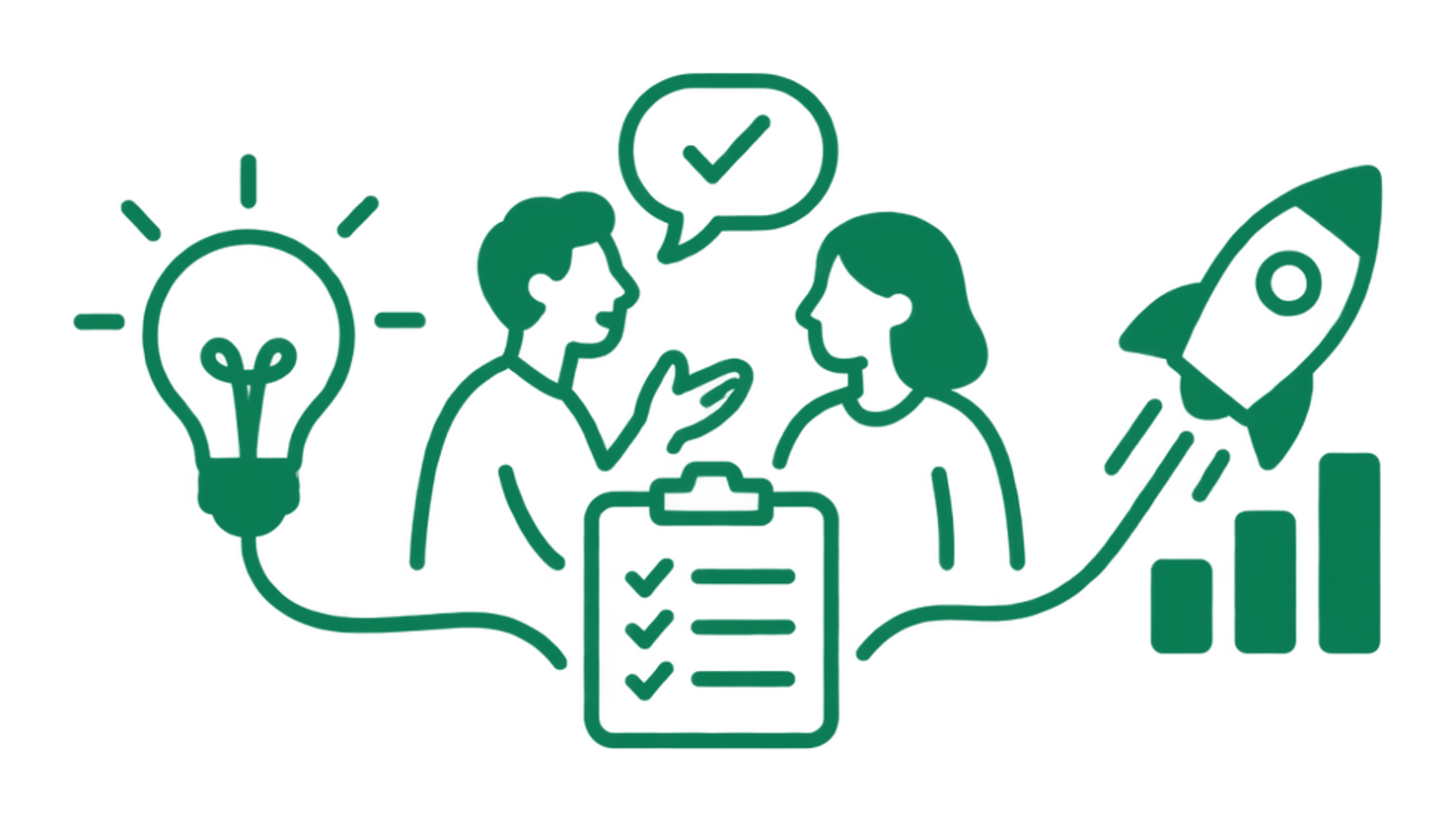
An idea is a starting point
An idea is a starting point, not evidence. To move it forward, identify a specific group of people and something they struggle to do. What gets in their way? How do they manage now? What does that workaround cost in time, money, effort, or risk? Those answers help you judge whether the problem matters enough to support a business. A clever feature can be appealing without solving anything people consider urgent.
Think of the early business plan as a collection of assumptions. You believe a customer has a problem, your solution will help, and someone will pay enough for you to deliver it sustainably. Each belief needs testing. A startup is commonly understood as a venture searching for a repeatable business model that can grow substantially. That is not the only worthwhile kind of company. A local service business can be successful without seeking rapid expansion or outside investors. The ambition should fit the opportunity and the founder’s goals.
Start learning from potential customers before committing to a large build. For an illustrative example, imagine you believe independent repair shops lose bookings because their scheduling is fragmented. Ask owners about the last time a booking went wrong, how staff handled it, and what happened afterwards. Listen for existing behaviour rather than asking whether they like your proposed app. Compliments are easy; changing a workflow is harder.
Also find out who uses the solution and who pays. Employees might welcome a scheduling tool while the owner sees no reason to buy it. You need to understand both perspectives, including what would justify switching from the current system. Next, test the assumption that could most easily undermine the idea. If you are unsure whether staff can use the booking workflow, a clickable mock-up might help. If the question is whether it saves useful time, try a limited service with bookings handled partly by hand.
A prototype is a learning tool
A prototype is a learning tool, not necessarily a smaller version of the finished product. Build only what the test requires, while being honest about what works and what is still experimental. Decide beforehand what result would justify continuing. Then observe what happens: do shops use it without repeated prompting, return to it, or agree to a paid pilot? Each tells you something different. Ease of use does not prove willingness to pay, and one payment does not prove lasting demand.
Once the solution shows promise, work on the business around it. How will customers discover you? What will it cost to win them and support them? Who pays, how often, and why would they stay? Our repair-shop service might save staff time but still be expensive to install and maintain. Revenue alone would not settle whether the model works.
Funding should support a concrete next step, such as improving delivery or testing a larger customer group. Savings and customer revenue can preserve ownership but limit spending. Loans involve repayment obligations. Grants have eligibility rules and conditions. Angel investors and venture capital usually exchange money for ownership, with expectations about growth.
Venture capital suits some businesses, not all. Raising money gives a company resources; it does not establish that customers want its product. Several mistakes can make this process misleading. Interviewing only friends can produce encouragement rather than useful evidence. Adding features can distract from a weak core offer. A rush of initial interest can fade once the novelty wears off.
Look for patterns across conversations and tests
Look for patterns across conversations and tests, then check whether people continue using and paying for the solution. If results disappoint, changing the customer group or offer may make sense. Sometimes stopping is the better decision. That is not wasted learning if it prevents a much larger commitment.
Finally, local rules, access to talent, and financing options affect what is feasible. Legal, tax, and regulatory requirements vary by location and sector, so they need appropriate local attention. An idea moves towards a business when the problem is real, customer behaviour supports the solution, and the economics can sustain delivery. Build to learn, and choose funding for the business you actually want to create.
To explore this further, you can generate two new Five Cents: Customer Interviews That Reveal Real Demand, for better discovery conversations, and Bootstrapping Versus Venture Capital, for comparing funding paths. And with that, you're up to speed in a few minutes.